

This article first appeared in The Edge Malaysia Weekly on November 10, 2025 - November 16, 2025
PENANG continues to strengthen its position as a key player in the country’s hospitality sector, driven by robust tourism activity and international investments. Global hotel chains are expanding their footprint across the state, reflecting growing confidence in its tourism infrastructure and long-term market potential.
According to Tourism Malaysia’s Paid Accommodation Survey for January–June 2025 (1H2025), the five states that recorded the highest number of hotel guests were Kuala Lumpur, Pahang, Johor, Selangor and Penang. KL topped the list with 10.95 million (up from 10.23 million in 1H2024), followed by Pahang with 5.82 million (5.74 million in 1H2024). Ranked fifth, Penang recorded 4.02 million guests, up from 3.8 million a year earlier.
Collectively, the top five states welcomed 48.7 million hotel guests, of which 17.4 million, or 36%, were international travellers.
The Penang hospitality market is expected to remain vibrant over the coming year, CBRE | WTW director Peh Seng Yee tells The Edge. “This outlook is supported by strong tourism fundamentals and proactive government initiatives under the Visit Malaysia 2026 (VM2026) campaign. Key drivers include ongoing infrastructure upgrades such as the Penang International Airport expansion, which will boost international arrivals through improved air connectivity, as well as the entry of renowned hotel brands.
“Penang continues to draw both domestic and international visitors with its Unesco-listed heritage charm, diverse culinary offerings, coastal attractions and vibrant cultural festivals.”

However, Peh notes that a surge in new supply of hotels, a gradual absorption period for incoming inventory and heightened competition are likely to present short-term challenges.
Carey Real Estate Sdn Bhd head of investment division Shawn Valerio shares a similar sentiment. “Penang is well-positioned for growth with VM2026, rising demand from both the leisure and MICE (meetings, incentives, conferences and exhibitions) segments, and improved connectivity.
“However, operators are facing rising operating costs and labour constraints. Well-branded hotels and resort assets that can capture international and MICE business will be the outperformers.”
Zerin Properties founder and group CEO Previn Singhe is likewise optimistic, citing the dual national campaigns — VM2026 and Malaysia Year of Medical Tourism — as key demand drivers.
He also highlights the Penang government’s “Not the Penang You Know” campaign, which runs until end-2026 and positions the state as a sustainable and innovative destination, targeting travellers from Southeast Asia, broader Asia, the Middle East and Europe.

Momentum is already evident in early 2025 airport data, with international passenger arrivals rising by more than 22%. Penang’s core tourism assets, such as George Town’s Unesco heritage zone, Batu Ferringhi’s resort coastline and the state’s renowned culinary culture continue to anchor leisure and repeat visitation.
“Medical tourism remains a key demand pillar. While the Klang Valley has overtaken Penang in total patient volume, Penang continues to record strong flows and retains deep patient trust, particularly among Indonesian families and regional Asian travellers,” says Previn.
In 2024, Penang recorded 412,944 foreign medical patients, generating RM888.7 million in healthcare travel revenue. As at mid-August 2025, the state had already received 213,032 foreign medical patients and RM461.4 million in revenue, reflecting sustained year-round demand, he says.
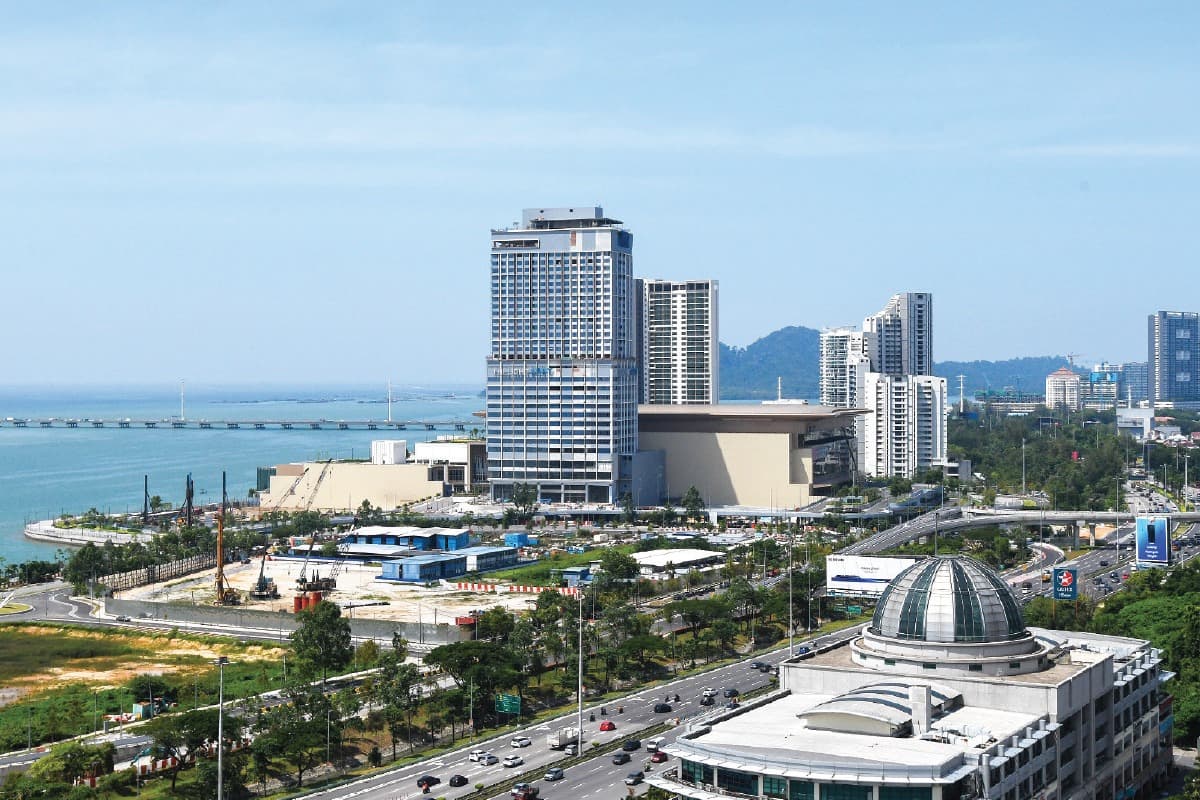
The newly opened Penang Waterfront Convention Centre adds dedicated capacity for meetings and business events, which is expected to strengthen weekday occupancy and attract higher-spending corporate and association travellers.
“International arrivals continue to diversify. Chinese arrivals surged more than 200% in 2024 to over 120,000 visitors, while Japanese arrivals grew by roughly 25% in early 2025. Growth from India is also reflected in airport passenger data.
“Indonesia remains Penang’s largest international source market. Air connectivity is expanding. TransNusa has introduced direct Jakarta-Penang services. Meanwhile, HK Express has doubled its Hong Kong-Penang flights. Additional routes from China, Japan and India continue to broaden Penang’s regional reach. Penang International Airport, now Malaysia’s second busiest, is being expanded to handle up to 12 million passengers per year,” says Previn.
Still, he cautions that several challenges must be managed.
“New hotel supply needs to be paced carefully to avoid rate and occupancy pressure during non-peak periods.
“Operating and labour costs remain elevated. The rise of short-stay and previously unlicensed accommodations has required intervention, and the new compulsory licensing framework is a necessary step. Effective enforcement will be key to ensuring fair competition and neighbourhood balance.”
Previn says the market’s fundamentals remain strong going into 2026. The state benefits from diversified demand drivers, expanding air links, a clear destination brand narrative, and enhanced MICE capacity.
“Penang enters 2026 from a position of strength. Its continued performance will depend on disciplined supply management, workforce development, service quality, continuous strategic marketing efforts and firm regulatory enforcement across all accommodation classes.”
‘4,000 new rooms to come on stream over two years’

The hotel sector in Penang recorded a notable expansion in supply during 1H2025, contributing some 1,280 rooms, says CBRE | WTW’s Peh.
Among these, he says, four were newly opened properties, with three located on Penang Island — Fifth Avenue Hotel Penang, Landison Hotel Penang and Citadines Tanjung Tokong — and one in Seberang Perai, namely Holiday Inn & Suites Penang Prai by IHG.
Two hotels also resumed operations after extensive refurbishment and rebranding: The Millen Penang (formerly The Northam All Suite Hotel) and M Social Resort Penang (formerly Copthorne Orchid Hotel Penang).
“The Millen Penang is the first five-star Autograph Collection hotel in Penang under the Marriott Bonvoy portfolio, offering 146 rooms, while M Social Resort Penang is the first of its brand in Malaysia, featuring 318 rooms equipped with in-room AI voice assistant technology.
“In 2H2025, Citadines Connect Bertam Georgetown Penang was completed in October, comprising 70 rooms,” he says.
Peh highlights that five more hotels are scheduled to open between 4Q2025 and 2026.
Carey Real Estate’s Valerio tells The Edge that Penang’s development pipeline remains strong for 2025 and 2026, with about 10 hotels currently under construction and another 11 projects approved, bringing an estimated 4,000 new rooms to the market. This includes The Westin Penang and the soon-to-reopen Equatorial Penang.
M Social Resort Penang in Tanjung Bungah, part of the Millennium Hotels and Resorts portfolio, opened earlier this year. The Equatorial Penang in Bukit Jambul, opened in 1989, has been undergoing a major refurbishment since it was closed on April 1, 2021, and is expected to reopen next year.
Other notable additions to the market include Frasers Hospitality’s Capri by Fraser, as well as JdV by Hyatt Hotel and Galaxy Minyoun Penang, which are scheduled for completion in 3Q2026 and located within IJM Land Bhd’s flagship mixed-use development The Light Waterfront’s The Light City. The 32.76-acre The Light City is developed by IJM Perennial Development Sdn Bhd — a joint venture between IJM Corp Bhd (KL:IJM) and Perennial Holdings Pte Ltd.
The anchor of The Light City is the recently opened Penang Waterfront Convention Centre, which is said to be the largest convention facility in north Peninsular Malaysia.
Another high-profile project, The Westin Hotel Penang in Gurney Drive, is expected to open next year. The property will feature 217 rooms and suites as part of the 69-storey Westin Hotel & Residences development. Launched in September, the development is reported to have achieved a 75% take-up rate, with unit ranging from 1,033 to 3,670 sq ft and selling prices starting at RM2,000 psf.
Rising competition could weigh on room rates, occupancy
All three consultants agree that Penang is not facing a shortage of rooms.

Zerin Properties’ Previn says the increase in supply has continued to move in tandem with growth in tourism, medical travel and business demand. As at mid-2025, the Penang government estimated that there were about 22,500 registered hotel rooms statewide. Between August 2023 and 2025, some 13 new hotels were added, contributing roughly 2,311 rooms to the market.
“Looking ahead, 2026 will see further openings, including the 217-room The Westin Hotel and Residences Penang in Gurney Drive, Soori Penang [a boutique restoration of 15 heritage shophouses] opening in January, the reopening of the 1926 Heritage Hotel, the 248-room Capri by Fraser Penang, the 289-room Harris Hotel Conventions Sunshine Penang [soft opening in January] and the 200-room Le Meridien Penang Airport Hotel expected in late 2026.
“The priority now is to ensure that service and quality standards are upheld in line with rating classifications, that product positioning matches demand segments across heritage, coastal leisure, medical corridors and MICE, and that future supply is paced responsibly to avoid rate pressure during softer periods,” he says.
CBRE | WTW’s Peh echoes that view, noting that with recent completions and reopenings, there is no shortage of hotels in Penang.
However, he warns that the anticipated surge in new supply, particularly in the mid-scale to upscale categories, is expected to heighten competition among operators and could exert downward pressure on room rates and occupancy performance.
Carey Real Estate’s Valerio agrees, noting that while competition is rising, demand for high-quality, branded upper-upscale and resort/MICE-capable hotels near Bayan Lepas/Queensbay and Batu Ferringhi continue to command premium rates and are easier to commercialise, particularly during VM2026 and other peak periods.
From January to September 2025, three- to five-star beach hotels on Penang Island achieved an average occupancy rate of 71%, with an average daily rate (ADR) of RM441. City hotels recorded an occupancy rate of 67%, with an ADR of RM305, according to Peh.
Penang’s hotel occupancy continues to strengthen, though it remains below full-capacity levels, reflecting a market that is recovering in a stable and sustainable manner, notes Previn.
For 1H2025, Penang recorded an average occupancy rate of 54.8%, up from 53.5% in the same period in 2024. Batu Ferringhi remained one of the strongest-performing localities, achieving 73.5% occupancy, while internationally branded and well-positioned hotels generally maintained more resilient occupancy levels across both peak and shoulder periods, he says.
KL outpaces Penang in hotel occupancy and rates
As at September this year, KL’s hotel market, supported by strong corporate, MICE and international travel segments, generally outperformed Penang in both average occupancy rates and ADR.
Peh observes that while Penang’s beach resort hotels lag behind KL’s luxury properties in occupancy and ADR, their performance aligns closely with KL’s mid-scale and upper mid-scale hotels.
Valerio notes that prime locations in KL capture a larger share of corporate, long-haul and high-yield business travel, which drives higher ADRs, whereas Penang achieves stronger rates in resort and heritage pockets. “Occupancy patterns differ. KL’s occupancy is more to corporate/MICE cycles and weekday business travel while Penang benefits more from leisure and holiday spikes (weekends, school holidays and festive periods),” he says.
For 1H2025, KL achieved an average occupancy of 63.6% compared with 54.8% in Penang.
Previn notes that well-established, strategically positioned hotels in Penang typically stabilise closer to 60% occupancy across the year, with peak periods reaching 80% to 90% occupancy. The key difference lies in average room rates, with KL at RM335.60 compared with Penang’s RM294.80.
He emphasises that this performance gap reflects the cities’ distinct roles within Malaysia’s tourism and economic ecosystem, rather than a simple measure of one market outperforming the other.
“KL’s position as the nation’s capital and primary business gateway creates a consistent, high-yield demand base. The city’s higher average room rate is sustained by its concentration of corporate travel, large-scale MICE events and diplomatic activity.
“This environment supports a hotel inventory anchored by international luxury and upscale brands such as Four Seasons, St Regis and Mandarin Oriental, alongside large-scale convention hotels. These properties are designed for efficiency, comfort and corporate-grade service, characterised by ballrooms and meeting halls, premium business centres, fine dining restaurants and integrated retail environments. This structure naturally supports stronger weekday occupancy and higher room rates,” he says.
By contrast, Penang is positioned as a curated leisure and cultural destination.
“The state appeals to travellers seeking heritage, food culture, coastal leisure and trusted medical treatment. Its accommodation ecosystem is intentionally diverse, ranging from international beach resorts in Batu Ferringhi to boutique heritage hotels and restored shophouses in George Town’s Unesco core.
“Here, the destination is the experience, and hotels complement the sense of place rather than conform to a standardised global model. Meanwhile, Seberang Perai caters to industrial, logistics and business-related travel, forming a different but equally important segment of Penang’s hospitality market,” Previn says.

Save by subscribing to us for your print and/or digital copy.
P/S: The Edge is also available on Apple's App Store and Android's Google Play.