

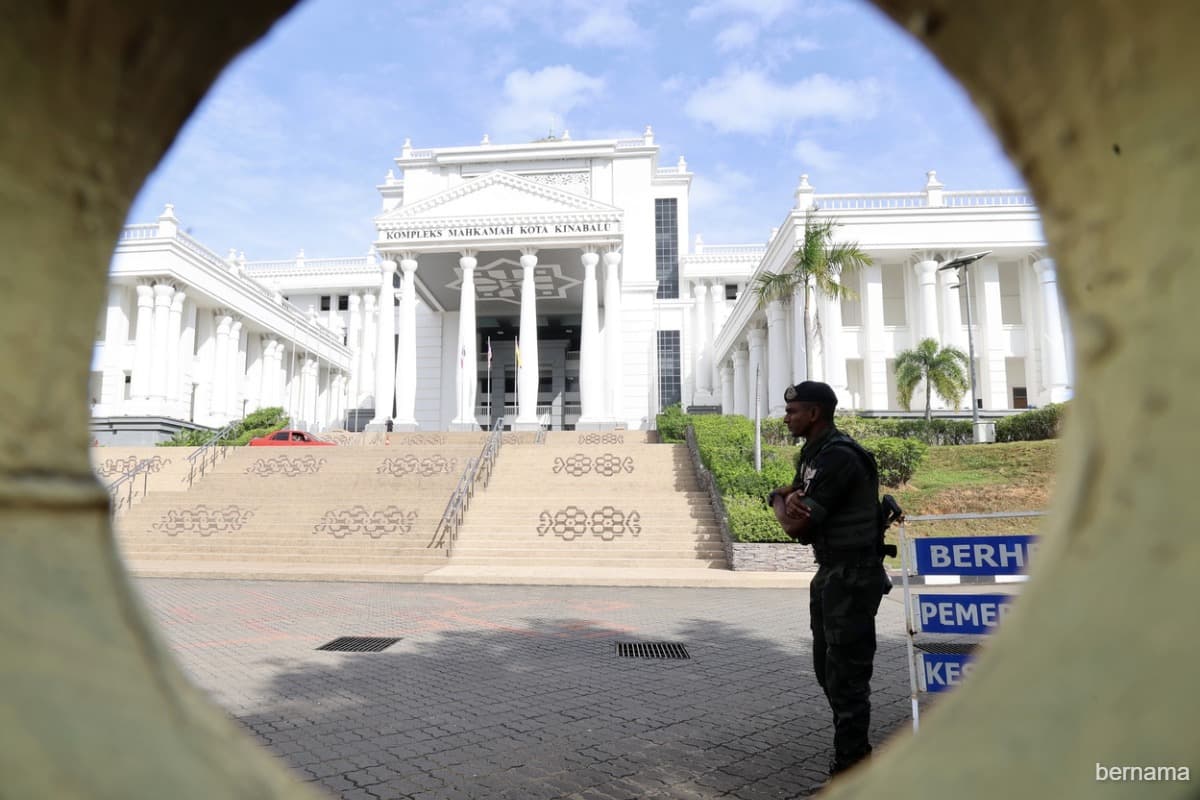
KUALA LUMPUR (Nov 10): A Kota Kinabalu High Court judge dismissed the federal government’s claim that there had been an ongoing review of Sabah’s revenue share from 1974 to 2021, on the basis that it offered no proof of this — only an affidavit claim.
Judge Datuk Celestina Stuel Galid allowed the Sabah Law Society’s (SLS) judicial review on Oct 17, ordering Putrajaya and Sabah to carry out the long-overdue review of Sabah’s 40% revenue grant. She noted in her 109-page written judgement, sighted by The Edge, that the SLS correctly pointed out that the federal government had provided no evidence to support its claim.
“Not a single document was exhibited, only the following averment by the Federal Government (to the claim of on-going review), that starting from 1974 to 2021, the review process was on-going between the Federal and Sabah Government, concerning the amount to be granted by way of a substituted grant under Article 112D(1) of the Federal Constitution taking into consideration of Article 112D(2).
“One would think that after the lapse of some 48 years, some semblance of evidence would be forthcoming of such on-going review — the people of Sabah (whose interests have been and are directly affected) has legitimate expectation to deserve to know what exactly their government and state have done in those 48 years to realise the continuity of the conditions and safeguards that their forefathers had insisted on when they agreed to become part of Malaysia.”
Galid said it was troubling that the federal government relied only on an affidavit to claim a 48-year ongoing review. Even citing rahsia (confidentiality) didn’t prevent Sabah from providing similar documents, yet none were shown.
“Despite the various correspondences and meetings between the federal and Sabah government, there was no agreement and/or subsequent review to the first review (1969) order that resulted in a substitution of the first review order….,” the Sabah government was cited as stating in the written judgement.
Article 112D of the Federal Constitution requires periodic reviews of Sabah and Sarawak’s special revenue grants.
The SLS filed a judicial review in 2022 to challenge the federal government’s RM125.6 million annual grant for Sabah, arguing it breached the Malaysia Agreement 1963 (MA63), which guarantees the state 40% of its revenue.
The SLS said the federal government had failed to review or pay Sabah’s 40% entitlement from 1974 to 2021 — a period it called the “lost years.”
Poverty, poor development not what Sabah agreed to when joining Malaysia
The judge noted that decades after joining Malaysia, Sabah still struggles with poverty and poor development.
The SLS highlighted that in 2022, eight districts — Kota Marudu, Kudat, Pitas, Beluran, Telupid, Nabawan, Tongod and Kota Belud — were among Malaysia’s 10 poorest, lacking basic infrastructure such as water, electricity, roads, healthcare and schools.
Data from the Statistics Department showed Sabah had Malaysia’s highest poverty rate, rising from 19.5% in 2019 to 25.3% in 2020, and has topped the poverty list since 1997 due to weak infrastructure, difficult terrain and foreign population issues.
“This high poverty rate is due to several factors including a lack of infrastructure, the presence of foreigners and the difficulty of accessing the geographical interior,” Galid said in her judgement.
She said the senior federal counsel (SFC) did not refute the SLS’ claims about Sabah’s poor development and only argued that constitutional breaches couldn’t be proven using reports on lacking infrastructure and basic amenities.
“With the greatest of respect, the learned SFC’s rather dismissive stance on this issue was, in my considered view, emblematic of the problem herein — the failure to appreciate that that was not what the people of North Borneo had bargained for when they agreed to the formation of the Federation of Malaysia.
“It’s the legitimate expectation of the state of Sabah and her people under the MA63, the Malaysia Act and the constitutional foundation documents as well as the Federal Constitution. Unfortunately, as shown in this judgment, this has been disregarded and trampled upon,” the judge said.
The judge said Sabah’s attorney general confirmed that the federal government had failed to carry out the review, calling the 48-year omission of special grant payments “irrational and unreasonable.”
“To put it another way, the sum of RM26.7 million under the first review order would have gone a long way towards the development of Sabah in 1974 but the same could not be said in the year 2020. However, that was what Sabah received then,” Galid noted.
The judge said the court’s order was necessary to ensure the federal and Sabah governments review the special grant for the “lost years” between 1974 and 2021.
“There was no review that took place in 1974 and no review has ever taken place in respect of the period of the 48 lost years from 1974-2021, the 40% entitlement remains due and payable by the Federation to the state of Sabah for each of those lost years.
“In breach of natural justice and legitimate expectation of the state of Sabah and her people, the Second Review Order made on April 17, 2022 and with effect from Jan 1, 2022 failed to provide for the making of annual grants for the period of the lost years (1974 to 2021). The Federation’s duty to make the 40% entitlement remains and remains to be fulfilled ….,” she added.
Galid ordered for the review for the period from 1974 to 2021 to be made within 90 days, and for an agreement to be reached within 180 days from the date of the court order.
The Attorney General’s Chambers (AGC) is reviewing Galid’s judgment before deciding its next steps. The federal government has 30 days from Oct 17 to appeal.
Entrepreneur Development and Cooperatives Minister Datuk Ewon Benedick announced on Facebook earlier on Monday that he has submitted his resignation letter and will start clearing his leave. He had earlier said he would resign if the federal government appealed the Kota Kinabalu High Court ruling. Ewon is a member of Parliament for Penampang, Sabah, president of United Progressive Kinabalu Organisation (Upko) and Sabah Pakatan Harapan chairman.
Prime Minister Datuk Seri Anwar Ibrahim, speaking at an event Monday, called the resignation premature, saying a special Cabinet meeting on Nov 11 will decide on the appeal after considering advice from the AGC and consulting all ministers.