

This article first appeared in The Edge Malaysia Weekly on November 3, 2025 - November 9, 2025
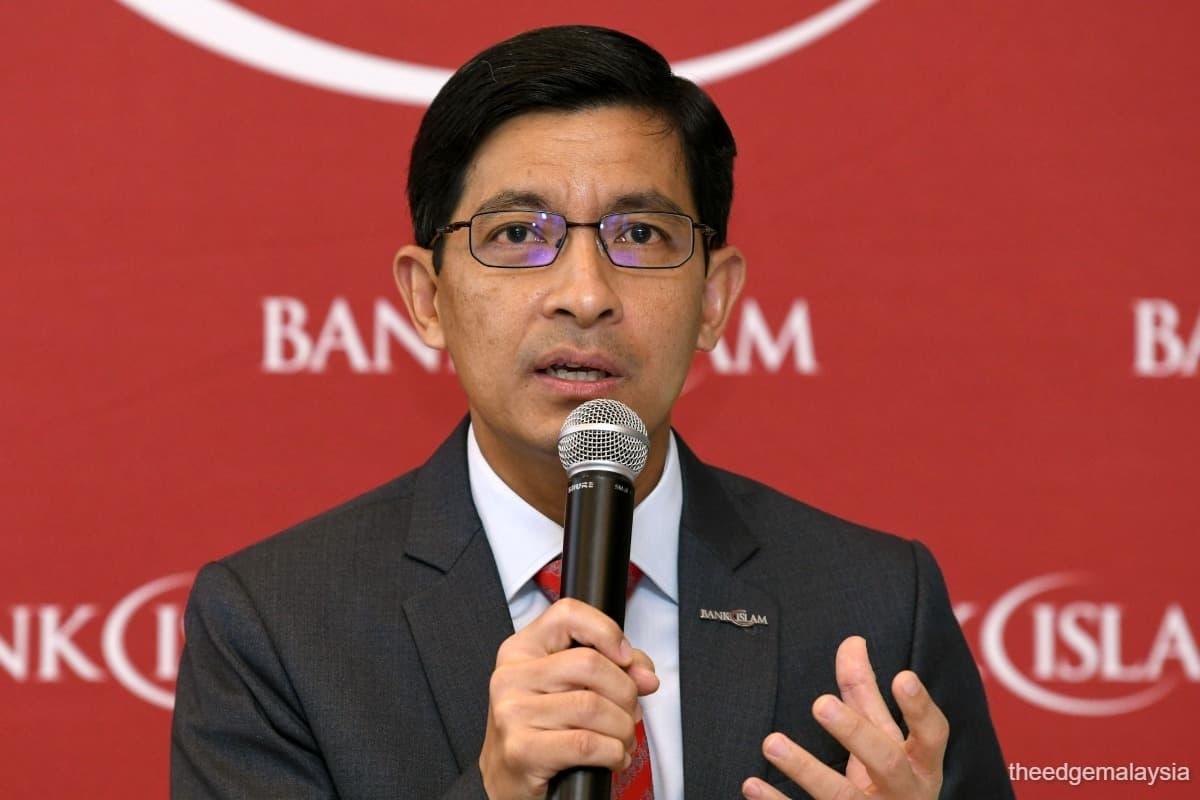
BANK Islam Malaysia Bhd (KL:BIMB), the country’s largest standalone Islamic bank, recently took many by surprise when it announced that its group CEO Datuk Mohd Muazzam Mohamed had tendered his resignation after seven years at the helm.
Analysts The Edge spoke to say they did not see this coming, particularly as it follows closely on the heels of another key departure — that of group chief financial officer Azizan Abd Aziz, who left on July 31 to assume the CFO role at Bursa Malaysia Bhd (KL:BURSA). Bank Islam appointed Siti Nur Huda Sufian, its group chief financial controller, as Azizan’s successor effective Aug 1.
Mohd Muazzam’s resignation, announced on Oct 24, has naturally sparked questions, including whether he may be leaving for another role. His resignation takes effect on Jan 7 next year, though his last working day is Dec 12.
“Is there reason to be concerned? I don’t believe so, because at the end of the day, banks are highly institutionalised, so it will be business as usual. It’s just that I’m surprised,” says one analyst.
Mohd Muazzam, when contacted by The Edge, says he felt it was the right time to hand over the reins, considering also that the bank’s current five-year strategy culminates at year end.
“After more than 10 years with Bank Islam, including seven as the CEO, I consider now is the right time for me to step aside for another person to lead the [bank]. This coincides with the conclusion of our existing five-year strategy.
“As Bank Islam embarks on a new strategy commencing 2026, and to ensure its effective execution, [the bank] must be led by a CEO who can take charge of the next few years at the beginning of the journey,” Mohd Muazzam says. “As to what I will do next, I have not given it much thought yet. I do look forward to a short career break after working flat out for almost 30 years.”
Bank Islam has already commenced a formal search process for a suitable successor. In the meantime, its group chief business officer (retail banking), Mizan Masram, will be the group officer-in-charge beginning Dec 13.
Under the five-year strategy, known as LEAP25, the bank had set out ambitious targets to be achieved by the end of the financial year ending Dec 31, 2025 (FY2025), a few of which had to be revised lower along the way to take into account heightened macroeconomic certainties and other challenges — something some other lenders too have had to do.
Based on its latest performance as at 1HFY2025, Bank Islam is likely to meet some of those targets but may also miss a few key ones, analysts note.
For instance, it’s on course to have its total asset size exceed RM100 billion by end-FY2025 (from RM74.6 billion at end-FY2020) as this already stood at RM99.5 billion as at 1HFY2025. And, its aspirational target for sustainable financing to increase to RM28 billion by year end has already been achieved, with the amount at RM28.8 billion in 1HFY2025.
However, a return on equity (ROE) target of 10% — based on profit after zakat and tax (PAZT) — is unlikely to be met, with the bank recently providing a revised guidance of 7%. ROE stood at 7.1% in 1HFY2025. In comparison, the industry’s stood at 10.8%.
Bank Islam is also some way off from its cost-to-income ratio (CIR) target of at most 57%, with the ratio standing at 64.5% in 1HFY2025. The bank recently guided for CIR of 63% to 64% for the full year.
Bank Islam’s biggest shareholder is Lembaga Tabung Haji with a 48.87% stake, followed by the Employees Provident Fund with 16.86% (as at Oct 8) and Amanah Saham Nasional Bhd with 7.97%.
To a question on why the bank is not performing better than in its heyday, a banking analyst puts it down to two elements — lower margins and higher expenses.
“It’s an unfortunate circumstance in the sense that Bank Islam’s margins have compressed a lot more than those of its peers. Although the bank has a relatively high current account and savings account (CASA) ratio, the fact is that it has had to pivot away from personal financing (PF) since Bank Negara Malaysia came out with its responsible financing guidelines [in 2012, which tightened the rules of personal financing].
“So, it tried to move more into mortgages and other areas, but for mortgages, the margins are so thin. Hence, this has brought down its overall margins quite substantially. It is also not big in terms of SME financing, and on the corporate front, it tends to do more of syndicated financing, the margins of which are pretty thin as well.
“Second, if you take a look at expense growth, it’s been pretty rapid, but I understand where the bank is coming from, in that it has to invest in people and information technology because it hadn’t really done that before. So I think it’s these two elements (margins and expenses) [affecting performance], coupled with the fact that its credit cost is still high,” says the analyst. Mohd Muazzam led the bank through a period of significant digital transformation and growth.
PF accounted for 30.3% of its financing book of RM72.48 billion in 1HFY2025, while house financing made up nearly 40%. Its net income margin had declined to 1.95% as at end-June compared with 2.2% a year ago.
In 1HFY2025, Bank Islam posted a PAZT of RM253 million, down 5.9% year on year despite a 67.4% y-o-y surge in non-fund-based income, mainly because of a 10.6% increase in overheads and a 57.7% rise in financing loss provisions.
Its PAZT has grown from RM491.67 million in FY2022 to RM553.05 million in FY2023, and to RM571.08 million in FY2024. Analysts, however, expect earnings to fall this year, before rebounding in FY2026.
“We expect 3QFY2025 net financing margin (NFM) to ease in the upcoming quarter due to the impact of the July overnight policy rate cut [of 25 basis points]. However, management has scope to cushion the contraction through optimising its relatively low financing-to-deposit ratio by accelerating its financing growth (FY2025 target: +7 8%). However, this could entail higher capital consumption and the bank may need to reinstate its dividend reinvestment plan. That said, gradual fixed deposits repricing will still help to restore NFM within six to nine months,” Hong Leong Investment Bank Research (HLIB) says in an Aug 26 report.
“Separately, net credit cost is seen to remain stable quarter on quarter at current levels, given steady asset quality (FY2025 target: less than 30bps),” it adds.
It noted that Bank Islam had already pre-emptively built up management overlays in 1QFY2025, thus reducing the likelihood of large provisions in the near term. Its gross impaired financing ratio rose to 1.05% at end-June from 0.92% a year ago, but was better than the industry’s 1.42%.
Bloomberg data shows that of eight analysts who track the stock, seven — including HLIB — have a “hold” call and the other, a “buy”. The 12-month average target price was RM2.40. As at the Oct 31 closing price of RM2.20, its share price had shed 10.9% year to date, giving the bank a market value of nearly RM5 billion.
Save by subscribing to us for your print and/or digital copy.
P/S: The Edge is also available on Apple's App Store and Android's Google Play.