

This article first appeared in Forum, The Edge Malaysia Weekly on November 3, 2025 - November 9, 2025
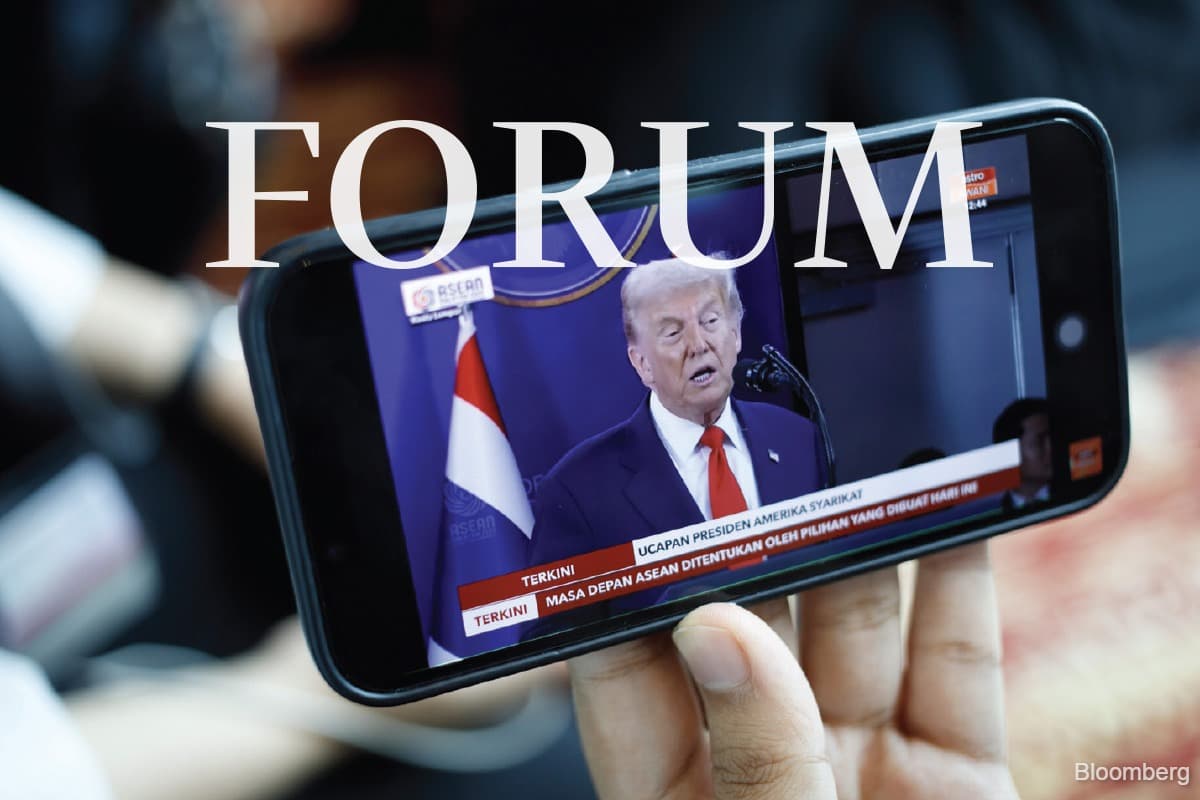
US President Donald Trump’s brief appearance at the Asean Summit dominated the headlines. Despite being prime minister of the rising power in the region, China’s Li Qiang did not command quite the same attention. This attests to the continued importance of the US to the region. Even with the trade war that Trump launched against the rest of the world and in the face of his administration’s controversial foreign policy actions, the assembled Asean heads of government chose to humour him. One even proposed nominating him for the Nobel Peace Prize.
The US will indeed be highly consequential over the coming year as the fallout from Trump’s many policy moves washes over the region. But the outcome may not be positive. As the US is likely to pose considerable downside risks for the region’s economies, financial markets and geopolitical positioning, the region needs to come up with strategies on how to cope with the challenges that will grow.
A weaker and more protectionist US economy will mean less export demand for the region
Our main concern is the health of the US economy. Nine months into the Trump administration, the US economy appears to be holding steady. The Federal Reserve Bank of Atlanta’s “nowcast” estimate is that the economy grew 3.9% in the third quarter and other agencies’ estimates are not far below that. The stock market is booming, with excitement over artificial intelligence unleashing a tidal wave of capital spending that is boosting earnings expectations of key companies.
Many analysts justify the upbeat mood by pointing to the tax refunds that will be paid out to households early next year, which should spur consumer spending. In addition, capital spending is seen continuing to grow because revised depreciation rules for purchases of capital equipment will encourage further expansion in investment. The deregulation that the new administration is pushing in many areas should also help capital spending. And the good news doesn’t end there. The consensus view is that oil prices are set to fall even more than they have already fallen this year, which would give yet another fillip to global demand.
Still, it will be a stretch to predict that such benign conditions will last. The broadly held view is that any US slowdown in 2026 will be moderate, with the economy growing roughly close to its long-term trend rate of just above 2%. Questioned about the risks, these analysts comfort themselves by insisting that the US Federal Reserve will be quick to cut the policy rate to give the economy downside protection.
Nevertheless, it all seems too good to be true for us. The areas of strength in the US economy are not to be gainsaid but is it really possible that there is little cost to the huge dislocations in trade, immigration, government services, foreign policy and institutional quality that the new administration has brought in? We are firmly in the pessimists’ camp.
First, we believe that several of the forces supporting the US economy will not last while the lagged effects of Trump’s economic and other actions will hurt economic activity as we move further into 2026.
• The economy is still enjoying the lingering effects of the previous administration’s infrastructure and industrial policies. However, as the current administration is already reducing or eliminating those policies, the uplift will give way to a decline.
• The capital spending boom has been extraordinary. One estimate is that investment accounted for a stunning 92% of economic expansion in the first half of this year. Investment in information processing equipment and software grew 14.5% year on year in the second quarter, a sizzling pace not seen since the height of the dotcom bubble in late 2000. To continue contributing strongly to economic growth, this investment category needs to sustain extraordinary rates of growth — which is possible but not likely.
• If we exclude investment in information processing equipment and software, the economy barely grew, registering just 0.1% annualised growth in the same period. That’s because there is substantial uncertainty in the business sector, a result of the policy shocks that the new administration has unleashed on the economy. This uncertainty is likely to persist and may even worsen as we explain below.
Second, the full damage from tariffs and other policy changes has yet to be felt because it is only recently that they have gone fully into effect. Even with the likely trade deal with China, the average tariff rate in the US will rise from just below 3% to somewhere in the region of 15% to 18%. That is a sizeable shock to the system, with its effects percolating into the broad economy over the coming months:
• For now, many companies are absorbing the tariff cost and not passing it to consumers. But the surveys suggest that this will not last, and that firms will be passing most of the higher cost to their buyers in time. As prices rise, consumers will become more wary and consumer spending will slow. The early signs show trade-sensitive consumer goods prices accelerating.
• Such a large uplift in tariffs will cause dislocation in supply chains, with many small firms likely to downsize as they will struggle to cope with the added burden and costs of compliance.
• The combination of rising prices and a slowing economy will place the Fed in a dilemma — cut rates to support the economy and inflation could spike further but if rates are not cut, then the economy could go into a tailspin. If the Fed still cuts, then bond yields could well remain higher than desired, reflecting the higher inflation risk.
• Remember also that the economy is suffering a huge and unprecedented labour supply shock as the new administration’s harsh crackdown on illegal immigration causes the net inflow of migrants to turn negative for the first time in almost 100 years. Sectors that rely on migrant workers — construction, agriculture, restaurants, home health and personal care aides and accommodation services — are certain to suffer.
• The US fiscal position is also on a tricky trajectory. The International Monetary Fund projects the US budget deficit to exceed 7% of GDP every year until 2030, higher than most Organisation for Economic Co-operation and Development nations. Tellingly, the IMF sees the US performing worse than Italy. Unlike the US case, it expects Italy’s net debt burden to fall from 2028 onwards. If the American political class is not prepared to address this ticking time bomb — and there is no sign of such political will — then there will be a financial shock at some point in time.
Third, even without a fiscally induced shock, there are emerging signs of possible stress in financial markets. A correction of some kind — not necessarily a crash like in 2008 or 2001 — is a reasonable expectation. This is especially the case as the signs of financial indiscipline typical of the late stage of a financial cycle have started to appear:
• The bankruptcies in quick succession of companies involved in the automobile supply chain — Tricolor, First Brands and PrimaLend — have raised questions about how rigorous banks were in extending credit.
• Private credit funds have been reported to be lending to their own subsidiaries or affiliated private equity firms.
• Over the past year, US banks have loaned US$600 billion or so to non-bank financial institutions, which have gone on to provide multifold leverage to their clients. This kind of leverage on leverage behaviour is often seen before a financial accident.
• Investor margin debt is now much higher than revolving credit card debt.
• The Bank for International Settlements has warned that credit ratings on private loans held by US insurers may have been systematically inflated.
We could go on but the picture is clear: as financial indiscipline worsens, it is a matter of time before there is a sharp correction. Note that, as the proportion of Americans playing the stock market is now much higher than 20 years ago, the damage from a sharp correction in equities will be significantly higher than before. Such financial shocks would be transmitted swiftly to Asean equity and currency markets as well.
One-sided trade deals for Asean could lead to trouble later
Another channel through which the US will impact our region is the trade shocks which will not go away just because a few trade deals were signed recently at the Asean Summit which Trump attended.
The agreements are greatly one-sided. Asean countries agreed to onerous conditions that the US placed on them. When it comes to the crunch, countries will struggle to fulfil them. For instance, some clauses in the deals could be interpreted as requiring regional countries to help the US contain China. An article in the Malaysian deal obliges it to adopt measures with “equivalent restrictive effect” as the US measures directed at a third country. Malaysia has to consult with the US before entering into a new digital trade agreement with another country. The Asean countries had little choice but to accede to US demands given their reliance on the American market. But if the US leverages these agreements to press the regional countries to adopt restrictions on China, then there will be pushback from the region and the trade deals could unravel.
Conclusion: Region must step up de-risking from the US
The US economy poses downside risks to Southeast Asia over the medium to long term. The chances of economic, trade and financial shocks are high. The region must therefore create strategies to reduce its reliance on the US and to build resilience against these shocks.
First, since a unified approach to the US on trade matters is not politically feasible, Asean nations should at least agree on a few common positions on future concessions when they negotiate bilaterally with the US. Otherwise there is going to be a race to the bottom on such concessions and everyone will be the loser.
Second, Asean can benefit from its position at the centre of the Regional Comprehensive Economic Partnership (RCEP), which brings together the Asean members with China, Japan, South Korea, Australia and New Zealand. Hong Kong, Sri Lanka, Chile and Bangladesh are applying to join the RCEP. Asean should work to get even more countries to join, and make RCEP the world’s largest trading bloc. Expanding RCEP will help maintain some momentum in trade opening despite the ill-effects of American protectionism and improve access to other markets besides the US. It will also give Asean better bargaining clout in trade negotiations.
Third, Asean needs to go further than it has on strengthening regional integration. At the recent summit, the member states upgraded their Asean Trade in Goods Agreement (ATIGA), so as to ease the non-tariff barriers (such as customs procedures) which have impeded intra-regional trade. They now need to resolve the differences that are holding back the Asean Digital Economy Framework Agreement and the Asean Power Grid proposal as well.
Fourth, Asean should quickly implement practical proposals made by the Asean Business Advisory Council (Asean-BAC). One idea is the Asean Business Entity concept, which would create a new category of companies that would more seamlessly operate throughout the region. The result would be to spur intra-Asean trade and investment.
The next few years will be troubled ones but the region can proactively take the necessary steps to protect itself from the downsides.
Manu Bhaskaran is CEO of Centennial Asia Advisors
Save by subscribing to us for your print and/or digital copy.
P/S: The Edge is also available on Apple's App Store and Android's Google Play.