

This article first appeared in The Edge Malaysia Weekly on October 27, 2025 - November 2, 2025
WHEN the government made the bold decision to position Port Klang as the country’s premier maritime gateway in the 1990s, it raised a lot of eyebrows. After all, competing with regional rivals like Singapore and Hong Kong was no small task, and both were already way ahead in terms of policy implementation and supply chain development. Many wondered if Port Klang was up to the task.
Fast forward to today and it has completely silenced the early sceptics. Not only has it broken into the ranks of the world’s top 10 busiest container ports for the first time, it has also proven that the government’s move was spot on.
In Lloyd’s List’s 2025 rankings, Port Klang — comprising Westports and Northport — climbed to 10th place, edging out long-time heavyweight Hong Kong, which slipped to 12th. The port in Selangor handled a record container volume of 14.64 million 20-foot equivalent units (TEUs) in 2024, a 4.1% increase from 14.06 million TEUs in the previous year. Westports accounted for a dominant 75% share, moving 10.98 million TEUs through its terminal.
The climb to 10th has not been easy, with many new ports coming up in China at the expense of Hong Kong, which has experienced a persistent decline in container throughput in recent years. For much of the past decade, Port Klang had been placed in the top 20 — from 12th in 2019 to 11th in 2023. Still, it was determined to break into the top 10.
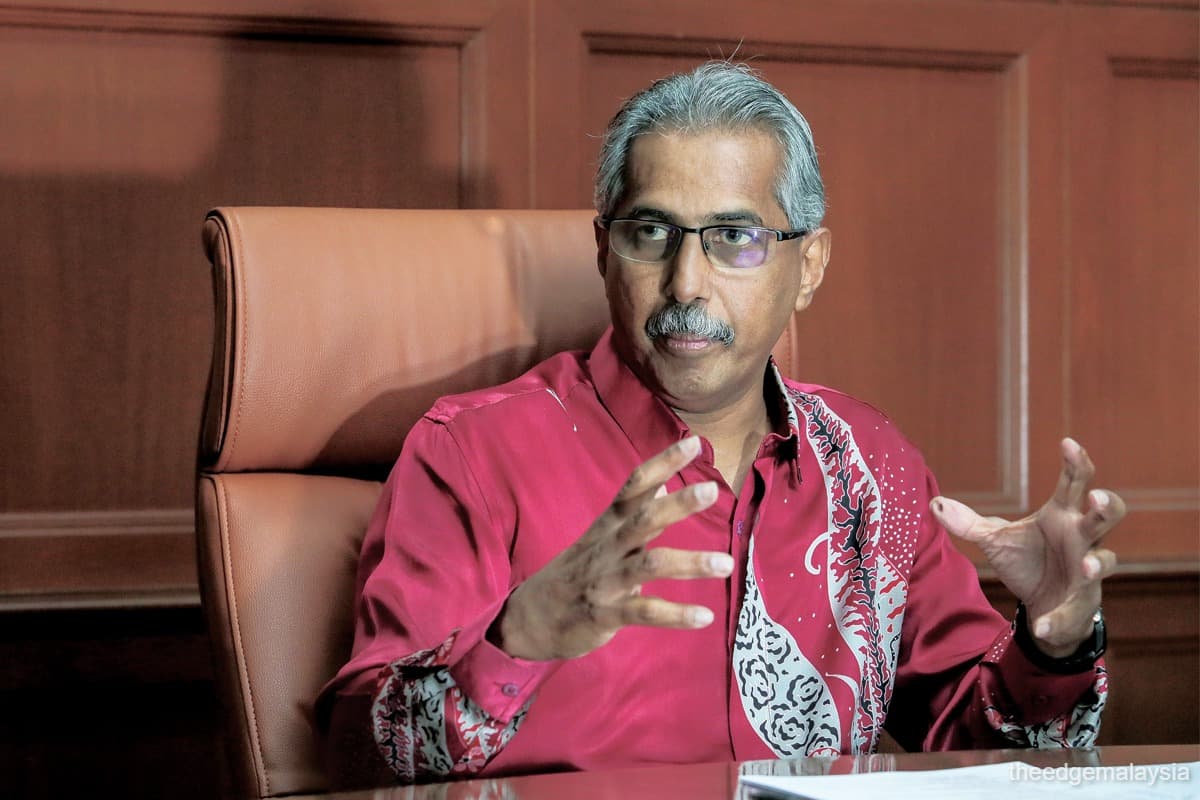
“It’s been a long, challenging journey,” says Captain Subramaniam Karuppiah, general manager of Port Klang Authority (PKA), in an interview with The Edge. “We’ve been steadily building towards this for years, but it’s still a pleasant surprise to finally see Port Klang in the global top 10.”
Subramaniam, 63, joined PKA in 1994, and has led the authority since 2016. “I think it showed what we’re capable of when we are all on the same page and we’re all firing.”

He credits Port Klang’s rise to the national policies introduced in the 1990s, particularly the national load centre policy, which aimed to centralise all Malaysian exports and imports through Port Klang and minimise “leakages” to Singapore. The Ministry of Transport (MoT) officially ended the policy in March last year, after 32 years, as it shifted its focus towards developing other ports in the country. Subramaniam says the removal of the policy is not expected to impact Port Klang, as it has fulfilled its intended purpose.
“Port Klang was always a major port. But we only began operating as a modern, container-focused port in the 1990s. At first, we were driven by domestic trade needs — imports and exports. But the real growth engine was transshipment, and we weren’t tapping into that yet,” he recalls.
That changed with the introduction of the national load centre policy, which repositioned Port Klang, not just as a national trade hub but also as a regional transshipment gateway.
“When the government came out with clear policies in the 1990s, we started focusing seriously on transshipment,” he adds. “Equally important was the steady growth of indigenous cargo, which gave us a strong foundation.”
The government saw Port Klang’s strategic location in the middle of the Strait of Malacca as a positive factor and used it to strengthen the port’s position, setting it on the right track.
Careful attention was also given to port planning, including the provision of capacity and additional infrastructure. A proper policy for port infrastructure planning was implemented, with much of the groundwork laid in the 1990s. These early efforts enabled the creation of the capacity needed to support future growth.
“The national load centre policy definitely played a role. At the time, Malaysia didn’t have many major ports. The government then made a decision: Why not use Port Klang as a major port and designate it as the national load centre? It was actually a way for us to focus trade in one port because shipping lines don’t like to call at too many ports within a country. If the volume is insufficient, the ships will not call,” Subramaniam points out.
“It wasn’t about cutting off the other ports in the country. The thinking was more about how to attract the main shipping lines to one particular port.”
The privatisation of the ports in the 1990s also helped turn Port Klang into a major international port. The privatisation of Port Klang into two port terminals, Northport and Westports, led to intense competition between them. That pushed both to aggressively market themselves and invest heavily in facilities.
Decision-making processes also became more efficient, allowing Port Klang to respond quickly — an essential factor, as shipping lines increasingly demand swift decisions.
Westports Holdings Bhd (KL:WPRTS) is listed on Bursa Malaysia. Its largest shareholder is the estate of the late Westports founder and executive chairman, Tan Sri Gnanalingam Gunanath Lingam, which holds a 42.42% indirect stake through Pembinaan Redzai Sdn Bhd and Semakin Ajaib Sdn Bhd. The second-largest shareholder is South Port Investment Holdings Ltd, a subsidiary of Hong Kong billionaire Li Ka-shing’s C K Hutchison Holdings Ltd, which held a 23.55% stake as at Feb 28, 2025. Northport (Malaysia) Bhd, on the other hand, is a wholly-owned subsidiary of utilities and infrastructure group MMC Corp Bhd.
Subramaniam points out that the port’s achievement is the result of a collective effort, with strong collaboration among all stakeholders, ranging from port operators to shipping lines, exporters, importers and various government agencies. The government’s role was particularly important in ensuring that cargo clearances were processed efficiently and without delays.
“This is something we have been working on for a long time. It didn’t happen overnight, so it took time for us to reach the top 10,” he says.
Still, there is a long way to go to close the gap at the top of Lloyd’s List Top 100 Ports. The top two players remain firmly entrenched. At 51.5 million TEUs, Shanghai held on to pole position in 2024, followed by Singapore with 41.1 million TEUs.
Subramaniam’s immediate focus is on ensuring that Port Klang stays among the top 10, though he admits it won’t be easy.

Port Klang is taking a leaf from Hong Kong’s book. Once the busiest container port in the world, Hong Kong has fallen in the global rankings in recent years due to increased competition from ports in mainland China.
“We’re a little different here in Malaysia. In Port Klang, we have a strong domestic market.
“Today, if you look at our market share, transshipment cargo accounts for 53% of total throughput, while the remaining 47% is indigenous cargo. In comparison, back in the late 1990s and early 2000s, it was 70% transshipment and only 30% indigenous cargo. This clearly shows that our local exports and imports are performing well, which reflects a robust domestic economy.”
While Subramaniam acknowledges that there were leakages of local cargo to Singapore Port in the past, he says the domestic market simply wasn’t very vibrant at the time.
“We weren’t really a major manufacturing centre, and we hadn’t yet embraced industrialisation. But over the last 20 years, we’ve seen a significant influx of foreign investment, with many industries being established here in Malaysia. As a result, our export markets have grown, and our import markets, especially for raw materials, have expanded as well.
“To a certain extent, we have also been able to offer better services to our customers, so they don’t turn to other ports. They can focus on Port Klang, which also brings cost savings for them. All these factors have contributed to Port Klang’s growth.”

PKA is making sure that Port Klang is not resting on its laurels.
“Going forward, we have to work harder. And this is where we need to become more efficient. We have to ensure that trade moves faster and business facilitation becomes more streamlined. We must adopt modern technology and embrace digitalisation. That’s why the port is investing heavily in digitalisation as well,” says Subramaniam.
“The positive point is that Malaysia is still a growing economy. Bank Negara Malaysia is predicting that the local economy will grow between 4% and 4.8% in 2025. This reflects not just positive growth for the nation, but also for the port’s volume. However, we also have to be cautious. There are many external factors that affect both the port industry and the nation’s economy,” he adds.
After the Covid-19 pandemic and the resultant logistics bottlenecks, global supply chains were tested once again by Russia’s invasion of Ukraine. That was followed by the war in Gaza. In addition, the Red Sea crisis has become a critical point in the Middle East conflict, disrupting trade and maritime transport.
The ongoing US-China trade war has evolved into broader trade tensions involving the US’ other trade partners. The US decision to impose tariffs not only on selected products but across the board poses a significant challenge for Malaysia, given its status as a trading nation that relies heavily on exports.
“Our top exports are electrical and electronics (E&E) and semiconductors. We also deal extensively with solar panels and machinery. Almost all items heading to the US are now facing tariffs.
“The worst part is the uncertainty around the tariff rates. It started off at 24%, then there was a threat it might go higher. Eventually, it settled at 19%. But we haven’t heard the end of it — new tariffs are being imposed on E&E products, though the specifics have yet to be determined by the US,” says Subramaniam.
“All this is creating significant uncertainty for our markets and manufacturers here in Malaysia. Our exporters are facing difficulties — will their products remain competitive? These are the challenges we’re confronting.”
Temporary front-loading ahead of higher US tariffs supported manufacturing activity in the first half of 2025. However, by August, as the impact of the US’ reciprocal tariffs took effect, exports contracted by 6.2% month on month, before rebounding to 5.6% m-o-m in September.
Despite these headwinds, Malaysia’s exports grew 4.8% year on year to RM1.17 trillion in the first nine months of 2025, while imports rose 4% y-o-y to RM1.06 trillion, resulting in a trade surplus of RM105.65 billion — a 13.6% increase y-o-y. Although export momentum moderated from April, economists believe the stronger performance in September may help offset some risks posed by ongoing global trade policy uncertainties.
“We were initially expecting Port Klang to achieve around 4% container volume growth in 2025. However, as of September, growth has only reached 2.8%. We’re hopeful that performance will pick up towards year end, typically driven by inventory clearances ahead of the festive season and forward planning for the new year. There is usually a volume boost in November and December,” says Subramaniam.
“We now expect about 3% growth in container volume for the year, which, given the circumstances, is still fairly good.”

Supply chain disruptions have eased
Port congestion still occurs occasionally, but it is nowhere near as severe as it was three to four months ago, according to Subramaniam.
The disruption began when the Red Sea crisis forced ships to bypass the Suez Canal and take the longer route around the Cape of Good Hope, Africa, wreaking havoc on sailing schedules. Shipping lines struggled to meet deadlines, leading to widespread delays.
“There were blank sailings as carriers consolidated cargo onto fewer vessels due to late returns. They also aimed to maximise ship capacity, though that wasn’t the main issue. The real challenge was the extended transit times. A round trip from Europe to Port Klang that once took 75 to 80 days stretched beyond 100 days. Losing 20 to 25 days per voyage forced some carriers to cancel subsequent sailings to catch up on schedules,” he explains.
While conditions have improved, uncertainty lingers. Despite the recent ceasefire between Israel and Hamas, many carriers remain hesitant to resume Suez Canal transits. Instead, they continue rerouting via the Cape, prolonging voyages beyond 100 days.
“This ‘new normal’ reflects ongoing security concerns. Attacks were reported as recently as last month,” Subramaniam observes.
‘No single port can handle everything’
According to Lloyd’s List, Port Klang ranked third in Asia (excluding China) in 2024, trailing only Singapore and Busan, South Korea. Meanwhile, Port of Tanjung Pelepas (PTP) was in fourth place, handling 12.25 million TEUs in 2024, a 16.9% increase from 10.48 million TEUs the previous year.
PTP is 70% owned by MMC Corp, while Netherlands-based terminal operator APM Terminals, a subsidiary of Maersk Group, holds the remaining 30%.
When asked how Port Klang plans to close the gap with Singapore and Busan, Subramaniam offers a broader perspective. “I wouldn’t say that Singapore and Busan are our major challenges, especially Busan. It’s located in a different region altogether — in North Asia — with a cargo mix similar to ours, heavily focused on transshipment. Busan’s split is about 55% transshipment and 45% local cargo. They serve a different customer base, mainly cargo from northern China and Japan.
“Closer to home, Singapore has seen steady growth, and we aim to catch up. In the early 2000s, Port Klang handled around three million TEUs compared with Singapore’s 17 million to 18 million — roughly six times more. Today, that gap has narrowed considerably; Singapore’s throughput is now only nearly three times larger than ours.
“We don’t view Singapore as a competitor but rather see the Asean region as a shared market. About 10 years ago, total container volume through the Strait of Malacca was around 60 million TEUs; today, it’s about 70 million. This growth is mainly divided among three ports — Singapore, Port Klang and PTP.
“There’s plenty of volume for all of us. Competition isn’t the priority; readiness to accommodate growth is. The Strait of Malacca’s volume is growing at approximately 5% annually and we need to be prepared to meet that demand.
“No single port can handle everything. Shipping lines have become wiser, especially after the challenges of Covid-19 and geopolitical issues. They prefer to diversify their hubs, maintaining primary and secondary ports to keep options open in case of disruptions,” he explains.
Major carriers such as France’s CMA CGM, Taiwan’s Evergreen and Denmark’s Maersk now call at all three ports — PTP, Port Klang and Singapore. “These shipping lines have strong operations in each port. It’s a strategy to avoid putting all their eggs in one basket, giving them the flexibility to respond to market changes,” Subramaniam says.
“They don’t mix cargo randomly but assign specific sectors and schedules to each port. The key is their willingness to work with all ports, and we must be ready to serve them effectively.”
But he concedes that space constraints are becoming an issue at Port Klang. “This raises the question of expansion, and yes, we are expanding. To rival Singapore and Busan, we first need the right ecosystem here.
“Capacity building is underway, particularly at Westports 2, which involves the development of eight additional berths comprising terminals 10 to 17. The first berth, Container Terminal 10, is expected to be operational by the end of 2028, adding 1.5 million TEUs of capacity.”
When fully completed, Westports 2 will nearly double the current handling yard capacity from 14 million TEUs to 28 million.
Malaysia eyes broader maritime leadership
Malaysia is now the fifth-largest container-handling nation in the world, behind China, Singapore, the US and South Korea. In 2024, the country’s ports moved 30.67 million TEUs, marking an 8.6% increase from 28.24 million in 2023. For the first half of 2025, throughput reached 16.11 million TEUs.
Subramaniam sees even greater potential.
“Malaysia has the resources to do better. We have room to grow our ports, industries and trade. Beyond that, we can serve the maritime industry more comprehensively, taking a page from Singapore, not just as a container hub, but as a full-fledged regional maritime centre.”
He points to value-added services such as marine refuelling services or bunkering, store provisioning and crew changes as key areas for expansion. “Shipping lines today aren’t just looking for efficient cargo handling. They want ports that can support their broader operational needs.”
To that end, Malaysia plans to establish its own bunkering hub. MoT is currently reviewing policies to enhance service quality, ensure competitive pricing and improve efficiency, according to Subramaniam.
“Our goal is simple: Make bunkering seamless. Ships shouldn’t have to wait. Bunkering should be completed while cargo is being exchanged,” he says. At present, multiple agencies are involved in the bunkering licensing process — a hurdle MoT is working to address.
“We’re aiming to bring all licensing requirements under one agency or ministry.”
In addition to regulatory consolidation, new bunkering standards are in the works. “Shipowners aren’t just chasing the cheapest fuel; they want assurances on quality. That means cleaner tanks, compliant supply vessels and highly trained personnel. We’re working to raise the bar across the board.”
PKA and the Johor Port Authority, which manages Pasir Gudang Port and PTP, are currently collaborating with MoT to develop a conducive ecosystem for shipping lines to bunkers in Malaysia.
“We’re hoping to roll this out within the next six to 12 months. Currently, there are 31 bunker service providers in Port Klang,” Subramaniam says.
Malaysia’s port growth comes at a time when the global shipping industry is navigating headwinds. Container freight rates have declined sharply as US-China tensions escalate into a broader trade war.
Drewry’s Intra-Asia Container Index, which tracks spot freight rates across 18 key Asian trade routes, dropped 3% y-o-y to US$487 per FEU (40-ft container) as at Oct 15, the lowest level since April 2024.
“Freight rates have been fluctuating over the past five years,” Subramaniam notes. “And I don’t think we’ve seen the end of it.”
He attributes this to the wave of new US policies targeting Chinese maritime assets, from tariffs to restrictions on ships built or registered in China. “These uncertainties are making many customers cautious. It’s not just about cost; it’s about predictability.”
Adding to the volatility is a looming overcapacity problem. Post-pandemic, shipping lines rushed to order new vessels to meet surging demand. But now, as trade volumes cool, those ships are hitting the water at the wrong time.
“During Covid-19, many carriers delayed renewing their fleets. Demand was high, so they kept older vessels running. Now, those new ships are arriving, but demand has softened. This is the perfect time to replace old tonnage, but some have held back, again because of the uncertainty.”
Subramaniam cites the International Maritime Organization’s proposed fuel standards and global emissions pricing mechanism as another key driver of future fleet changes. But progress has been delayed. On Oct 17, member countries agreed to postpone a vote by 12 months.
The deferment has added to the overcapacity issue. Carriers were anticipating tighter fuel and emissions standards and planning to retire older ships. But with the vote pushed back, many are holding off again.
PKA returns to profit, doubles down on value-driven spending
For PKA, it’s been a year of exceeding expectations and delivering results. After grappling with losses in previous years, the port regulator has returned to profitability, reflecting stronger financial discipline and strategic investments.
“2023 and 2024 have been a turnaround for us,” says Subramaniam. “While the financial statements have not yet been tabled in parliament, I can say they’ve been positive years.”
PKA’s 2022 annual report shows that it recorded a net profit of RM50.08 million in 2020 but slipped back into a net loss of RM68.54 million in 2021, followed by a bigger net loss of RM247.01 million in 2022.
Subramaniam says PKA achieved double-digit profit growth in 2024, driven by higher revenue and tighter cost management. A key contributor was Westports’ record annual payment of RM110.5 million to the authority, reflecting strong operational performance.
Still, he emphasises that PKA will continue to maintain fiscal discipline.
“We will only invest in areas that add value to the port. Whether it’s infrastructure, business facilitation or targeted incentives, the return must be clear. Otherwise, we’re not putting the money in the right place.”
Over the past two years, PKA has made several high-impact investments to support the port ecosystem. In 2024, it allocated RM25 million to upgrade road infrastructure within a 25km radius of Port Klang, on top of what was already committed by the Ministry of Finance and the Public Works Department.
Workforce development has also emerged as a strategic focus.
“We realised a lot of people were leaving logistics jobs for the e-hailing sector,” Subramaniam explains. In response, PKA, in collaboration with MoT and the Ministry of Human Resources via HRD Corp, launched a driver training fund to address a shortage of certified heavy vehicle drivers.
A total of 300 drivers have been trained and certified with a Class E Goods Driving Licence (E-GDL) since the programme started. “By 1Q2026, we’ll have 500 E-GDL-certified drivers ready to support the industry.”
PKA strives to move past PKFZ scandal
Despite successfully positioning Port Klang as one the world’s busiest container ports, the Port Klang Authority (PKA) continues to grapple with the legacy of the Port Klang Free Zone (PKFZ) scandal — a high-profile case of mismanagement and misuse of public funds that implicated two transport ministers.
The scandal still casts a long shadow over the port regulator, which remains burdened by a RM3.8 billion federal loan extended 12 years ago for the development of the free zone adjacent to Westports.
PKA general manager Captain Subramaniam Karuppiah is, however, committed to putting this troubled chapter behind it.

“We have come a long way. PKFZ is doing better today and we expect revenue to reach RM110 million this year (from RM100.09 million in 2022). While we still face significant overheads, including management, maintenance and debt servicing costs, we’ve managed to fulfil all our financial obligations without returning to the government for support,” he tells The Edge.
Since 2018, PKA has serviced its federal loan without default. “We’ve paid diligently for seven consecutive years,” says Subramaniam. “Our financial situation is now much healthier.”
The loan is expected to be fully settled in 2047.
PKFZ, which spans 1,000 acres, is divided into two segments: 950 acres of industrial space and a 50-acre commercial zone. While the industrial component has been fully taken up, the latter, which includes a hotel, four eight-storey office buildings and an exhibition centre, remains largely unoccupied.
PKA is now focused on boosting PKFZ’s revenue. Efforts are ongoing to attract new businesses and customers in a bid to enhance the free zone’s overall value.
For one, the authority is exploring ways to convert the office blocks into retail spaces to attract footfall.
“Planning could have been better,” Subramaniam admits. “The four office blocks were originally built with the expectation that companies would establish their business operations there. Instead, many chose to consolidate within their industrial premises, integrating office, warehouse and manufacturing functions in a single location.”
Similarly, a purpose-built hotel aimed at housing visiting professionals failed to gain traction. “We anticipated that multinational teams would stay on-site during project deployments. But most prefer accommodations in nearby, more vibrant areas like Subang Jaya, Bukit Tinggi or Shah Alam,” he explains.
PKA is actively repurposing the space. “We are in discussions to introduce retail outlets, fast food chains, coffee shops, and even healthcare services like clinics to generate foot traffic.
“Additionally, we are considering converting the underused office blocks into centralised labour quarters (CLQs) for foreign workers, in line with new government planning guidelines.”
According to Subramaniam, PKA is eager to move forward with the project but recognises the need to evaluate its feasibility and find the right partners. Key considerations include potential take-up rates and the level of demand in the area, especially as Pulau Indah continues to grow rapidly.
Refurbishment and conversion work will be required, along with approvals from local authorities to transform the office blocks into labour quarters. Currently, PKA is engaging both the local authorities and potential project partners to advance the initiative.
The industrial zone is fully occupied, but its revenue remains insufficient to cover the full costs of PKFZ.
“Our business model was crafted 25 years ago, and many lease rates from that period are too low to support the commercial zone,” Subramaniam explains. “Much of the infrastructure was basic and lacks appeal in today’s competitive logistics market.”
Among the key assets are 512 light industrial units (LIUs) built on 150 acres that are now nearly two decades old. With most leases running on short one- to three-year terms, PKA is encouraging tenants to upgrade operations.
“We are promoting higher-value business models. Some of these LIUs could be redeveloped into multi-storey cargo complexes, bringing better returns.
“Many (industrial plot) leases are approaching the 30-year mark. Once they expire, we’ll have the opportunity to renegotiate terms more in line with current market conditions,” he says.
Turning the corner
Though challenges remain, PKA’s financial footing is firmer than ever.
“We used to be questioned about our ability to manage the debt. Today, we’re proud to say that we have turned things around, albeit slowly,” says Subramaniam.
In 2023, PKA returned to profitability even before the implementation of a long-awaited port tariff increase. He credits the strong performance to revenue generated from non-port land areas that the authority leased out in the past two years.
Starting in July 2025, Port Klang began introducing a phased tariff hike that will total 30% by January 2027. The increase is structured in three stages: 15% in July 2025, followed by 10% in January 2026, and a final 5% in January 2027.
As for 2024’s performance, renegotiations of the lease agreement with Westports, which expired in 2024, secured more favourable terms and enhanced profit sharing. Both Westports and Northport delivered robust results last year, bolstering PKA’s financial standing.
The three-tier tariff adjustment is expected to drive further revenue growth through 2025 and beyond.
Subramaniam emphasises that with increased rates comes greater responsibility. “We’ve made significant investments, including RM26 million spent this year on dredging and upgrading navigational infrastructure. We also co-funded a seafarers’ recreational centre at Westports to improve welfare.”
Port Klang’s third port
The Selangor government has earmarked 1,699.68ha on Pulau Carey in Kuala Langat for development into a third port in Selangor. In September, Selangor State Development Corp (PKNS) and Yayasan Selangor signed a memorandum of understanding to plan a sustainable and competitive development on the site.
Subramaniam notes that since Pulau Carey falls within PKA’s jurisdiction, the authority is naturally involved. By law, PKA oversees port development within Port Klang limits unless the Ministry of Transport (MoT) decides otherwise — a scenario he does not foresee.
While it remains uncertain whether the new development will proceed under PKA or a newly established authority, Subramaniam is clear on the commitment to collaboration.
He says PKA is engaging with the MoT and is ready to work with the state government and private developers to ensure Pulau Carey becomes the next chapter in Port Klang’s growth.
“Just like Westports and Northport, any port developer or operator can participate. Ultimately, it depends on the government’s appointment decisions.”
Save by subscribing to us for your print and/or digital copy.
P/S: The Edge is also available on Apple's App Store and Android's Google Play.