

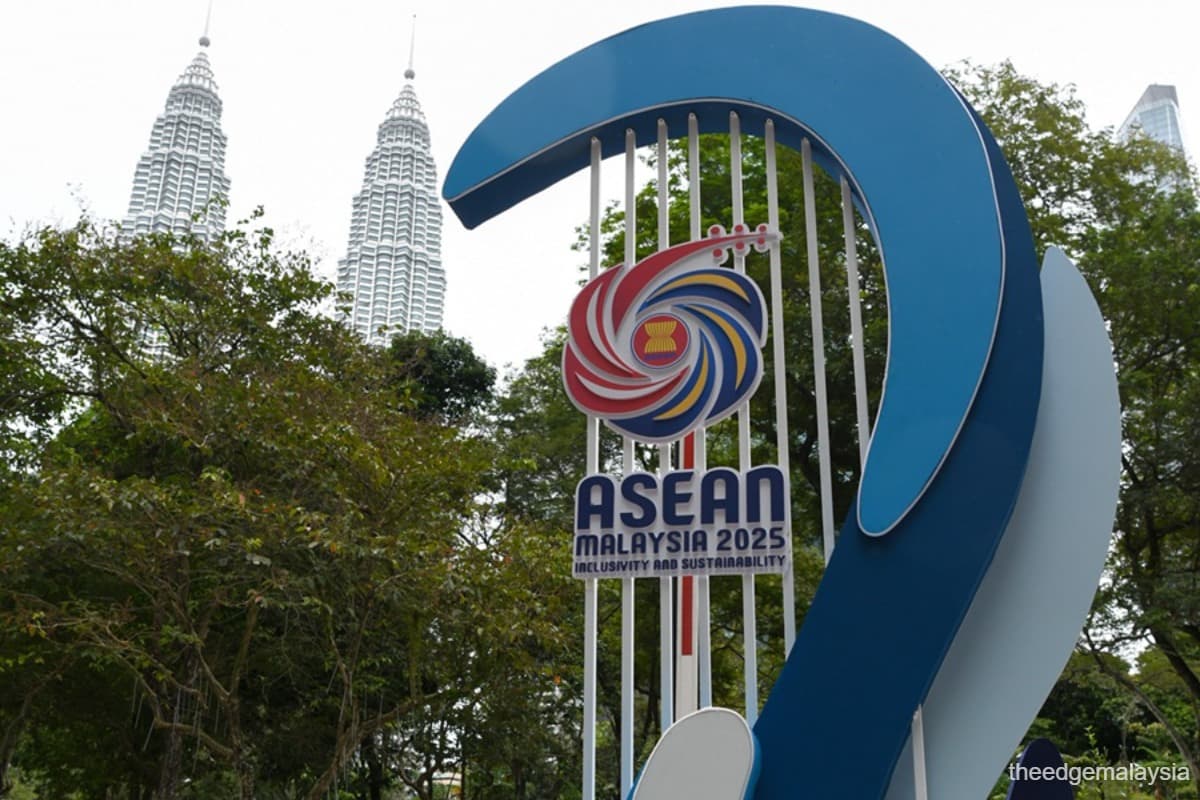
WHEN global leaders gather in Kuala Lumpur next week for the 47th Asean Summit, they will convene at what may prove to be one of the most consequential moments in the bloc's history. Escalating tariffs and geopolitical competition are fragmenting global trade, exposing the vulnerabilities of the region's reliance on external markets. For Asean, caught at the intersection of deepening global fragmentation, the imperative to strengthen regional integration has never been more urgent.
Yet here lies a paradox. Despite decades of trade liberalisation, Asean's intra-regional trade has stagnated at slightly above 20%of total trade — unchanged since the early 2000s and far below the 43% achieved by the broader Asean+3 grouping or the European Union's 61%. This plateau persists even as tariffs within Asean have fallen to near zero and the region has established one of the world's most extensive networks of free trade agreements. Clearly, trade policies and liberalisation alone cannot unlock deeper integration.
Research by Amro staff helps explain why. Asean's current integration levels align closely with what economic fundamentals would predict: modest market sizes, diverse development stages, and limited production sophistication. Unlike the EU, where convergence towards high incomes created overlapping demand structures, Asean economies are at very varied stages of development, from advanced service hubs to rapidly industrialising manufacturing bases.
This diversity enables global integration but reduces internal complementarities: higher-income members demand goods that lower-income partners cannot yet supply, while lower-income members lack the purchasing power to absorb higher-value regional exports.
Perhaps most tellingly, intra-Asean foreign direct investment (FDI) remains just above10% of total FDI stock — less than half what fundamentals predict and far below the roughly 50% in Asean+3 or the EU. This matters significantly. FDI builds production networks, transfers technology, and creates the supplier relationships that sustain deeper trade. Without stronger cross-border investment within Asean, efforts to enhance complementarity or reduce policy frictions will struggle to gain traction.
The path forward requires Asean to complement its liberalisation agenda with a deliberate investment strategy built on two mutually reinforcing pillars.
Pillar 1: Leverage existing positions in global value chains — particularly deepening integration with the Plus-3 economies (China, Japan, and Korea) — to build domestic capabilities. Asean's role as a major production base in electronics, automotive and digital services provide channels for technology transfer and skills upgrading that liberalisation alone cannot deliver.
Another promising area is regional energy integration, where Asean can tap Plus-3 investment and technology, such as in clean-energy projects across the Lower Mekong, to simultaneously strengthen industrial capacity and environmental outcomes.
The focus should be on attracting high-spillover FDI in knowledge-intensive sectors, strengthening linkages between multinational firms and local suppliers, and ensuring small and medium enterprises capture these benefits through investments in education, regulatory oversight, and financial market development.
Pillar 2: Prioritise facilitating intra-regional investment flows through the internationalisation of Asean firms. As domestic companies expand across borders, they create the investment flows and production networks that trade agreements assume but cannot generate.
This represents the next stage of structural transformation for many Asean economies — the shift from being recipients of foreign investment to becoming regional investors. Targeted policies could include operationalising existing initiatives to curate cross-border opportunities, establishing recognition frameworks for regionally active firms, and promoting financial integration initiatives — from cross-border payments to local currency use and regional capital markets — to reduce frictions and facilitate firm expansion across Asean.
The implications extend beyond Asean itself. For the Plus-3 economies, a more deeply integrated Asean would strengthen the anchor of regional demand and resilience. Sustained intra-Asean trade and investment growth would create a more stable source of final demand within Asia's production ecosystem, providing a buffer against global volatility. . It would also reinforce a more stable and competitive Asian production system, helping to diversify supply chains and align standards as global value chains reconfigure amid rising protectionism.
Model simulations suggest the potential is substantial. Under current trajectories, intra-Asean trade may reach only 25%-30% by 2050. But with successful domestic upgrading through global value chain linkages and stronger intra-regional FDI, the share could approach 40% — a level that would fundamentally reshape Asean's economic geography.
As leaders convene in Kuala Lumpur, the message should be clear: trade policies and liberalisation remain necessary, but they are no longer sufficient. In an era of fragmenting global supply chains and rising protectionism, Asean's path to deeper integration runs through industrial upgrading and regional investment — leveraging external linkages to build capabilities while fostering the cross-border firm expansion that embeds those capabilities within the region.
If the last decade for Asean has been about resilience — navigating shocks and maintaining openness — the next must be about transformation: deepening integration and upgrading capacity. The alternative is continued dependence on external demand and shallow regional ties that leave Asean vulnerable to precisely the kind of global disruption now unfolding.
The stakes could not be higher.
Dong He is Amro’s chief economist and responsible for overseeing the organisation’s country and regional surveillance, as well as research activities related to the Asean+3 economies. Allen Ng leads the Regional Surveillance group and a separate team of economists in conducting macroeconomic and financial system surveillance on Thailand.