

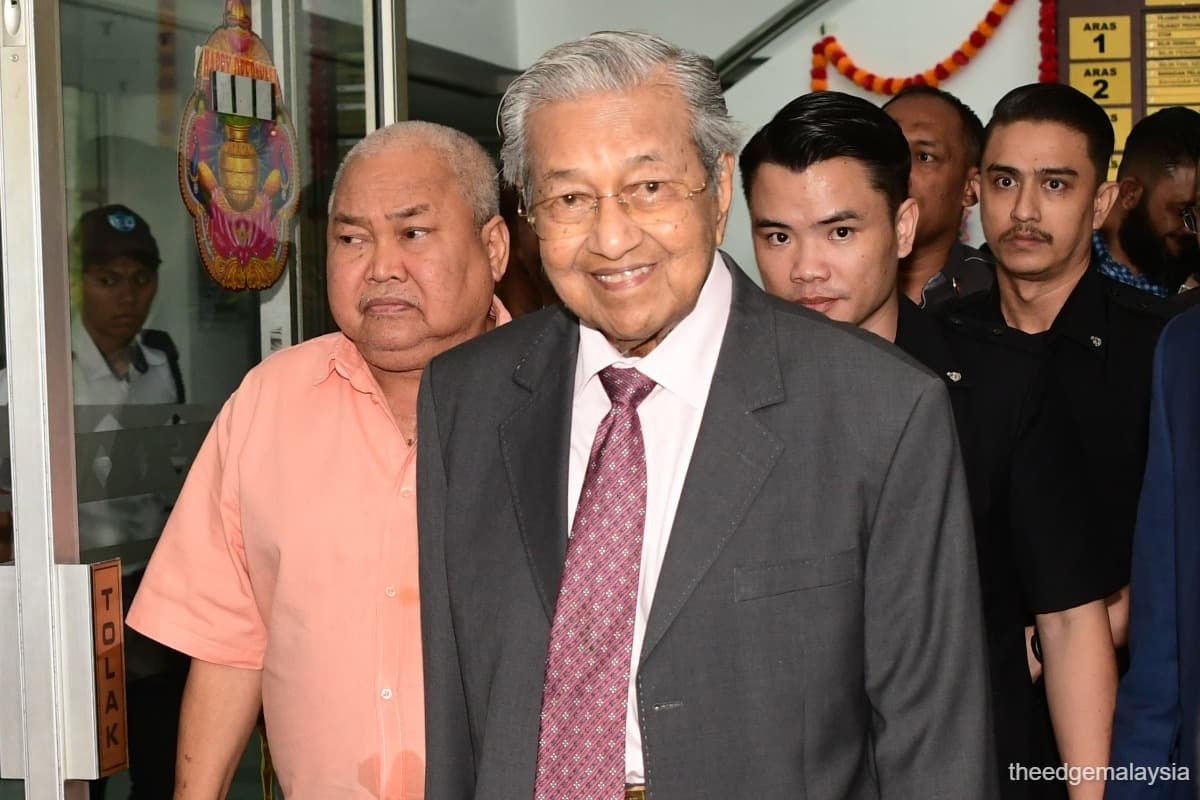
SHAH ALAM (Oct 23): Tun Dr Mahathir Mohamad, while on the witness stand in his RM150 million defamation suit against Prime Minister Datuk Seri Anwar Ibrahim, questioned the High Court on Thursday as to why he was being subjected to questions about his character when he was the one who filed the complaint. The suit centres on Anwar's remarks alleging that Mahathir stole billions of dollars when he was in government, enriched his children, and hid money overseas.
Lamenting his advanced age, Mahathir, who is 100 years old, said he could not answer all the questions posed by Anwar’s counsel, Ranjit Singh, regarding his character.
"This trial will take 10 years or 15 years. I will be dead before this case is finished. You (Ranjit) are not dealing with my original complaint. Anwar accused me of stealing billions of dollars, that I enriched my children, that I hid money overseas," Mahathir said.
Mahathir appeared to bemoan Ranjit’s line of questioning, which included asking about the former prime minister’s loss in the 2022 general election, where he was placed fourth out of five candidates and lost his deposit. The lawyer also brought up Parti Pejuang, the party Mahathir founded, which had lost its deposits in all 120 seats it contested.
At one point, Mahathir refused to answer a question posed by Ranjit.
Ranjit, in response, assured the former PM that the trial would not take a decade or more. He then asserted that he was entitled to ask the questions, given Mahathir’s claim that he is a statesman and that Anwar’s statements had harmed his reputation.
Mahathir said he is regarded as a statesman "based on what the people say".
The cross-examination extensively covered Mahathir's two tenures as prime minister, the first for 22 years from 1981 to 2003, and the second for 22 months from 2018 to 2020. Among topics he touched on were issues involving the sacking of former lord president Tun Salleh Abas, the massive security crackdown known as Ops Lalang, the alleged judicial fixing involving Datuk VK Lingam, and the Reformasi movement.
When Ranjit asked Mahathir whether he regretted sacking Anwar in 1998, the centenarian simply replied, "No."
Ranjit pursued the point, asking if the sacking of his client affected Mahathir's reputation. "Not wholly, partially," Mahathir replied.
'I merely worked as a postman'
When questioned about his knowledge of the alleged corruption and judicial fixing involving VK Lingam and former lord president Tun Eusoff Chin, Mahathir said he was aware of the matter.
The exchange continued regarding the appointment of Eusoff as head of the judiciary:
Ranjit: Would you accept Tun that you ultimately would have appointed Eusoff Chin as leader of the judiciary?
Mahathir: The name was submitted by the judges. I passed it to the (Yang di-Pertuan) Agong.
Ranjit: Constitutionally, as the PM, you played a big role in it.
Mahathir: I merely worked as a postman. I didn't change any recommendation.
Regarding the Reformasi riots following Anwar’s 1998 sacking — when Anwar was charged with abusing his power and sodomy — Mahathir said he was aware of the events. But when Ranjit pointed out that various individuals were detained under the Internal Security Act, Mahathir maintained that "it was police work", and that he "could not recall" all that. He also said he was not briefed over the Reformasi riots and maintained that he was "only briefed over Anwar’s case".
'A dictator would never resign'
Mahathir maintained that he has a "sterling reputation as a negarawan (statesman)" despite being shown examples of protests against him, such as the Reformasi movement.
Ranjit suggested that Mahathir’s actions, such as curbing dissent, indicated that he had "acted in a dictatorial manner".
Ranjit said, "You maintain that you are a statesman, as people like Abraham Lincoln, (Nelson) Mandela or Winston Churchill have been identified as. But there are various incidents I would suggest that you acted in a dictatorial manner [such as when] curbing dissent from the opposition. Do you maintain that you have a sterling reputation?"
Mahathir rebutted, "I still maintain to be regarded as a negarawan (statesman)."
He justified this status by noting that he had been invited to give talks by Japan, the British Broadcasting Corporation, and many Islamic countries.
The two-time former prime minister also denied Ranjit’s assertion that he was dictatorial or authoritarian during his administration, quipping that "a dictator does not resign". Mahathir resigned as the fourth PM in 2003, with the late Tun Abdullah Ahmad Badawi succeeding him.
Nevertheless, Mahathir agreed with Ranjit that his reputation depended on what the rakyat (people) had perceived him to be.
The hearing before Judicial Commissioner Datuk Donald Joseph Franklin is scheduled to resume next Wednesday, Oct 29.