

This article first appeared in The Edge Malaysia Weekly on October 20, 2025 - October 26, 2025

JUST when the chips were down for the Lim family behind Genting group, their fortunes seemed to have turned around, thanks to the euphoria over the upcoming integrated resort and casino in downtown New York.
After months of speculation that Genting Bhd (KL:GENTING), the flagship company headed by Tan Sri Lim Kok Thay, was looking at a corporate exercise to unlock value in the group, it embarked on an exercise that was fairly predictable.
Last Monday (Oct 13) morning, trading in the shares of Genting and its 49.36% associate company Genting Malaysia Bhd (KL:GENM) was suspended. That evening, Genting announced a voluntary general offer (VGO) for GenM shares at RM2.35 apiece — an exercise that would see it incur a debt of RM6.7 billion.
The fact that Genting would take GenM private had always been on the cards because the latter had long been deemed “low hanging fruit” among the other companies in the group for it to unlock value.
But the unattractive exit offer made to the minority shareholders, considering that GenM is largely held by institutions that probably had held its shares at between RM2.50 and RM3 apiece, came as a surprise.
Nevertheless, this audacious bid for GenM is proving to be a bounty for Genting, which is substantially owned by the Lim family through Kien Huat Realty Sdn Bhd. In the days following the announcement, Genting’s share price has risen more than 20%.
According to Genting, the reason for wanting to take GenM private is to “demonstrate control” in accordance with accounting regulations and enhance the financial profile of GenM should it be successful in one of the bids for an integrated resort and casino in New York City.
“The offer is in line to achieve more than 50% and secure statutory control over GenM,” Genting stated in its VGO announcement.
What’s perplexing is that even before the VGO, Genting had always consolidated GenM’s earnings and cash flow into its books, even though it only held 49.36% of the company. This is because it controls the management of GenM and passes the test of “control”.
So, what could be so pressing that required Genting to secure statutory control over GenM now? Why not just buy more GenM shares on the market and trigger a mandatory general offer, instead of embarking on a VGO?
An investment banker says the level of scrutiny by the New York gaming authorities may be stringent, necessitating Genting to have more than 50% equity interest in GenM to demonstrate that it has statutory control under accounting rules.
“As for the VGO, Genting is probably on a fishing expedition to try and see how much acceptance it will get. The immediate objective is to get more than 50%. If Genting gets enough to take GenM private, it will be a bonus for it,” says the investment banker.
Analysts have upgraded their recommendations on Genting — up to RM6 a share — for a myriad of reasons.
First, Genting is largely undervalued compared to the other companies in the group. The value of its 53% stake in Genting Singapore Ltd (GenS) is more than its entire market capitalisation on Bursa Malaysia.
Second, Genting’s price for GenM does not take into account several developments that would lead to a rerating of the latter. Among them is the potential sale of a piece of land in Miami and GenM being one of the successful bidders for an integrated resort and casino in downtown New York.
According to a note from Maybank Investment Bank, if Genting is successful in privatising GenM, its sum-of-parts valuation would be RM4.25 per share. Goldman Sachs has a target price of RM6 for Genting.
According to a fund manager, the euphoria over Genting’s proposal to take over GenM at a relatively low price is good for the former. “What is bad for GenM is good for Genting. But overall, nothing has changed for Genting. The management is still very much the same,” he says.
The optimism about Genting now is different from that in August after it announced the results for the first six months of the year. The company did not declare any dividends, citing cash conservation to reduce debts, which stand at more than RM38.6 billion, as among the reasons.
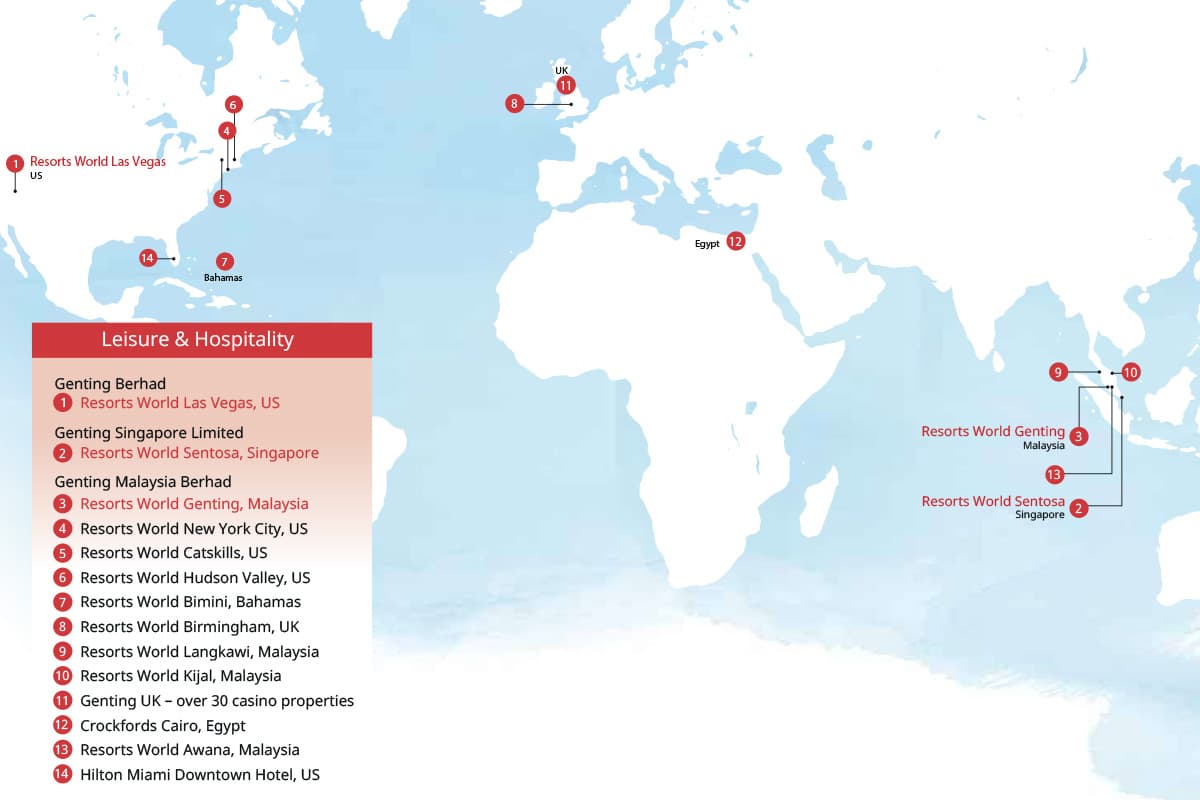
The pessimism about Genting stemmed from the non-declaration of dividends and poor performance of Resorts World Sentosa in Singapore and Resorts World Las Vegas in the US.
Resorts World Sentosa continues to lose market share to rival casino operator Marina Bay Sands. This was because Resorts World Sentosa was undergoing upgrading works under the S$6.7 billion (RM21.9 billion) RWS 2.0 project, where several new attractions were being built to entice tourist arrivals to the integrated resort.
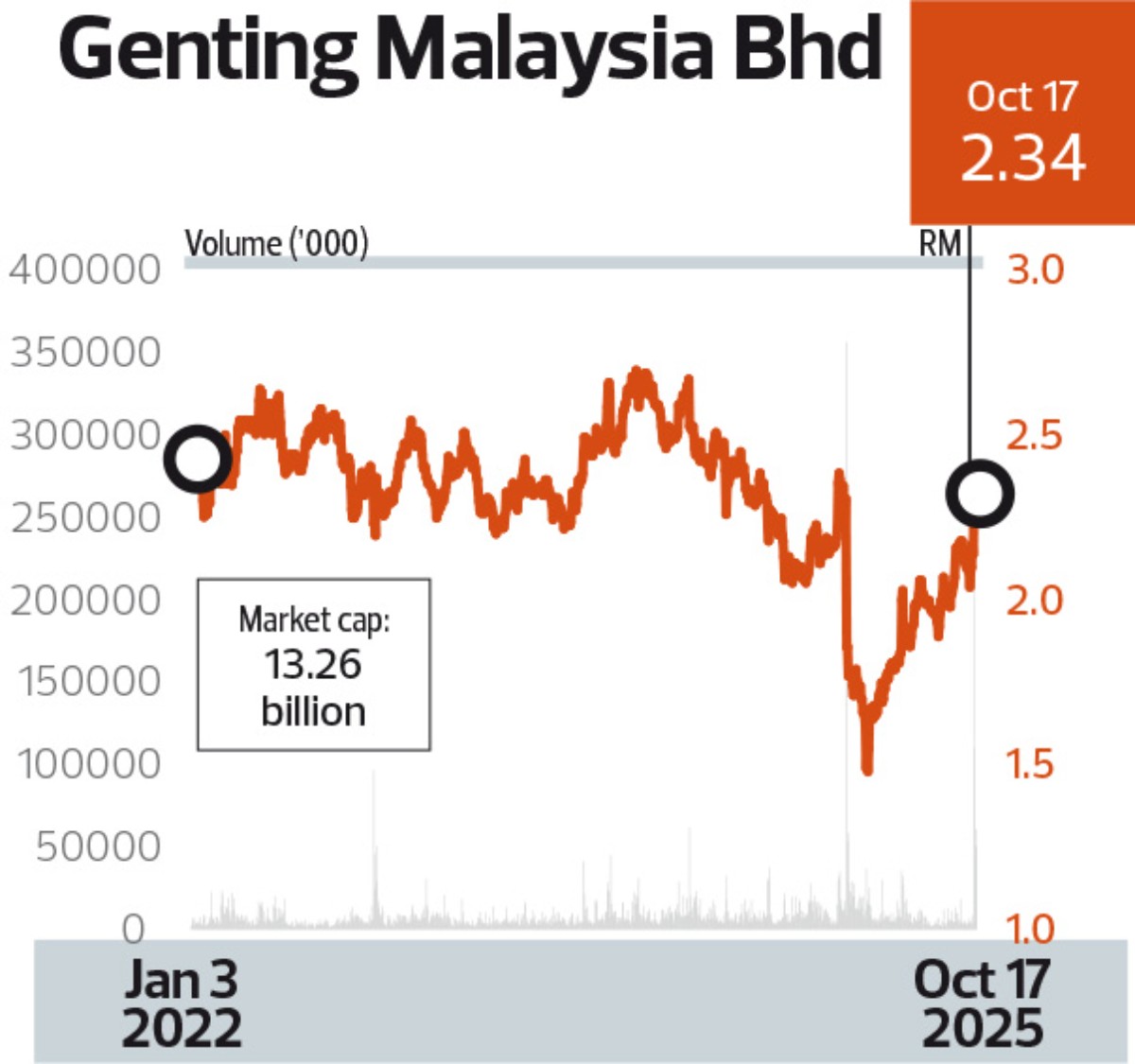

Weakening financial metrics
As for Resorts World Las Vegas, it has yet to produce the desired results since opening in June 2021, after six years of construction at a cost of US$4.5 billion (about RM19 billion). In its latest quarterly results, Genting says Resorts World Las Vegas occupancy rate and average daily rate for the second quarter of this year were down from the same period a year earlier.
The overriding concern about Genting is its RM38.6 billion debt that came about largely due to the huge investments in Resorts World Las Vegas starting in 2014. Its debt-to-Ebitda (earnings before interest, tax, depreciation and amortisation) ratio is more than 4.2 times. The acceptable level is under three times, while anything that is two times or below is considered healthy.
A stark warning about Genting’s rising borrowings comes from Moody’s, which has placed Genting, Genting Overseas Holdings Ltd (GOHL) and GenS on review for a downgrade. GOHL is the immediate holding company controlling 53% of GenS.
According to Moody’s, Genting’s adjusted debt-to-Ebitda ratio will rise to about 5.1 times in 2025 if the proposed privatisation of GenM is completed and funded by borrowings.
“Our projections exclude the potential US$5.5 billion of investments associated with a possible New York casino licence win, which remains uncertain. Genting’s credit metrics will likely deteriorate further if the company secures the licence,” it says in a statement issued last week.
Moody’s has warned that Genting’s rating will likely face a multi-notch downgrade if its financial profile weakens because of a material increase in debt that results in higher leverage and the absence of any corresponding plan to reduce it.
The 74-year-old Lim, who is executive chairman of Genting, is certainly well aware of the weakening financial metrics and how things could go wrong if the company’s persistently high debt level is not addressed.
Not too long ago in January 2022, the Lim family had to place Genting Hong Kong in liquidation when it could not meet its debt obligations following the collapse of its cruise business due to the Covid-19 pandemic. The cruise business was something that Lim himself had built. The liquidation of Genting Hong Kong proved that the group’s recession-proof casino business was not invincible to unexpected events.
Genting’s VGO for GenM underlines its resolve to secure one of the casino licences in New York. In hindsight, perhaps it does not have a choice because GenM already has three other casinos in New York state — one in New York City and two further upstate. If it is left out of the biggest casino in New York, it will lose control of the market there.
But securing the casino licence in New York is one thing. Successfully completing the project and reducing the risk of debt is quite another. It is a tough balancing act, and history has shown that the “house does not win” all the time.
Save by subscribing to us for your print and/or digital copy.
P/S: The Edge is also available on Apple's App Store and Android's Google Play.