

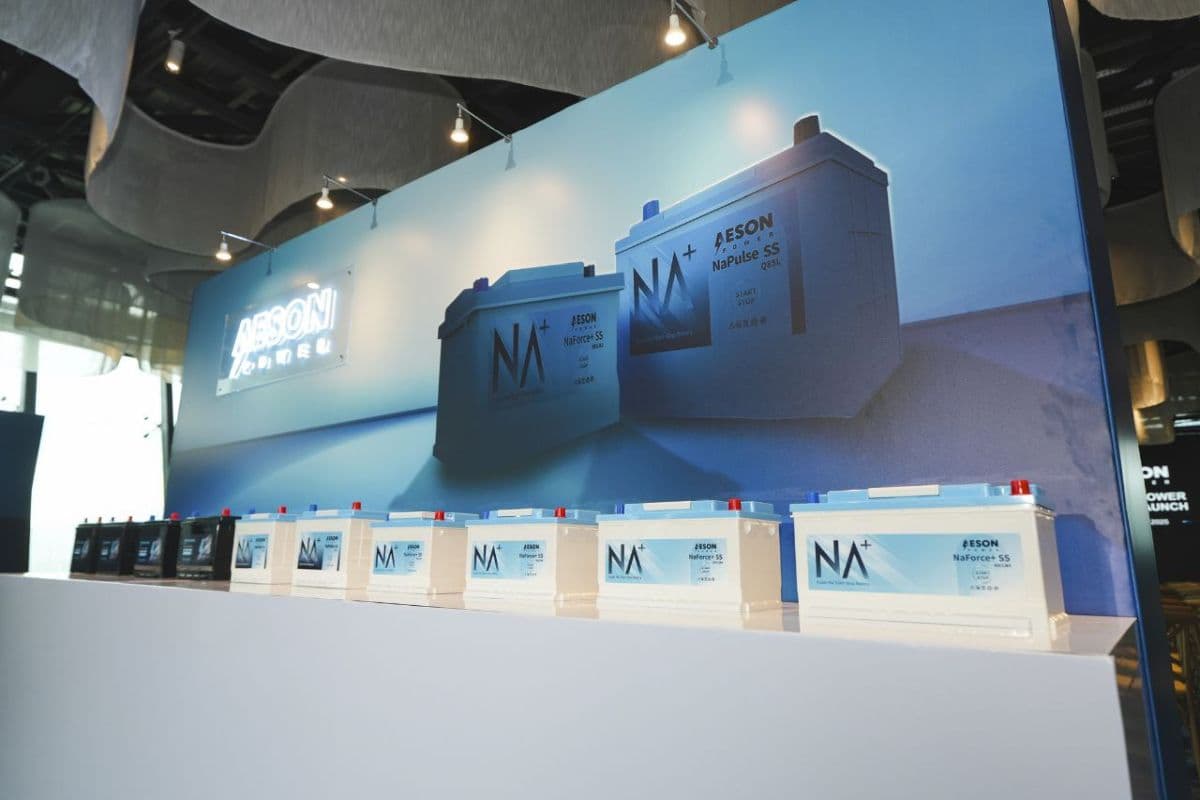
KUALA LUMPUR (Oct 17): Australian battery manufacturer Aeson Power made its debut in the Malaysian market on Friday with the official launch of its sodium-ion automotive batteries for internal combustion engine (ICE) cars.
The company has partnered with local automotive service equipment provider Corida Sdn Bhd to distribute the batteries and educate the public on sodium-ion technology to accelerate adoption.
The launch event, held at The MET, Mont Kiara, showcased Aeson’s sodium-ion batteries, which include the NaPulse Starting, NaPulse Start-Stop and NaForce Start-Stop series of automotive batteries, designed for both traditional starting-type engines and modern start-stop systems.
Jin Chan, managing director of Aeson Power Malaysia, highlighted the various strengths and benefits of sodium-ion batteries compared to lead-acid batteries, which are most commonly used in ICE vehicles.
“It is up to 73% lighter than the traditional lead-acid; they charge super-fast, deliver smoother power and is able to unlock better performance, better fuel efficiency and keep your car’s electronics running at their absolute best,” said Chan.
Scott Clark, product manager of Aeson, elaborated on the key characteristics of sodium-ion batteries as a replacement for lead-acid batteries and even a viable competitor to lithium-ion batteries.
Automotive batteries are typically placed in the engine bay, where it is exposed to residual heat from the engine and other components. On a hot and humid day in Malaysia, Clark explained that conventional lead-acid batteries can suffer from diminished power, swelling and other issues.
Thanks to their chemical composition, sodium-ion batteries are not affected by heat and can retain up to 83% of their peak performance even in extreme weather conditions.
Clark said this enables sodium-ion batteries to deliver performance comparable to lithium-ion batteries, which far exceed that of lead-acid batteries. However, unlike lithium-ion batteries, sodium-ion batteries are less volatile.
He explained that even in Aeson’s extreme stress tests — including puncturing, crushing, baking and dropping — the sodium-ion batteries neither combusted nor exploded.
Additionally, because the batteries primarily consist of sodium, they are less reliant on rare earth metals and significantly cheaper to produce.
Inside these batteries lies the company’s proprietary polyanion cathode material technology. This enables their fast-charging capability and lightweight construction, with even the heaviest sodium-ion battery remaining lighter than the lightest lead-acid model.
Thanks to Aeson’s partnership with Corida, its sodium-ion batteries are now available at 60 workshops nationwide. Chan added that the company aims to expand this number to 2,000 locations by the end of the year.
The NaPulse Starting series is priced between RM369 and RM629, while the Start-Stop series ranges from RM749 to RM1,359. These prices include a two-year warranty, with an optional one-year extension available for RM20 to RM70, depending on the model.
Clark added that, for now, these batteries are only suitable for internal combustion engine (ICE) cars. He explained that batteries for electric vehicles (EVs) require higher energy density than sodium-ion batteries can currently offer, though this may change as the technology matures.