

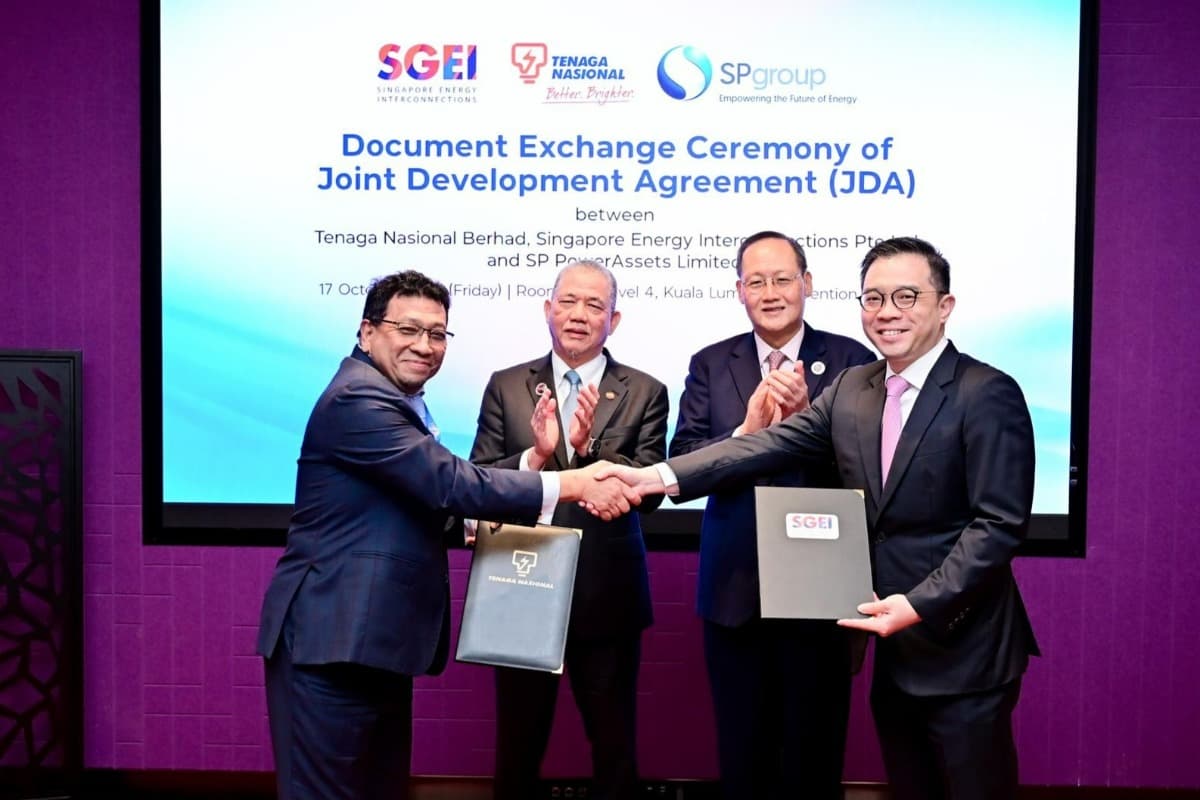
KUALA LUMPUR (Oct 17): Malaysia and Singapore on Friday have agreed to conduct a full feasibility study for a proposed second electricity interconnection between the two nations.
The second link, if it materialises, will have potential capacity of up to 2,000 megawatts, according to a joint statement from Tenaga Nasional Bhd (KL:TENAGA) and Singapore’s state-owned firms SP Group and Singapore Energy Interconnections. The target is to begin operations by 2030.
“The upcoming feasibility study for the second Malaysia-Singapore interconnection is a crucial step towards expanding cross-border electricity trade,” said Tenaga chief executive Datuk Megat Jalaluddin Megat Hassan.
Under a joint development agreement signed on Friday, all three parties will start a full feasibility study to ascertain the technical and commercial viability of the second link.
_and_SP_Group-JDA_20251017150019_4dp8d2.jpg)
The study will build on findings in an initial evaluation conducted by SP Group and Tenaga that was completed in May 2025, which established that there were no technical barriers in implementing a second interconnection.
“This study will be the conduit for closer collaboration with Malaysia to enhance energy security through diversified low carbon energy sources,” said Stanley Huang, the chief executive officer of SP Group, an electricity and gas distribution company.
The agreement marks another step in the collaboration between Malaysia and Singapore in regional power connectivity. The first interconnection between the two countries was created in 1983 and upgraded in 2022 to accommodate bi-directional electricity flows of 1,000 megawatts.
For Singapore Energy Interconnections, or SGEI, the collaboration with Tenaga and SP Group “reflects our shared commitment to enable electricity trade and greater grid resilience between both countries", said its chief executive officer Ong Teng Koon.
SGEI has been appointed by the Singapore government to develop and operate cross-border electricity interconnections to import power into the island nation.