

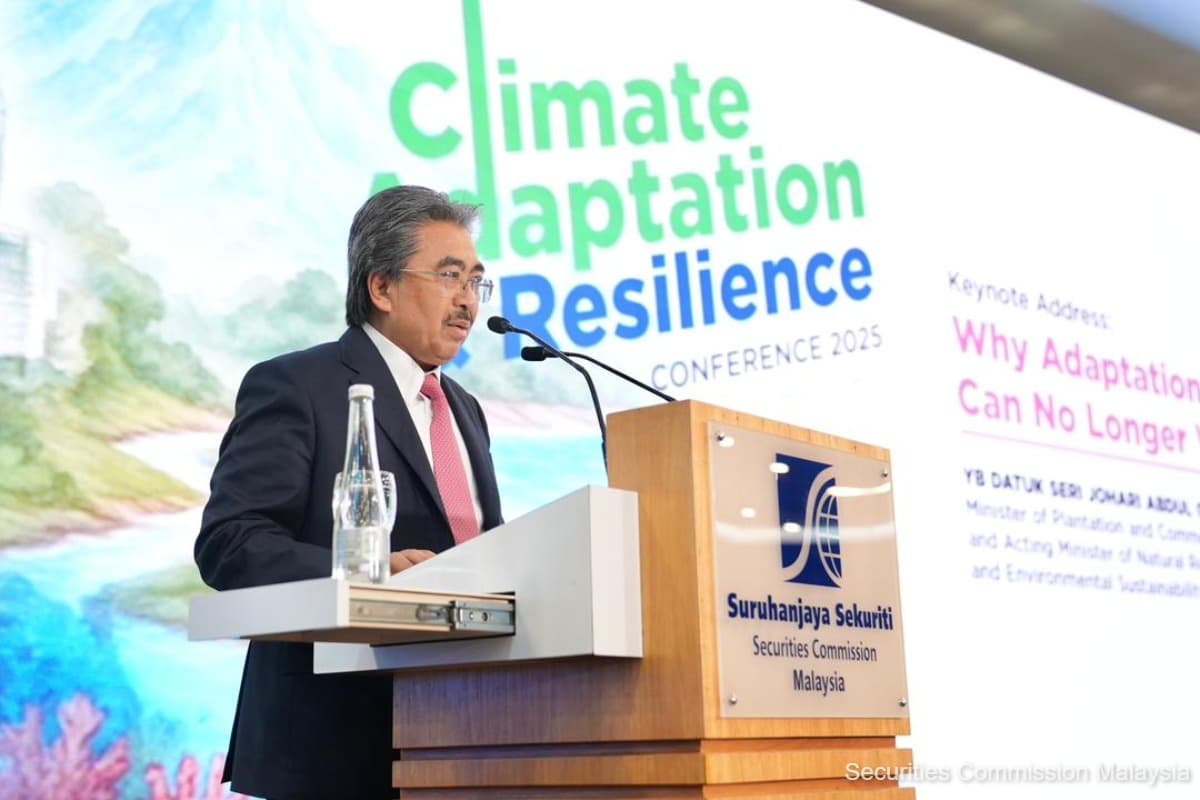
KUALA LUMPUR (Oct 15): The tabling of the Climate Change Act will be delayed as more engagement among stakeholders is needed, said Datuk Seri Johari Ghani, acting minister of Natural Resources and Environmental Sustainability (NRES), at the inaugural Climate Adaptation and Resilience Conference 2025 held by the Securities Commission Malaysia on Tuesday (Oct 14).
“The reason why I'm requesting to delay is because I need to do a very detailed engagement with a lot of stakeholders, because I want them [public and private players] to understand [the importance of this act]. If they do not understand, then we cannot have an act that only certain states will comply and certain states will not comply,” said Johari, who is also the minister of plantation and commodities.
The national Climate Change Bill or Rang Undang-Undang Perubahan Iklim Negara (Ruupin) was initially expected to be tabled in the Parliament after the presentation of Budget 2026.
The bill aims to establish a legal framework for addressing climate change issues in the country.
“This proposed bill, Ruupin, will enshrine both mitigation and adaptation measures into law. This will provide impetus to the development of a domestic carbon market, boosting alignment with our net-zero and Nationally Determined Contribution (NDC) targets,” said Johari.
The Ruupin includes climate adaptation efforts which prepare Malaysia to face the impacts of climate change. This will be aligned with another national policy document being prepared.
“The ministry is developing Malaysia’s first comprehensive National Adaptation Plan, known as MyNAP. The aim is to outline strategies and measures to help the country withstand the impacts of climate change,” he said.
This process brings together over 100 stakeholders from both the public and private sectors including non-governmental organisations to share insights and identify priorities across key sectors, namely public health; infrastructure and cities; water and coastal resources; agriculture and food security; forestry; and biodiversity.
The minister said Malaysia is in the process of developing MyNAP with a goal to complete it by 2026. The plan is led by the Ministry of Natural Resources and Environmental Sustainability with support from the Green Climate Fund and focuses on building resilience to climate change impacts through strategies like strengthening governance, improving climate data, engaging the private sector and securing adaptation financing.
“Upon its completion, MyNAP will complement the Climate Change Act, serving as a blueprint for adaptation in Malaysia,” said Johari.
Additionally, the minister also said climate adaptation must be realistic and fit for purpose. Part of this includes adequate financing that is accessible to stakeholders.
“While mitigation projects like renewable energy attract private investors, adaptation projects like flood defences often struggle for funding because they do not always generate tangible economic returns. We must shift this paradigm by harnessing both public and private financing to drive climate adaptation,” he noted.
Datuk Mohammad Faiz Azmi, chairman at the Securities Commission Malaysia, reiterated a similar sentiment during his opening remarks, noting that although there is an immense climate urgency, there are adaptation financing gaps which public funding alone cannot bridge.
“Private investors must step in but, for this to happen, adaptation finance must be made more attractive and investable,” he said.
Mohammad Faiz said to view smart adaptation efforts as an investment with upside rather than a cost to bear.
“Findings by the Global Commission on Adaptation suggest that every ringgit invested in tailored adaptation measures will deliver two to ten times the return in avoided losses or economic gains,” he added.
“The stakes are high if we fail to adapt, with the cost of inaction staggering. Under a 3.2°C warming scenario, it is estimated that Malaysia’s economy could contract as much as 46% by 2048.”
The one-day conference included speakers from various fields, addressing topics such as the science of climate change, financing challenges for adaptation projects and solutions to address urban heating and flooding.
Professor Joy Pereira, co-chair of working group III at the Intergovernmental Panel on Climate Change and principal research fellow at the Universiti Kebangsaan Malaysia’s Southeast Asia Disaster Prevention Research Initiative, stressed the importance of localised adaptation efforts and empowering scientists and local governments to assess climate change impacts and prepare for them.
Laura Canas da Costa, global policy co-lead at the UNEP-FI, shared the regional adaptation gap that it is preparing, called the Mitigation Co-benefit and Adaptation for Resilience Guide, which is aligned with the Asean Taxonomy for Sustainable Finance. It is meant to guide financial institutions, regulators and other stakeholders to identify the right approaches for adaptation finance.
Many speakers also spoke about the need to move away from reactive measures in addressing climate change impacts. Gary Theseira, independent director of the Centre for Environment, Technology and Development Malaysia, gave the example of building flood mitigation measures in one part of the river that may just cause water to flow elsewhere if it is not planned well.
The speakers also called for investors and businesses to properly address climate risks and value resilience. There are already innovative financing tools to support climate adaptation projects and it is increasingly included in sovereign bonds.
Yogi Chellappan, senior manager and lead for climate resilience at ThinkCity, shared the projects that the company has been implementing in Penang to address urban heat, flood risk and biodiversity protection, such as by providing grants for local businesses to green their roofs, greening car parks and engaging the public on climate vulnerability assessments.
Other cities, such as Shah Alam, Yong Peng in Batu Pahat and Kuala Kangsar, are also now evaluating the use of nature-based solutions for climate adaptation with ThinkCity.