

This article first appeared in The Edge Malaysia Weekly on October 13, 2025 - October 19, 2025
WHILE carriers AirAsia and Firefly have withdrawn their jet operations from the Sultan Abdul Aziz Shah Airport (Subang Airport) in Subang, Selangor, Malaysia-based Malindo Airways Sdn Bhd (operating as Batik Air Malaysia) sees opportunity in the gateway and is betting it can turn a profit by operating there.
AirAsia and Firefly had struggled to remain financially viable at Subang Airport, owing primarily to structural constraints such as limited slot availability, constrained aircraft parking and a strict operating curfew due to the airport’s proximity to residential areas. Firefly, however, still operates its ATR turboprop services out of Subang.
Batik Air Malaysia CEO Datuk Chandran Rama Muthy, 45, says the airline is pursuing a two-pronged expansion strategy, with the Kuala Lumpur International Airport (KLIA) remaining its primary hub. Subang Airport will serve as a secondary base, allowing the airline to broaden its market reach, tap into different passenger segments and reduce its reliance on a single hub.
The airline has recently been granted additional slots at Subang Airport, taking over the gap left by AirAsia and Firefly, bringing it to a total of 12 slots from six slots previously. Subang Airport currently has a limit of 15 slots for jet operations.
“We have invested heavily in upgrading our facilities, resources and infrastructure at Subang Airport. For our operations to be profitable there, however, we need economies of scale to spread out the cost,” he tells The Edge in an interview.

Batik Air Malaysia has stationed two aircraft at Subang Airport and plans to double that number by end-December.
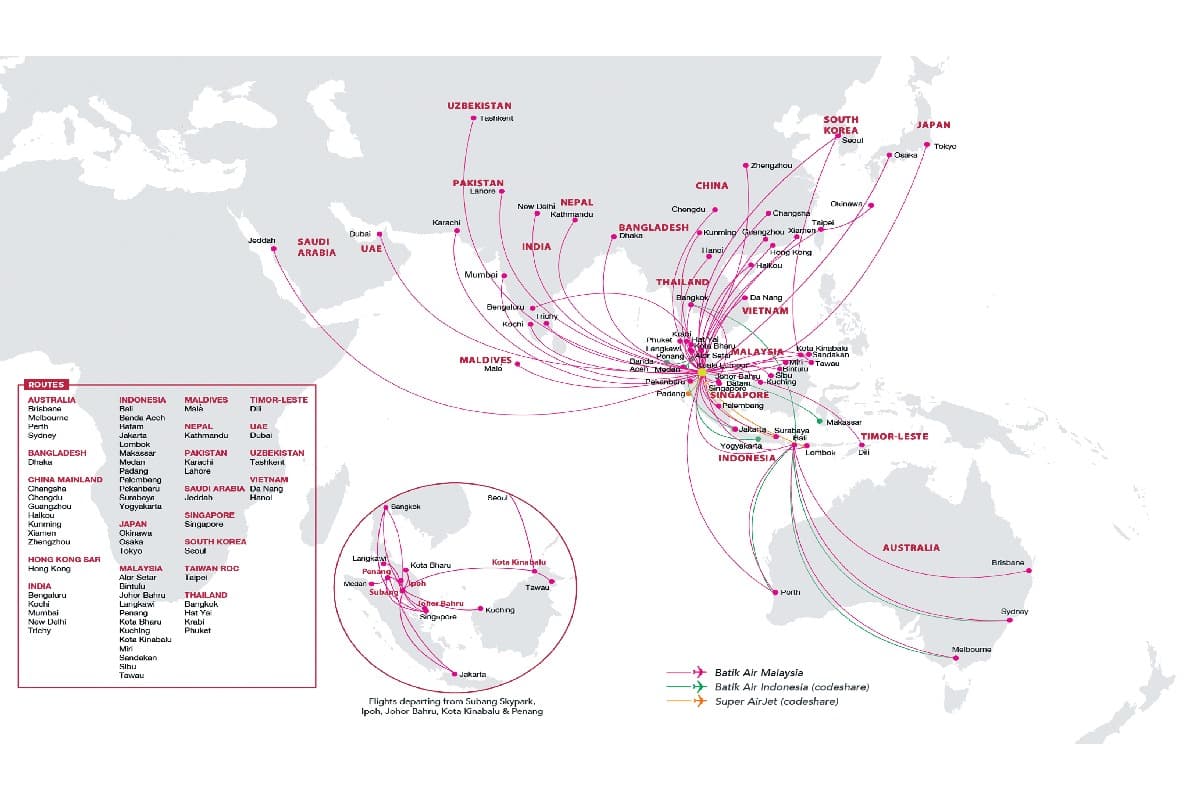
The airline’s fleet currently comprises five widebody Airbus A330 300s and 47 narrowbody Boeing 737 8/800s, servicing 63 destinations across 20 countries. Over the next three years, it aims to operate between 82 and 85 aircraft, comprising about 70 narrowbody and 12 widebody aircraft.
This fleet expansion aligns with the airline’s plans to add 20 destinations and increase flight frequencies on existing routes in the next three to five years. Its upcoming routes include Osaka, Japan, as well as Makassar, Pontianak, Semarang, Banjarmasin and Padang in Indonesia.
Strength in numbers
Chandran notes that the ambition to make KLIA its regional transit hub has been part of the airline’s strategy for years, inspired by how Singapore Airlines (SIA) built its network across the region and beyond.
“If you look at SIA, its success comes down to one thing — the network. The low-hanging fruit for Singapore is Indonesia. Before there were SilkAir, Tigerair and Scoot, SIA was already flying to nearly every major city there. We want to emulate that success story by positioning KLIA as a regional transit hub,” he says.
“We’re confident we can achieve this because we have strong backing from Lion Air Group [in Indonesia], whose airlines collectively serve more than 200 destinations across the country.”
Apart from Batik Air Malaysia, Lion Air Group comprises Lion Air, Wings Air, Batik Air (Indonesia), Thai Lion Air and Super Air Jet.
Chandran highlights the advantages of being part of a large airline group — extensive network connectivity, shared resources and infrastructure, stronger bargaining power, such as for aircraft leasing or spare parts, and the ability to mitigate risks more effectively.
“The beauty of being in a big group is that you always have support when you need it,” he says, adding that Batik Air Malaysia is also riding on Lion Group’s connectivity.
“We offer two distinct products within the group. For example, passengers can choose to fly with Batik Air Malaysia, with Batik Air Indonesia, or Lion Air via Jakarta.
“We want to emulate SIA’s success story with Changi Airport. If Changi can do it, why not KLIA? As a Malaysian, I’ve always wanted to do the best for the country and that means making Malaysia, through Batik Air Malaysia, a central hub in the region.
“Malaysia is geographically blessed, sitting strategically between two major economies, namely China and India, as well as in Southeast Asia between Thailand, Singapore and Indonesia, with Australia just a few hours’ flight away. We’re sitting in a sweet spot [to serve a range of high-potential markets].
“Take Australia, which has a relatively affluent population of 20 million with high spending power. Then there’s Indonesia, with a population of over 280 million people. While it’s a price-sensitive market, they’re still willing to spend on travel.
“Add to that the two giants, China and India, with 1.4 billion people each. If we market the right product and provide good connectivity, I don’t see why we can’t be successful.”
As such, Batik Air Malaysia’s fleet expansion is aimed at filling a key market gap, particularly the lack of direct flights from India and the need for improved transit connectivity to secondary cities in Indonesia beyond Jakarta and Bali, as well as to Australia, says Chandran.
To support this strategy, Batik Air Malaysia has so far partnered with 13 international airlines through codeshare and interline agreements, including Emirates, Qatar Airways, Oman Air, All Nippon Airways and, most recently, KLM. These partnerships are part of the airline’s broader goal to strengthen its connectivity to Europe and Australia.
Chandran describes this as Batik Air Malaysia “feeding the Asean network”, meaning that one ticket can cover multi-segment journeys seamlessly.
“For example, Batik Air Malaysia passengers flying from Kunming, China, to Kuala Lumpur, then on to Jakarta and finally Makassar, can do so on a single ticket. They don’t have to collect their baggage at each stop, as it goes straight through to the final destination,” he says.
“Likewise, they receive their boarding pass in Kunming for the entire journey. It’s a seamless experience. All they need to do is be at the right gate at the right time.”
He adds that the airline is currently in discussions with a European-based airline and aims to finalise the partnership by the end of this year.
Aiming for profitability by 2027, listing on hold
Chandran returned to the airline as CEO in February 2024 after serving as group strategy director at Lion Air Group. He was the airline’s first CEO from its inception in 2013 to August 2019, when it was still known as Malindo Air.
According to Companies Commission of Malaysia data, Malindo Airways is 51%-owned by Sky One Investors Sdn Bhd, with the remaining 49% held by PT Lion Group. Chandran holds a majority stake in Sky One Investors.
He says Batik Air Malaysia had been preparing for a public listing before the Covid-19 pandemic, but the plans have been put on hold. For now, the priority is to stabilise the airline’s operations and return to profitability, which he is targeting by 2027.
“We were actually gearing up for listing before the pandemic. But when Covid-19 hit, the outlook changed entirely,” he says.
“The focus now is on strengthening the airline, ensuring the fundamentals are solid and the earnings sustainable. Only then would it make sense to revisit the idea of going public.”
For the financial year ended Dec 31, 2022 (FY2022), Batik Air Malaysia posted its first-ever net profit — of RM78.22 million, compared with a net loss of RM188.13 million in FY2021. The turnaround was underpinned by a significant increase in revenue, which surged to RM1.28 billion from RM169.84 million previously.
The momentum did not carry through to FY2023, however, as it slipped into the red, dragged by its fleet expansion to meet rising travel demand.
“In 2023, we made a loss because we inducted 17 aircraft. Each induction is costly because you start paying the lease immediately, as well as investing in resources such as pilots and crew, but the aircraft can’t fly for about three months because of the certification and refurbishment processes,” Chandran explains.
“On top of that, fuel prices were high and the ringgit was weak then. Around 65% of our operating costs are in US dollars.”
Still, he remains optimistic.
“Operationally, we’re on a better footing this year and we’re targeting to close 2025 with better results. Once our growth stabilises — which we expect by 2027 — we’re confident we’ll return to profitability,” he says.
Industry outlook improving, but supply chain challenges remain
Chandran believes the aviation sector is on a more stable footing compared to the pre-pandemic era despite ongoing headwinds. He cites International Air Transport Association (IATA) data, which projects global airlines’ revenue to reach a record US$979 billion in 2025, with a net profit of US$36 billion. Passenger numbers are expected to increase 4% to hit five billion globally.
In a January report, the Malaysian Aviation Commission (Mavcom) expected air passenger traffic in the country to hit a record high in 2025, with a year-on-year growth of between 8.4% and 15.6%, or 105.8 million to 112.9 million passengers.
“The industry still faces numerous challenges such as supply chain bottlenecks, geopolitical uncertainties, shifting tax regimes and evolving aviation regulations. It’s about how well we navigate and manage these complexities,” says Chandran.
A noticeable shift since the pandemic has been pricing discipline across the industry, he notes.
“Before Covid-19, airfares were incredibly low. You’d see tickets selling for RM39 or RM49. I used to wonder how that was even sustainable. Even if 20% of the seats are sold at that rate, how does an airline make money? Even a ride from downtown KL to KLIA costs RM65 one way — higher than the flight itself,” he recalls.
“Low fares are fine, but if you push them too low, you risk killing off the competition. And when that happens, fares will spike and passengers will start complaining about monopoly again. The key is to maintain sustainable pricing — affordable for consumers, yet viable for airlines.”
Batik Air Malaysia’s average passenger load factor currently stands at 83%, nearing its internal target of 85%.
Scale and support matter. Chandran emphasises that being part of the larger Lion Air Group helps mitigate some risks associated with the airline business during expansion and operational challenges, particularly in areas such as maintenance and procurement.
“Spare parts, for instance, used to take three days to be delivered before the pandemic, but can now take months because of global shortage. That’s where being part of a large group really helps. When we speak to an engine manufacturer, we don’t go as Batik Air Malaysia but as a larger aviation group,” he says.
Product and positioning
According to Chandran, Batik Air Malaysia should not be viewed as a budget airline. Instead, he describes it as a “hybrid model” between full service and low cost — a positioning the airline adopted from the very beginning when it entered the Malaysian market as Malindo Air.
“Not everyone needs a 20kg baggage allowance or an in-flight meal. Young travellers flying to Bangkok for a two-night stay might only require 7kg of hand luggage. For them, we offer a basic fare — no meals, no baggage,” he says.
Passengers who want more flexibility or added services have options.
“If you want meals and baggage, that’s available in our next tier. And for business travellers who need flexibility such as refunds, cancellations or itinerary changes, we offer a flexi fare,” he adds.
This tiered, branded fare structure allows Batik Air Malaysia to meet a wide range of passenger needs, from budget-conscious travellers to corporate clients, while maintaining a full-service standard.
“In fact, this is the same model that full-service carriers in Europe and the US are now using. Many of them offer a basic economy option with no checked baggage. Does that make them low-cost airlines? Not really,” says Chandran.
Founded 13 years ago as Malindo Air, the airline was rebranded as Batik Air Malaysia in April 2022, in line with Lion Air Group’s strategy to unify its full-service carriers under a single brand identity. Its business model remains lean and asset-light, as the group leases all its aircraft, allowing it to scale operations up or down quickly in response to market conditions.
“The airline industry is exposed to many uncontrollable risks such as weather, geopolitical events, airspace restrictions and natural disasters. Take our Kuala Lumpur-Istanbul route, which we had to suspend because of airspace issues that made the route financially unviable,” says Chandran.
Batik Air Malaysia demonstrated resilience during the pandemic. At the height of it, the airline scaled down operations from more than 30 aircraft to just three.
“But we managed to rebuild the business post-pandemic,” he points out. In fact, Batik Air Malaysia was among the few airlines globally to resume operating at full capacity shortly after the pandemic.
Save by subscribing to us for your print and/or digital copy.
P/S: The Edge is also available on Apple's App Store and Android's Google Play.