

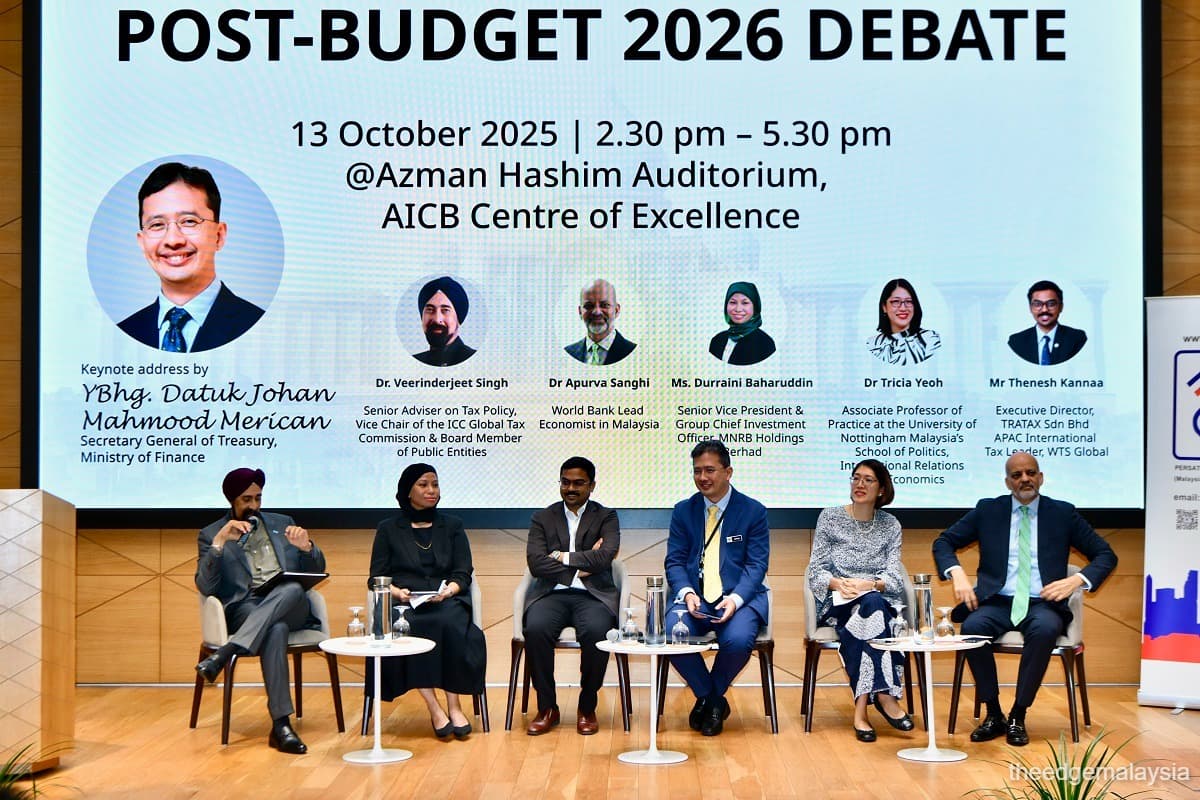
KUALA LUMPUR (Oct 13): The World Bank has questioned the Malaysian government’s estimated fiscal savings from the ongoing RON95 petrol subsidy rationalisation programme, urging greater transparency on the assumptions underpinning the RM2.5 billion figure cited by Putrajaya.
Dr Apurva Sanghi, the bank's lead economist for Malaysia, said the projected savings appear to hinge heavily on foreigners and high-income Malaysians paying full market prices, which may not be realistic given current consumption patterns.
“The claimed savings of RM2.5 billion would depend heavily on foreigners like me paying full price — and on T20 Malaysians or others exceeding the 300-litre quota. But how many foreigners or Malaysians actually do that? Even the T1 don’t exceed 300 litres on average,” Sanghi said during the post-Budget 2026 debate organised by the Malaysian Economic Association (MEA) on Monday.
“It would be nice to see the math, and we haven’t seen it from the Ministry of Finance (MOF),” he added, while stressing that the government, nonetheless, deserves credit for taking on subsidy reform after years of delay.
Under the new Budi95 targeted subsidy programme effective Sept 30, Malaysians aged 16 and above with a valid driving licence can buy up to 300 litres of RON95 petrol per month at RM1.99 per litre by verifying their MyKad at pumps, counters or participating station apps. Non-citizens are not eligible and must pay the market rate of RM2.60 per litre.
According to the MOF, before the Budi95 system was introduced, the government spent about RM8 billion annually on RON95 subsidies. With Budi95, projected savings are estimated at between RM2.5 billion and RM4 billion per year, depending on global crude oil prices.
Sanghi said that while the quota-based system is a good start, the government has yet to spell out whether it is part of a broader plan to phase out blanket subsidies.
“If this is part of a larger roadmap to tighten the quota or phase out the T20 group, that’s fine. But then make it public. Surprises are great in K-dramas, not in policy reforms,” he said, noting inconsistencies between the country’s green transition goals and policies that continue to encourage private fuel consumption.
The economist said Malaysia could draw lessons from its own diesel subsidy reform, where price flotation helped curb smuggling and align domestic prices with market realities.
“The diesel reform worked because prices were floated. That lesson seems not to have been applied to RON95,” he said, adding that globally, the most effective reform models combine price liberalisation with targeted cash transfers.
Sanghi explained that such a model allows governments to reflect true market costs while cushioning lower-income groups through direct aid, rather than maintaining universal subsidies that disproportionately benefit wealthier households.
He described this as the “textbook fix” for subsidy reform, one that balances fiscal discipline with social protection. However, he acknowledged that Malaysia’s political and institutional realities — including public sensitivity to fuel prices and administrative capacity for targeted payments — may necessitate a more gradual transition.
MOF: Addressing leakages comes first
Responding to Sanghi, Treasury secretary general Datuk Johan Mahmood Merican said the government’s immediate focus is to plug leakages and curb cross-border smuggling before moving toward a more refined system.
“Based on our analysis, consumption of RON95 in Malaysia is about 18 billion litres. You can only account for about 78% as household consumption, while the balance could include corporate use or leakages. We’ve all seen RON95 being resold in bottles across the border,” he said.
Johan said the new mechanism is expected to mirror the success of the diesel subsidy reform, which saw a sharp drop in petrol station diesel sales and a corresponding rise in direct commercial purchases by legitimate users.
He also acknowledged the “psychological” dimension of fuel subsidies, noting that Malaysians prefer to see the discount at the pump rather than receive it as a cash transfer.
“When people receive cash transfers, they often perceive it as a bonus and then curse the government for higher prices. At least now, they can see the full market price on the pump and the actual subsidised amount they’re paying,” Johan said.
The government, he added, is open to adjusting parameters such as quota limits or price thresholds as implementation data becomes clearer, but stressed that delaying reform any further would have prolonged distortions and smuggling losses.
“We had to make a call. If we didn’t do anything, we’d spend another year debating. At least now, we’ve achieved some traction,” he said.