

This article first appeared in Forum, The Edge Malaysia Weekly on October 13, 2025 - October 19, 2025
Malaysia’s public healthcare system has long stood as a cornerstone of national identity, embodying the promise of universality that no citizen should be denied treatment because of financial barriers. It has been celebrated regionally as a model of affordable and accessible care. Yet, beneath this proud achievement lies a fragile reality. Universality, while admirable, does not guarantee either equity or quality. Rising demand, a rapidly ageing society and the growing burden of chronic diseases are stretching the system’s resources beyond its limits.
Since 1998, when the Private Healthcare Act was passed, Malaysia has faced a growing risk: without decisive reform, the country may slide into a two-tiered healthcare system — one where private facilities serve those who can afford superior services, while the public sector is left as a residual option, burdened by long waiting times, overstretched staff and underfunded facilities. Such a trajectory would undermine the equity principle that underpins universal healthcare. To avoid this outcome, Malaysia must fundamentally reframe the way it sees public health expenditure. Healthcare cannot continue to be treated as a recurrent fiscal cost; it must instead be understood and financed as a strategic investment in human capital, social well-being and long-term economic growth.
These challenges, and the urgent reforms they demand, are the focus of a new working paper from the Social Wellbeing Research Centre (SWRC) at Universiti Malaya, “Universal in Name, Equitable in Quality: Re-Framing Malaysia’s Public Healthcare Expenditure From Spending To Investment”. The paper argues that healthcare financing levels in Malaysia are no longer adequate to sustain quality and equity, and that a paradigm shift is needed: public health expenditure must be understood not as a cost to contain, but as an investment in the country’s future prosperity.
The double burden of ageing and chronic disease
Two structural forces are converging to reshape Malaysia’s healthcare landscape: demographic ageing and the rise of non-communicable diseases (NCDs).
Malaysia is ageing at one of the fastest rates in Asia. In 2023, around 7.4% of the population was aged 65 or older. By 2044, this proportion is projected to double to 14%, and by 2056, it will exceed 20%, a threshold that defines a “super-aged” society. This demographic transition will also increase the dependency ratio, placing significant pressure on both the working-age population and government finances.
At the same time, NCDs including cardiovascular disease, diabetes, cancer and chronic respiratory illnesses have become the dominant health challenge. They already account for nearly three-quarters of premature deaths in Malaysia. According to a 2024 World Health Organization (WHO)/Ministry of Health (MoH) Malaysia investment case report, NCDs cost the country about US$14 billion per year in economic losses — as of 2021 — equivalent to about 4.2% of gross domestic product (GDP), with the majority of the burden arising from lost productivity rather than direct treatment costs.
These dual pressures, ageing and chronic disease, represent not just a public health concern but also an economic and fiscal challenge. They signal rising healthcare demand at precisely the moment when the ability of government revenue to keep pace is under strain.
Underspending and its price: The numbers don’t lie
Malaysia’s public healthcare expenditure consistently falls short when compared with international standards. In 2023, total public health expenditure amounted to 2.83% of GDP. For international comparison, the latest comparable data show that government-financed healthcare in Malaysia represented only 1.98% of GDP (purchasing power parity) in 2022 — far below the Organisation for Economic Co-operation and Development (OECD) average of 6.94% and the global average of 4.27%. Within Asean, Malaysia’s spending is broadly in line with the regional average of 2.03%, underscoring that underinvestment is a shared regional challenge rather than an exception.
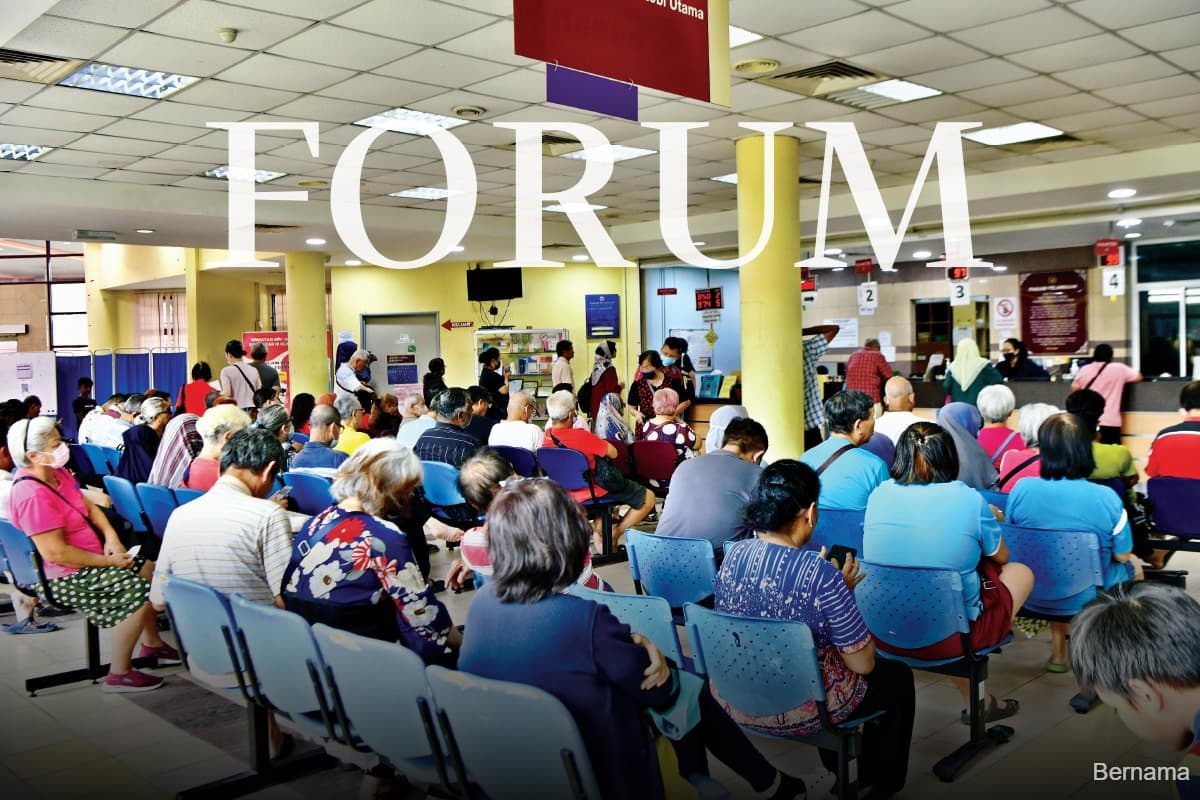
This chronic underinvestment is felt most acutely on the front lines. Public clinics, despite forming a minority of facilities nationwide, manage nearly two-thirds of all outpatient visits. Infrastructure is often outdated, waiting times are long and diagnostic equipment is insufficient. In a 2023 survey by CodeBlue, 95% of healthcare workers described the system as “in crisis”. Over 80% reported being overworked and underpaid, three-quarters experienced burnout, and 60% feared their career progression would stall.
The human cost of underinvestment: Burnout, brain drain and inequity
The human resource challenge is particularly stark. Malaysia has only 2.3 doctors per 1,000 population, well below WHO benchmarks. Shortages are unevenly distributed: while Kuala Lumpur has one doctor for every 183 residents, Sabah has only one per 872. The disparity has grown as resignations increase. Specialist resignations from MoH rose by about 57% between 2019 and 2023, increasing from 229 to 359. At the same time, a sizeable share of contract medical officers have declined permanent placements, often due to relocation to less desirable postings. In 2023 alone, about 20% (1,118 out of 5,489) did not report for duty at their assigned locations.
The result is a vicious cycle. Underfunding drives staff attrition, which worsens workloads for those who remain, further eroding morale and service quality. Patients experience longer delays, while public trust in the system weakens.
Rakan KKM: Innovation or two-tiered healthcare?
In response to these pressures, MoH has introduced innovative initiatives, the most notable being Rakan KKM. Launched under the Malaysia Madani framework, the programme allows selected public hospitals to offer elective outpatient, day care and inpatient services with enhanced features such as choice of specialist, improved privacy and reduced waiting times. Crucially, revenue generated from these services is reinvested into the public system, and incentives are shared across healthcare teams.
Rakan KKM appears to address two pressing challenges: retaining skilled professionals by offering better remuneration, and diversifying revenue sources for public hospitals. However, the initiative has generated considerable debate. Civil society organisations, including the Galen Centre for Health and Social Policy, warn that the programme risks institutionalising a two-class system within public healthcare. By offering “premium” services for those who can pay, the fear is that standard services may be left underfunded, effectively creating inequities within the same public institution.
If managed transparently, with safeguards to protect access equity and guarantees that revenue genuinely strengthens core services, Rakan KKM could represent an important innovation. But without such safeguards, it risks undermining the universality principle that has long defined Malaysia’s healthcare model.
When universality falls short: The quality-equity nexus
The central challenge facing Malaysia’s healthcare system is no longer just access, but the quality of that access. If the poor are left with overstretched and under-resourced services, while those with means secure better care elsewhere, universality becomes hollow. Worse still, perceptions of declining quality erode public trust, which in turn weakens political will to allocate additional funding.
Breaking this cycle requires sustained public investment. Funding is needed to shorten waiting times by expanding specialist capacity, operating theatres and diagnostic services. It is essential to modernise ageing infrastructure to ensure patients receive care in dignified conditions. Competitive salaries and improved working conditions are vital to retaining skilled professionals and reversing the brain drain. Equally important is the expansion of preventive care, especially for NCDs, to reduce costly hospitalisations in the future.
Investing in quality is, ultimately, a pro-equity strategy. It ensures that universality is not merely a legal guarantee, but a lived reality experienced equally across all income groups.
Why healthcare is not a cost but an investment
One of the most damaging narratives surrounding healthcare financing in Malaysia is the framing of allocations as ballooning costs. Year after year, budget debates describe health expenditure as a liability that competes with other pressing demands. This framing is not only misleading, it is dangerous.
Healthcare is not consumption. It is investment in human capital, in social stability and in long-term fiscal resilience. Preventing chronic diseases reduces future treatment costs and preserves workforce participation. Modernising hospitals and clinics supports productivity by reducing time lost to illness. Retaining skilled professionals prevents costly reliance on expatriate workers or the attrition of talent abroad.
For Malaysia, treating healthcare as an investment is not just a moral imperative; it is an economic necessity.
Rebuilding the fiscal base: Taxes, subsidies and solidarity
Reframing healthcare as investment requires parallel reforms in fiscal mobilisation and governance. A priority is the creation of a coherent social protection floor (SPF) that consolidates Malaysia’s more than 60 fragmented assistance programmes into a unified system aligned with international standards. Embedding healthcare within such a framework would ensure that universality is not only preserved but also matched by quality and equity.
Fiscal reforms are central to this effort. Malaysia’s tax-to-GDP ratio of 12.1% in 2022 remains well below the OECD average of around 34%. Within Asia-Pacific, this places Malaysia among countries with relatively low tax revenue as a share of GDP. A phased reintroduction of the goods and services tax — with exemptions for essentials and targeted rebates for low-income households — would provide a predictable and broader-based revenue stream, far more robust than the narrower sales and service tax. At the same time, rationalising regressive universal subsidies, particularly those for fuel, would free several billion ringgit annually for reinvestment into healthcare and social protection. Complementing these measures, a solidarity fund, drawing on earmarked surcharges on alcohol and tobacco as well as contributions from the private sector, diaspora and philanthropy, would diversify revenue sources and institutionalise the principle of shared responsibility.
Such reforms would anchor healthcare financing in fairness and efficiency while strengthening fiscal sustainability.
Political will and clear commitments
Reform is not merely a technical challenge; it is a political one. The Health White Paper (HWP), approved in June 2023, provides a 15-year reform road map across four pillars: service delivery, health promotion, sustainable financing and governance. Yet its proposals on financing remain vague, with few measurable targets.
What is now required is political courage. A clear commitment to raise public health expenditure to 5% of GDP would signal serious intent. Ring-fenced allocations tied to measurable outcomes; shorter waiting times, modernised infrastructure and digital integration would strengthen accountability and public trust. Equally important is a national dialogue that reframes healthcare as a long-term investment in human capital and productivity, rather than a recurrent cost, and that identifies specific programmes and priorities through broad-based public discourse.
A defining choice for Malaysia
Budget 2026 will decide whether Malaysia’s healthcare system remains a source of national pride or drifts into a crisis of inequity. Continued underinvestment will leave public hospitals and clinics overcrowded, staff overstretched, and public trust eroded — trapping the poor in “poor services” and deepening social divides. The consequences reach beyond health: weakened social cohesion, rising inequality and a workforce less able to sustain long-term growth. By treating healthcare as an investment and setting binding financing commitments, Malaysia can ensure quality universality is not just a promise on paper. It must become a lived reality for every citizen. The choices made in Budget 2026 will determine whether inequity takes root or whether Malaysia seizes the chance to make equity the defining strength of its future.
Muhammad Aizat Zainal Alam is deputy director of the Social Wellbeing Research Centre at Universiti Malaya and Professor Emeritus Datuk Norma Mansor its director
Save by subscribing to us for your print and/or digital copy.
P/S: The Edge is also available on Apple's App Store and Android's Google Play.