

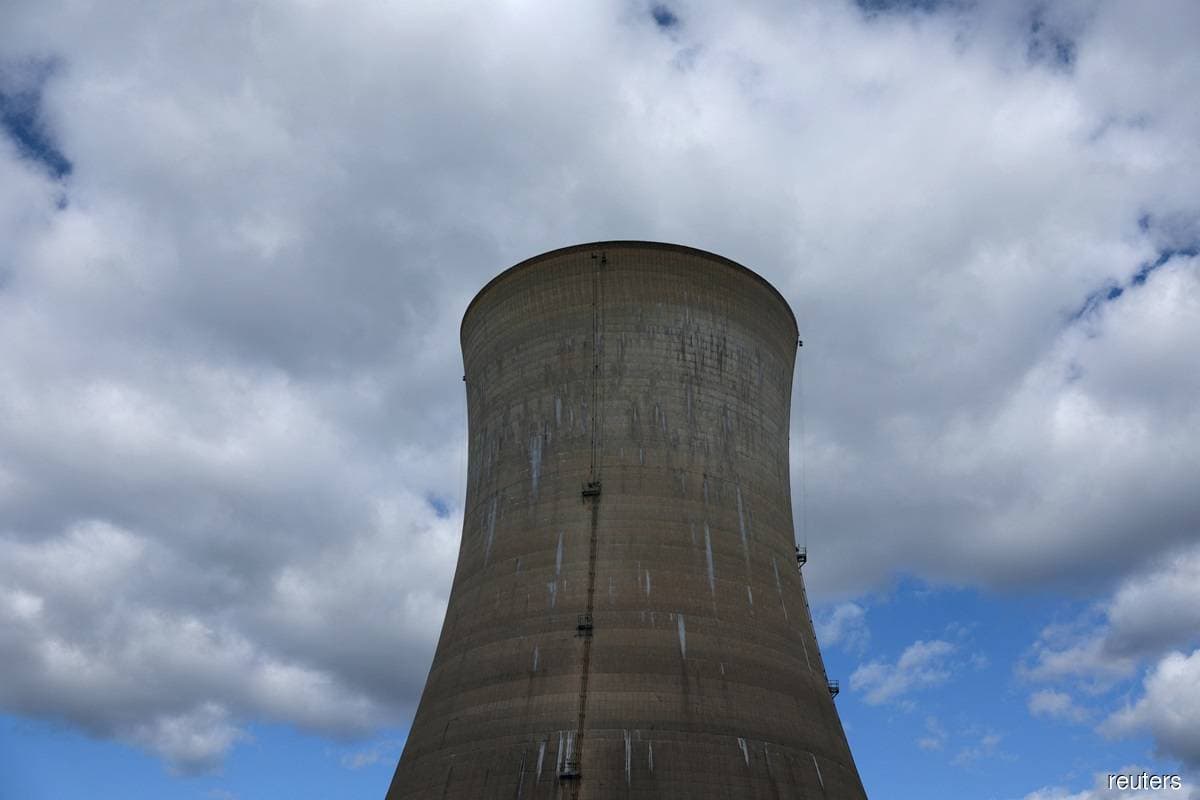
KUALA LUMPUR (Oct 13): The government's latest budget allocation signals that nuclear power is becoming an increasingly tangible consideration in Malaysia’s long-term energy strategy.
In a note on Monday, CGS International analysts highlighted the RM28.6 million allocation for the Nuclear Energy Development Programme under MyPower — an agency under the Ministry of Energy Transition and Water Transformation — characterising it as an "early but meaningful step" towards building the foundational infrastructure and governance required for potential future adoption.
"We see this as an early but meaningful step towards building institutional readiness and technical capacity for potential adoption of nuclear power, signalling that nuclear energy is becoming an increasingly tangible consideration in Malaysia’s long-term strategy for low-carbon and reliable baseload generation."
This funding is designed to strengthen the nation's nuclear energy infrastructure and governance in line with International Atomic Energy Agency standards.
It represents a crucial move to build the institutional readiness and technical capacity required for any potential future adoption of nuclear energy. This initiative underscores a serious commitment to exploring all viable options for low-carbon and reliable baseload generation.
In parallel with this nuclear groundwork, the government is pushing forward with its decarbonisation agenda.
Plans to introduce a carbon tax next year were reiterated, initially targeting the steel, iron, and energy sectors. While specific details on the tax rate are still pending, CGS noted a key observation.
Carbon taxes in the inelastic utilities sector are typically passed through to end-users. This mechanism, successfully demonstrated in Singapore, would likely result in higher electricity prices for consumers.
Budget 2026 also outlined a comprehensive series of initiatives to sustain the renewable energy (RE) momentum, noted CGS.
The confirmed rollout of the sixth large-scale solar programme (LSS6) and an expansion of feed-in tariff quotas reinforce vital policy continuity for the sector, it added.
These moves should sustain the strong momentum in new capacity additions across Malaysia. Furthermore, initiatives like the Solar Accelerated Transition Action Programme (Solar Atap) and Corporate Renewable Energy Supply Scheme (CRESS) are democratising access to RE participation for both corporations and households, it added.
CGS noted the government reaffirmed its commitment to regional energy integration by prioritising the Asean Power Grid.
The research house cited a key project involving Tenaga Nasional Bhd (KL:TENAGA) and Petronas collaborating to accelerate the Vietnam-Malaysia-Singapore interconnection to enhance cross-border RE trade.
"We view the collective funding commitments — including RM16.5 billion from GLCs (government-linked companies) and continued catalytic support from the NETF (National Energy Transition Facility) — as clear evidence that public and private capital mobilisation remains central to achieving NETR (National Energy Transition Roadmap) objectives. The extension of GTFS (Green Technology Financing Scheme) 5.0 until 2026 also ensures continued financial support for green tech adoption."
Beyond traditional utilities, the budget strategically positions Malaysia as a regional cloud and digital hub by 2030.
A sum of RM5.9 billion was allocated for research and development, complemented by RM2 billion for a sovereign artificial intelligence cloud.
These initiatives are bolstered by major planned investments from global tech giants to expand data centre capacity. Building on the National Cloud and Connectivity Plan, these efforts enhance Malaysia's appeal to hyperscalers through clearer regulations and stronger data sovereignty.
All in all, Budget 2026 reaffirms the government's strong commitment to advancing Malaysia's clean energy transition through the NETR, said CGS.
"In our view, this continuity and broad-based approach should accelerate progress towards Malaysia’s 2050F net-zero goal while reinforcing investor confidence in the nation’s energy transition pipeline."
CGS' sector top picks are Tenaga, whose shares gained eight sen or 0.6% to RM13.30 in early trade, and Malakoff Corporation Bhd (KL:MALAKOF), down two sen or 2% to 98 sen.