

This article first appeared in Digital Edge, The Edge Malaysia Weekly on October 13, 2025 - October 19, 2025
Human resource (HR) online platforms are typically made and designed by an IT department or a tech company with an emphasis on administration, payroll and attendance. But those who work in HR know that the day-to-day actions lean more towards people management, something most platforms lack efficient tools to automate.
This was the gap that Benjamin Croc, CEO and co-founder of local start-up BrioHR, sought to close. His company’s take on the HR platform is based on his experience working in HR for various companies of different sizes and industries.
“I used to manage teams of five up to 200 people and, consistently, there was a lack of proper HR tools to help us do things more efficiently. This is what prompted us to start BrioHR in 2019,” says Croc.
He recalls one such experience of working at a financial institution with 200 employees in an industry where turnover was high. He had to recruit several employees to make up the numbers, which involved managing candidates, putting up job postings and conducting interviews, among other responsibilities.
“Everything was managed manually — dozens of job openings, hundreds of candidates, dozens of interviews and so on … making sure that everything was ready from day one. To do all this manually is very complex,” he says.
But Croc knew that his experience alone would not be enough; different companies handle people management differently.
To ensure their platform worked with as many HR teams as possible, Croc and his team spoke to HR professionals, company managers and owners, asking them about issues or frustrations they might have faced with HR platforms before. The team identified three key recurring issues: lack of tools addressing the day-to-day needs of HR, unintuitive and confusing user interface and unreliable customer support.
For the first issue, Croc and his co-founder, Nabil Oudghiri, spent nine months to a year talking to HR professionals across industries to fully understand what they do on a day-to-day basis. Even then, when the platform was taking shape, Croc would go back to check if they were on the right track.
“We still have these [discussions] today. We talk with a number of our clients, asking questions like ‘What do you like? Where should we improve? What should be next?’ It’s a continuous process,” says Croc.
To address the second issue, BrioHR’s platform places emphasis on the user experience and accessibility. Most HR platforms are cumbersome and unintuitive to use. This is especially frustrating, given that HR platforms are the only ones used by every employee.
As most platforms are created by IT departments or tech companies, a certain level of tech competency is required to access or use them. BrioHR aims to break down this barrier by making its platform accessible to all.
The last key pillar is support. Croc says many of the people they consulted with complained that if the HR team had issues with the platform, then getting in touch with customer support would be a constant problem. This is because most HR platforms are developed in the West — in Europe or the US — so getting in touch with customer support promptly was difficult due to the different time zones.
In response, Croc says he invested heavily in BrioHR’s support team, training a team of humans instead of artificial intelligence (AI) bots, as humans are more reactive and can connect with their customers more.
This focus on a human-centric support team over AI bots comes with careful consideration. Croc says AI can be great at generic topics, like an employee requesting access to a specific section of company policy. But when it comes to HR matters, such as dealing with payroll issues, owing to how varied company approaches can be, further context and nuance are required, which is where human support is vital.
Balancing HR with AI
Despite BrioHR’s focus on human-centric support, Croc acknowledges that due to how fast AI is evolving, the level of AI integration within HR platforms could change dramatically in the future, requiring his team to keep a close eye on AI trends to ensure they do not get left behind.
He has no worries about AI replacing workers shortly, especially within the HR space, as he has not seen such trends at any of his clients, nor internally within BrioHR itself.
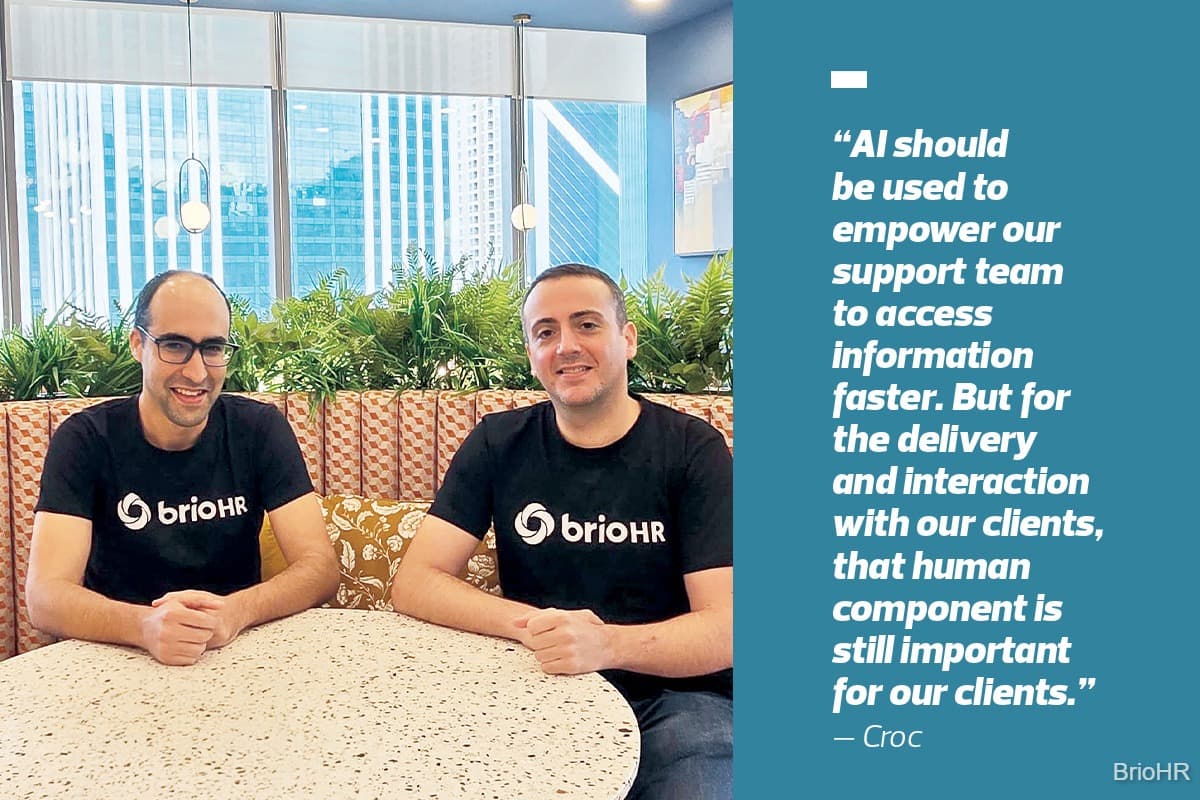
“AI should be used to empower our support team to access information faster. But for the delivery and interaction with our clients, that human component is still important for our clients,” he says.
Instead, Croc sees the biggest risk with AI being falling behind in adoption and integration — becoming a company that does not know or cannot use AI while competing with those using and leveraging AI.
As AI technology evolves, Croc sees HR platforms shifting from being a collection of organisational data to becoming more of an insight engine.
By insight engine, he means AI will be able to sift through employee data and proactively provide relevant insights into company management and HR professionals, such as recommended actions for employees based on their performance. BrioHR is already preparing for this possible shift.
Setting up in Malaysia
Although BrioHR is a Malaysian start-up, its founders, Croc and Nabil, are French. Their decision to leave their home country and establish a business here was driven by Malaysia’s strategic location at the heart of the Southeast Asian market, as well as Croc’s affection for the country.
“We have been in Malaysia for the past 14 years ... Soon, I’ll be more Malaysian than French!” jokes Croc.
“Malaysia is extremely unique in terms of building a regional and even global powerhouse. If you consider Malaysia, and the availability of talent who are very well educated, can speak many languages, are well trained, young and motivated to grow — that’s one important component.”
The second major component, according to him, is the country’s infrastructure. This is in terms of both macro infrastructure like airports and highways, as well as smaller infrastructure like the internet, which he says puts Malaysia ahead of other countries in the region and beyond.
Explaining how he ended up in Malaysia, Croc, who has a passion for badminton, says he came here for several tournaments and fell in love with the country, leading him to seek work opportunities here as soon as he completed his studies.
He describes Malaysia as a nation with all the right ingredients to build a successful company and expand not only in the region but also beyond.
Since its establishment seven years ago, BrioHR now serves more than 600 companies in various industries, from manufacturing to e-commerce. While headquartered in Kuala Lumpur, BrioHR’s other main markets are in Singapore and Thailand. It hopes to be the leading HR operating system in Southeast Asia in the next five years.
Save by subscribing to us for your print and/or digital copy.
P/S: The Edge is also available on Apple's App Store and Android's Google Play.