

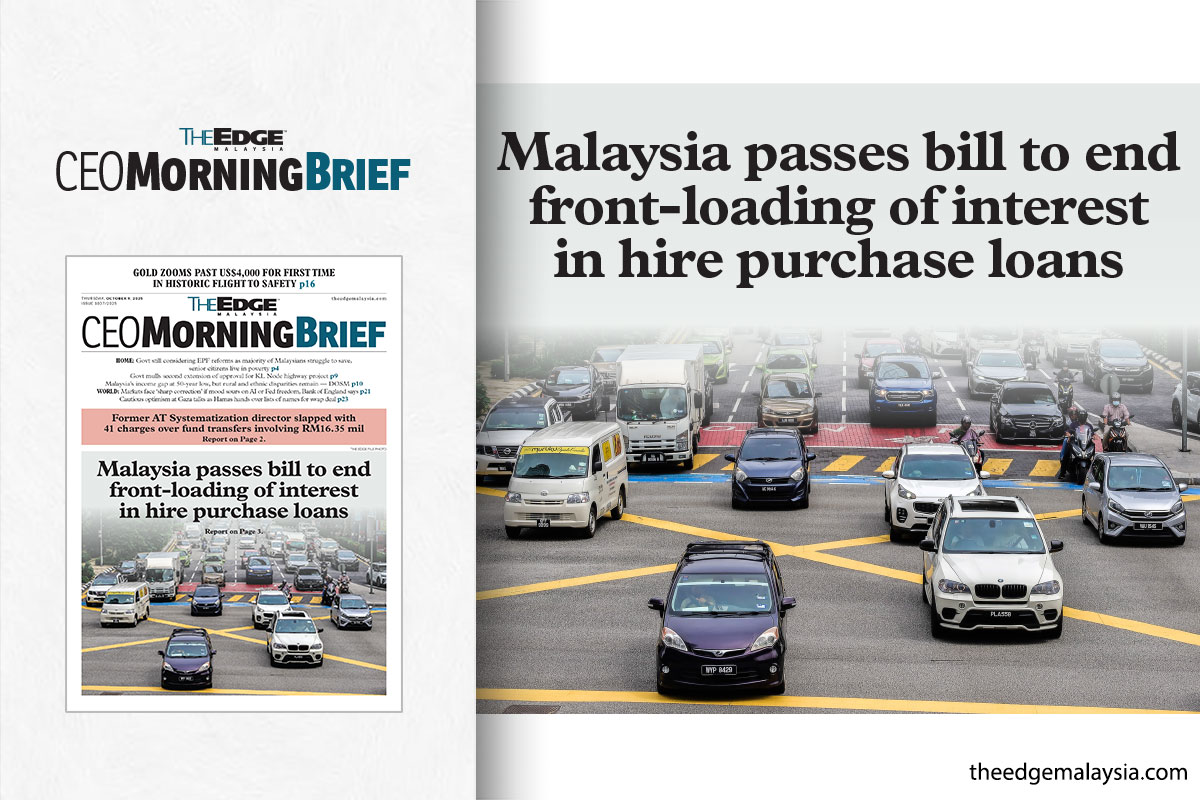
KUALA LUMPUR (Oct 8): The Dewan Rakyat on Wednesday approved the Hire Purchase (Amendment) Bill 2025, which abolishes the use of the flat rate and the Rule of 78 for fixed-rate hire-purchase loans.
The Rule of 78 calculates a loan’s total interest based on the original principal amount, which means borrowers do not enjoy any interest savings even if they settle their loans earlier than scheduled.
Under the amendment bill, the effective interest rate (EIR) and reducing balance method will replace the Rule of 78 to ensure greater transparency in loan calculations.
The EIR represents the actual financing cost of a hire-purchase agreement. For fixed-term agreements, it reflects the true cost of financing, while for variable-term agreements, it is calculated using a reference rate as a benchmark.
The bill also revises the ceiling for EIRs on fixed-rate hire-purchase loans and requires lenders to disclose the EIR to consumers during marketing and before signing any agreement.

Under the revised structure, fixed-rate loans with a tenure of up to five years will be capped at 17% per annum, while those exceeding five years will be capped at 16% per annum. The rate for variable loans remains unchanged at 17% per annum.
A hire-purchase agreement is a contract between an asset owner, typically a bank, and a hirer who intends to purchase goods. Payments are made in instalments, and ownership is transferred to the hirer only after all instalments are fully settled.
Currently, the Hire Purchase Act 1967 (Act 212) covers all consumer goods purchased for personal, family or household use, including motor vehicles such as cars, motorcycles, taxis, hire cars, buses, and light goods vehicles with a maximum permitted load not exceeding 2,540kg.
Minister of Domestic Trade and Cost of Living Datuk Armizan Mohd Ali said the proposed changes aim to make the act more comprehensive, relevant and aligned with the evolving financial landscape, while enhancing transparency and consumer protection.
He added that the amendment also complements the Consumer Credit Act 2025, which was passed by both the upper and lower houses earlier this year.
“The proposed amendments do not stand alone but are part of the government’s broader reform strategy to improve Malaysia’s consumer credit ecosystem and services,” Armizan said when tabling the bill for second reading in the Dewan Rakyat.
“The main goal is to create a fairer and more transparent consumer credit environment, thereby strengthening protection for all credit users in the country.”
In addition to removing the flat rate and the Rule of 78, the bill also proposes allowing the use of digital technology in hire-purchase agreements and updating references to the base lending rate to align with Bank Negara Malaysia’s updated Reference Rate Framework.
Hire-purchase providers will be given a grace period of 18 months from the date of gazette notification to upgrade their systems before offering financing under the new reducing balance method.
The bill was passed by voice vote, after 20 members of Parliament took part in the debate.
MPs urge for shorter grace period
While most lawmakers voiced support for the amendment bill, several urged the ministry to shorten the 18-month transition period and expedite its implementation.
Kota Melaka MP Khoo Poay Tiong proposed that the grace period be reduced to between six and 12 months, arguing that financial institutions already have established computer systems for housing loans that use the reducing balance method.
“This is a simple technical adjustment. There’s no need to take 18 months — shortening the period would allow existing borrowers to benefit from the amendments sooner,” he said.
Bayan Baru MP Sim Tze Tzin, meanwhile, asked whether financial institutions would still be allowed to apply the Rule of 78 during the transition period. He also sought clarification on how consumers would be informed about the calculation method used in the financing products offered to them during that time.
In response, Armizan said the 18-month grace period was agreed upon after engagement sessions with stakeholders.
“We take note of the suggestions and will give them due consideration. Discussions will be held with stakeholders, Bank Negara Malaysia and the Ministry of Finance to explore the possibility of bringing forward the rollout date,” he said.