

This article first appeared in The Edge Malaysia Weekly on September 29, 2025 - October 5, 2025
When companies first began publishing sustainability reports, Mak Yuen Teen, professor of accounting at the National University of Singapore Business School and founding director of Centre for Investor Protection, was sceptical about their impact.
“The first time I came across sustainability reports, I thought they were just marketing and public relations documents, and companies just reported based on whatever frameworks they chose.At the end of the day, if you want to manage your sustainability-related risks and opportunities well, you need to report on the right things and start [with] identifying what is most material to you,” says Mak, who is known for his work on corporate governance in the region.
This led to him collaborating with Tina Thomas, head of ESG and sustainability at Baker Tilly, to investigate how public listed companies (PLCs) choose the material topics to disclose in their sustainability reports, and how they prioritise these topics.
The team combed through the financial year 2022 and 2023 sustainability reports of 300 PLCs on the Australian Securities Exchange (ASX), Bursa Malaysia (Bursa) and Singapore Exchange (SGX), to assess how these companies conduct materiality assessments and disclose such information.
The results were published in the report Climate first… or last in August. The title reflects the key finding: environmental and social topics were commonly mentioned in the reports but rarely ranked as the most important, while governance and economic issues were prioritised.
Based on the results, Mak and Tina are concerned that the current approach to identifying sustainability-related material impacts, risks and opportunity could mean businesses are not ready to address long-term risks from climate change.
“In our report, we are not saying that climate issues are last. We’re saying that companies seem to be talking a lot about it but not really prioritising it when they look at the relative importance [of material topics] — but maybe they should,” says Mak.

“Maybe it’s a blind spot because [the impacts] are too far into the future, and they have to worry about things that are going to impact them in the immediate future first. This raises the question of whether they are sufficiently prioritising the environment.”
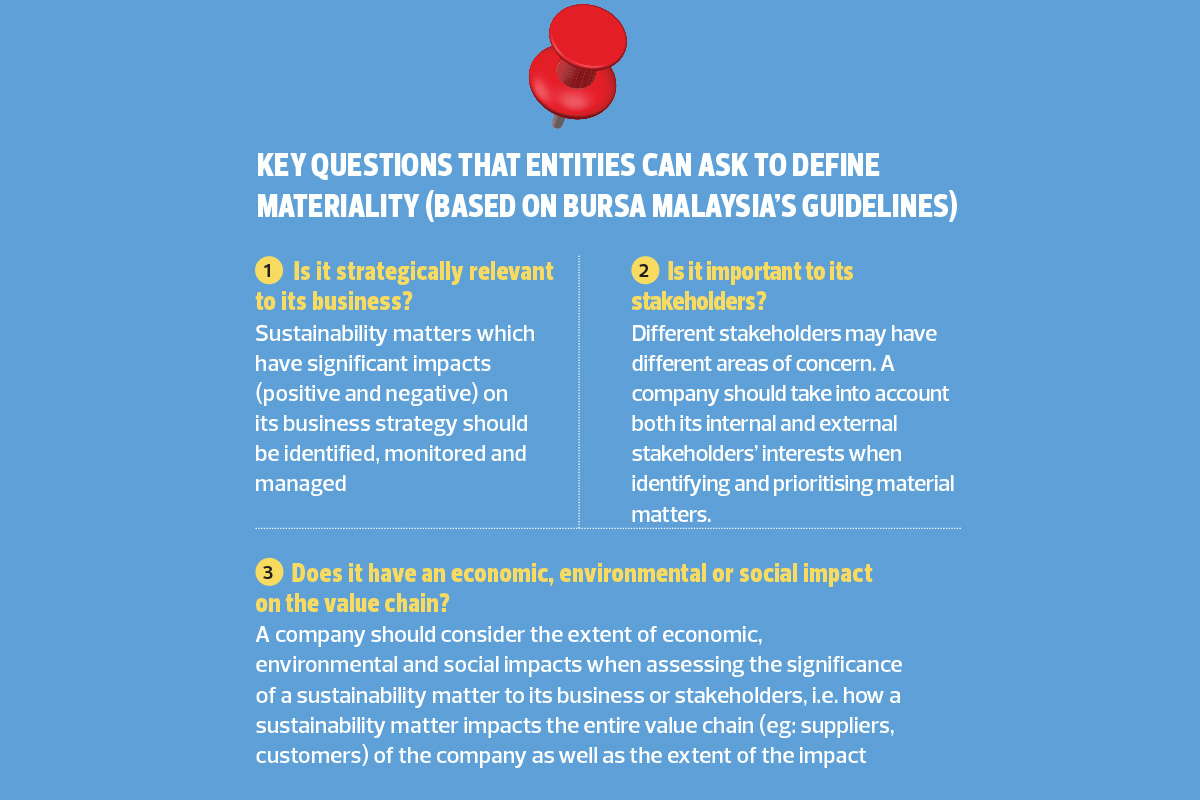
Companies undergo a materiality assessment to identify and prioritise the sustainability topics that have potential economic, environmental and social impacts caused by or impacting them. This is done by surveying their internal and external stakeholders.
On this point, Mak hopes that boards of directors will be more engaged in this process, so they can spot any misalignment in priorities.
“Sometimes, companies choose what is material based on what is easy for them to set targets to achieve, rather than what is truly important. You should be choosing those that are truly going to impact your business,” he says.
Should environmental and social topics be prioritised?
Through their research, Mak and Tina found that Bursa-listed companies have the clearest presentation of their materiality assessments via a matrix that shows the relative importance of each topic. ASX-listed companies, meanwhile, are most likely to survey internal and external stakeholders, especially non-governmental organisations.
Human capital and labour management, alongside workplace health and safety, are the two most frequently disclosed material sustainability-related risks and opportunities (SROs) among Bursa and SGX-listed companies.
ASX-listed companies, meanwhile, have community relations, followed by climate change and emissions, as the most important SRO topics. These reflect the different environments in which businesses in the three countries operate.
Overall, social and environmental factors were ranked third and fourth respectively for each market in relative importance, behind governance, which is ranked as most important, followed by economic factors.
The data was collected before the International Sustainability Standards Board’s (ISSB) standards — which have a “climate first” approach — were adopted by many countries, including Malaysia, so the results might change going forward.
Concerns over ISSB’s financial materiality focus
Regardless, Mak believes that companies should seriously consider the context of their business and sectors to identify material topics, instead of just following what their peers report on or what the standards suggest.
“If you key in a sector on the SASB Standards (Sustainability Accounting Standards Board) website, it will show you what the most important disclosure topics are … But it’s geographic agnostic because they assume it applies equally to everybody,” says Mak, who brings up glove manufacturers in Malaysia as an example.
“You would totally report on the wrong thing because they (SASB, in its suggestions for the health and medical equipment sector) don’t talk about human rights. This is the danger when you just reference the standards [without considering the context].”
Additionally, regulators could consider mandating the reporting of certain material topics, especially those related to the environment.
“If you leave it to the companies, many of them may say, it’s not my problem. Then you’ll have a free rider issue. They might say, I’m not going to be the CEO by 2030, so why should I care? I think that might also be why many companies are underplaying the environment factor,” says Mak.
An example is Bursa’s mandate for PLCs to report on 11 common material sustainability matters, which include anti-corruption, community or society, diversity and inclusion, energy management, water, waste and emissions management.

Another concern that Mak and Tina have as ISSB is being adopted is that the standard emphasises financial materiality — topics that will financially impact the company — and not the impact of a company’s activity on the environment.
This could result in a narrow view of sustainability matters, and involve less stakeholder engagement.
“While this focus meets investor expectations and regulatory requirements, it may not capture higher-order impact materiality issues that have profound implications for society and the environment but may not present near-term financial risks,” they write in the report.
In contrast, the European Financial Reporting Advisory Group’s Implementation Guidance 1 Materiality Assessment demands double materiality, which requires companies to assess their potential impact on the people and environment, and also how the identified topics could affect their financial performance. The GRI Standards, meanwhile, focuses on impact materiality, which is an entity’s impact on the economy, environment and people.
Although companies are not required to do double materiality under the ISSB, Mak believes they should still consider it because a company’s actions will impact external stakeholders, and if they are not addressed, they will affect the company in the long run.
“Even if you keep emitting carbon and mistreat your employees, at some point it is going to come back and hit you,” says Mak.
Tina suggests that companies continue reporting using the GRI Standards, even as they adopt the ISSB standards.
“Just imagine if you stop recording everything you’ve done before and then you start off with a new set. It doesn’t really have continuity.”

Save by subscribing to us for your print and/or digital copy.
P/S: The Edge is also available on Apple's App Store and Android's Google Play.