

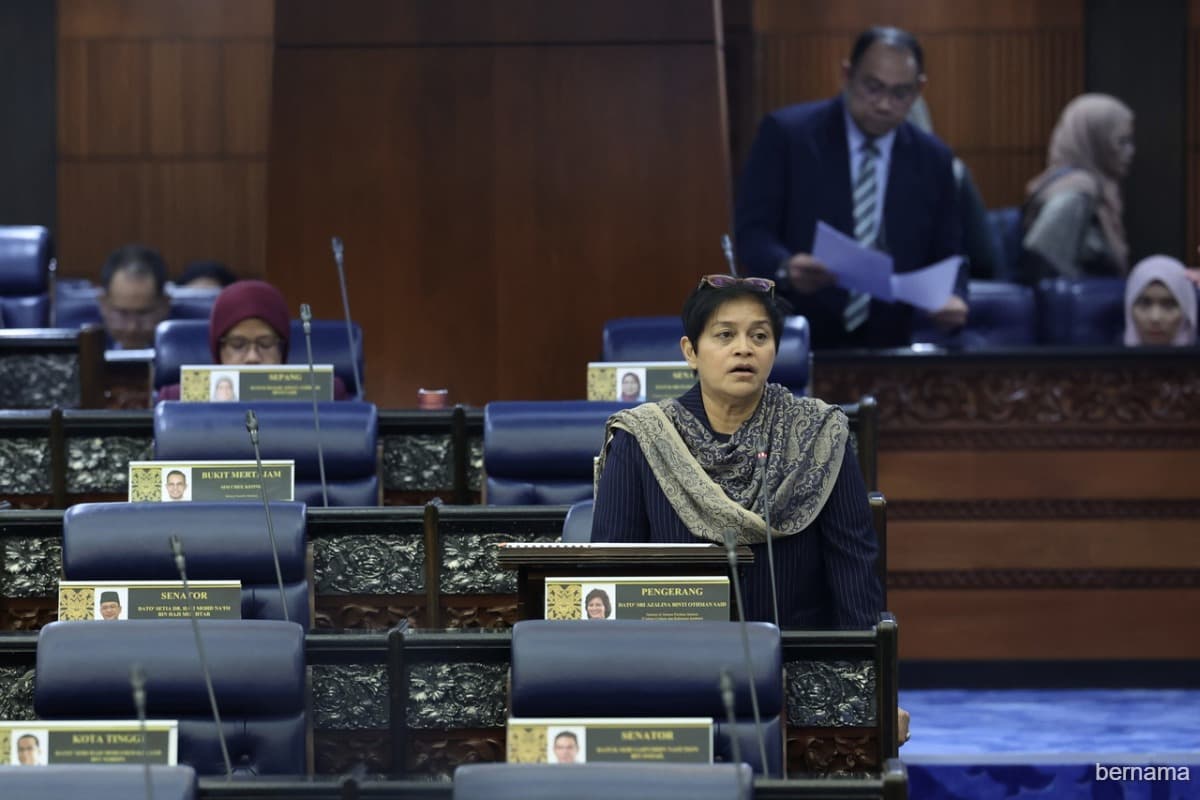
KUALA LUMPUR (Oct 6): Malaysia’s Cabinet will determine whether the attorney general (AG) should continue to hold a government position after the upcoming separation of powers.
The status of the AG in the Cabinet post-separation will “depend on the policy decision made by Cabinet ministers”, according to Minister in the Prime Minister’s Department (Law and Institutional Reform) Datuk Seri Azalina Othman Said.
Azalina drew parallels with the role of legal advisers at the state level, who advise the state government and may occasionally attend executive council meetings upon invitation.
For now, the AG is still considered to hold a government position, serving as the principal legal adviser to the government while at the same time holding the power of the public prosecutor. The AG is also currently not directly answerable to Parliament or any minister.
Azalina was responding to questions in the Dewan Rakyat on Monday on Malaysia’s plan to separate the roles of the Attorney General’s Chambers and the Public Prosecutor’s Office, as announced in early September.
Current opposition chief whip Datuk Seri Takiyuddin Hassan (Perikatan Nasional-Kota Bharu) had asked whether the AG would remain part of the administration and attend Cabinet or parliamentary sittings after the separation.
Any participation in the legislative proceedings would require the AG to be a member of Parliament or as a senator, Azalina said.
“Currently, when Parliament seeks answers related to the AG’s functions, it is the minister who responds on behalf of the government,” Azalina explained. “But that is not the minister’s personal decision.”
Constitutional amendments
Azalina noted that the separation would require constitutional amendments as the country’s highest law currently only recognises a single office, the AG, while the move would create two distinct and equal positions under the Federal Constitution.
To implement this, the government plans to table constitutional amendments and an omnibus bill — the Law Reform (Public Prosecutor) Bill — to amend the Criminal Procedure Code and 18 other related laws.
A new law will also be introduced to regulate the remuneration of both the AG and the public prosecutor, akin to the Judges’ Remuneration Act 1971, to ensure parity and independence between the two new offices.
“The Federal Constitution (Amendment) Bill related to this separation is targeted to be tabled next year,” Azalina told the House.
The separation is one of Pakatan Harapan’s key reform pledges, featured in both its 2018 and 2022 election manifestos. Other upcoming legislative reforms promised by the government include the Ombudsman Bill and the Freedom of Information Bill, which may be tabled by year end.
In response to a separate question from Datuk Mohd Isam Mohd Isa (Barisan Nasional-Tampin) regarding public concerns about political interference in prosecutions, Azalina said financial autonomy and an independent appointment process are central to ensuring prosecutorial independence.
“Once the separation takes place, the most crucial elements will be financial control, remuneration, ranking, and the assurance that appointments and dismissals are carried out independently,” she said.
Many hats
Deputy public prosecutors currently assume various roles as magistrates, legal advisers, or prosecutors, which may create perceptions of bias, and the concerns could be mitigated by a fully independent prosecutorial service, she said.
Azalina added that under the proposed system, the Public Prosecutor’s Office would have its own career structure and operational system, separate from the judicial and legal services, to safeguard neutrality and public confidence.
For more Parliament stories, click here.