

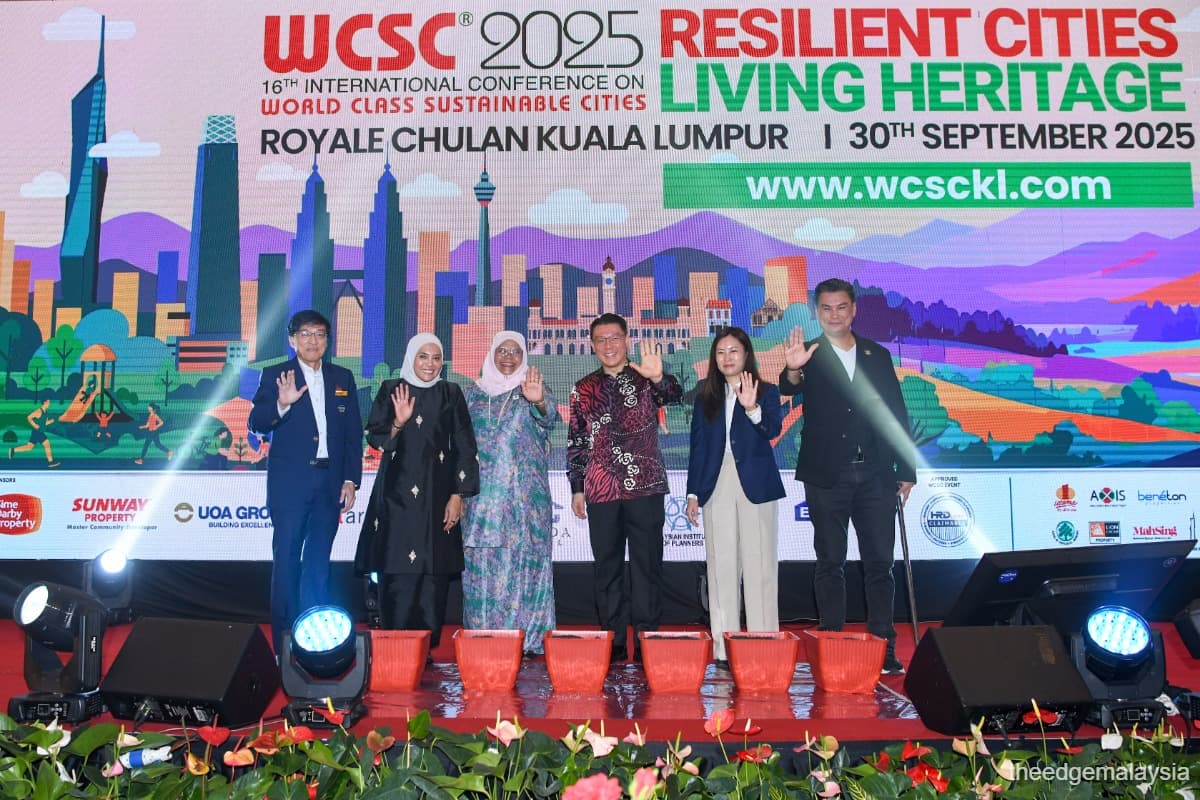
KUALA LUMPUR (Sept 30): The government has identified seven heritage sites in Kuala Lumpur for rejuvenation and restoration projects worth RM700 million.
At the 16th International Conference on World Class Sustainable Cities (WCSC) 2025 held at Royale Chulan Kuala Lumpur on Tuesday, Housing and Local Government Minister Nga Kor Ming told the press that the seven heritage sites include the Carcosa Seri Negara, Sultan Abdul Samad Building, National Textiles Museum, Merdeka Square and Old Post Office Kuala Lumpur.
He added that the Sultan Abdul Samad Building will be repurposed into a retail space for Malaysian brands.
In his welcome address, Nga also highlighted the need to integrate diversity and climate resilience into urban planning to create stronger, more sustainable cities.
“Resilience is not just about strong infrastructure in city planning. A truly resilient city is one that can withstand the pressures of climate change and rapid growth while holding on to its cultural roots and living history. High-quality development is not merely a technical exercise. It should carry within it a soul … one that reflects the spirit of its people. In Malaysia, cultural diversity is our strength, and all city planning must reflect the element of harmony and unity in diversity with the focus to build not only liveable cities but loveable cities,” said Nga.
WCSC 2025 chairwoman Victoria Chua, in her opening remarks, said: “The cities of tomorrow need to adopt effective urban planning by integrating sustainable development goals and community engagement into every facet of urban planning in order to accommodate urban growth, safeguard the environment, preserve cultural and natural heritage and enhance city resilience.”
Meanwhile, Kuala Lumpur mayor Datuk Seri Maimunah Mohd Sharif, in her keynote presentation, shared about creating resilient cities under the Kuala Lumpur Structure Plan 2040 and the Kuala Lumpur Local Plan 2040.
“As a real estate developer and professional of the built environment will tell you, the best investments are made when you are assured of consistent and long-term returns. For those communities living in places impacted by development, they want developers to understand and adopt returns that are not only monetary but also sustainable. This is why the Local Plan 2040 of Kuala Lumpur commits us to stronger zoning, inclusive housing and 70% of trips to be made by public transport,” said Maimunah.
With the theme “Resilient Cities, Living Heritage”, the full-day WCSC featured three sessions and a total of 25 international and local speakers, panellists and moderators. These speakers presented ideas on proactive actions that can be taken, as the cities of tomorrow need to adopt effective urban planning by integrating the United Nations Sustainable Development Goals.
Endorsed and supported by Kuala Lumpur City Hall (DBKL), the conference was jointly organised by the Real Estate and Housing Developers’ Association (Rehda) Wilayah Persekutuan Kuala Lumpur, Malaysian Institute of Architects (PAM) and Malaysian Institute of Planners (MIP). The conference had more than 800 participants consisting of policymakers, members of the local government, industry experts and academics.