

This article first appeared in The Edge Malaysia Weekly on September 29, 2025 - October 5, 2025
It can be difficult to eliminate single-use plastics from daily life. Even with the ban on these packaging items, they are still commonly offered by merchants in Malaysia. Many of these plastic bags are, however, now labelled as “compostable” or “biodegradable”.
Nevertheless, not all of these are actually good for the environment. Oxo-degradable and photo-degradable plastics, for instance, just degrade into microplastics. According to a 2016 European Commission report, this kind of plastic is not suitable for composting, does not biodegrade easily and could negatively impact the quality of recycled plastics.
Not all biodegradable plastics, meanwhile, use fully natural ingredients. There are biodegradable plastics made from fossil fuels.
Mohamad Faizal Zainol, CEO of Maribumi Starchtech Sdn Bhd, delved into these topics when he was invited to join the company, which produces compostable plastic packaging products, as an adviser in 2017. Despite his background being in architecture, he researched the science behind compostable plastics and surveyed the range of products in the market.
He concluded that biodegradable plastics should not be the goal of the transition away from single-use plastic.
“That product is only good for the transition period from [conventional] plastics to compostable plastics because biodegradable or photo-degradable plastics use a mixture of natural resources and additives from chemicals … When [the product] breaks down, it is not 100% composted and there are still microplastics,” explains Mohamad Faizal.
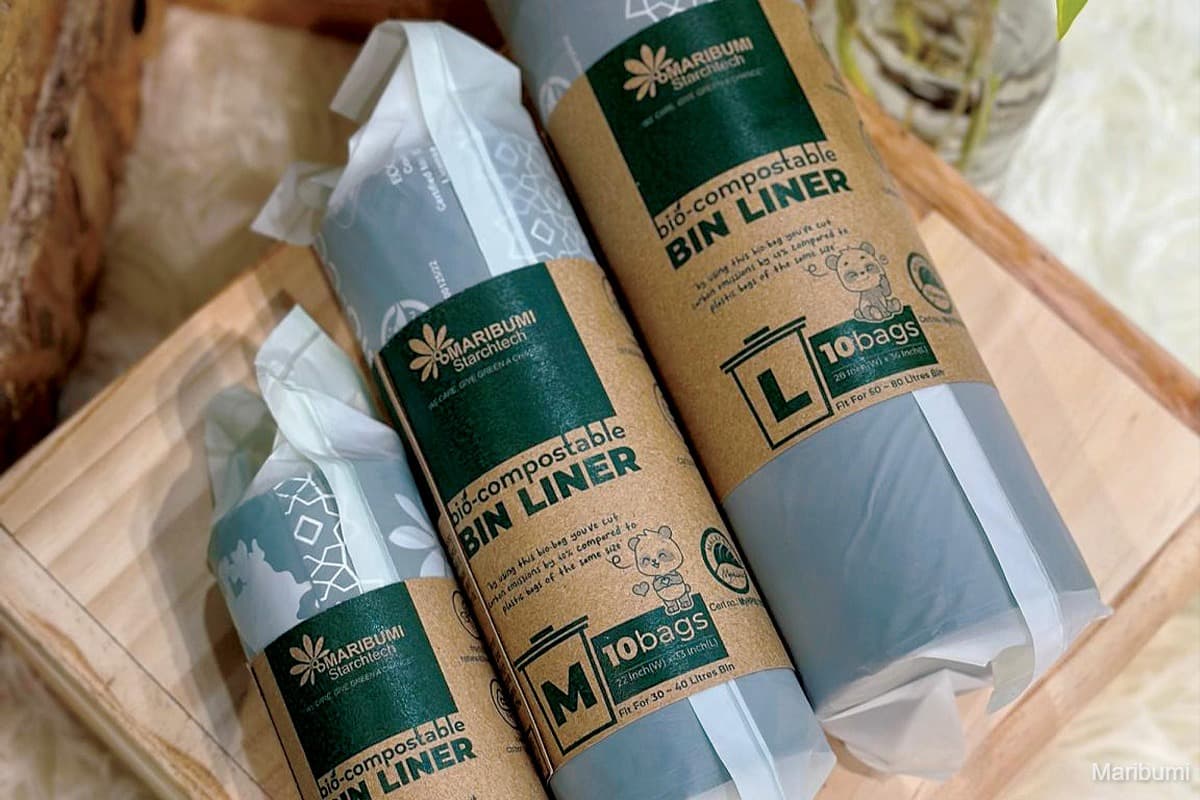
This is why Maribumi opted to focus on producing compostable plastics from natural sources, which must be certified to be 100% compostable.

“We looked at the latest resins in the market that have all the right certifications. For the bio-plastics industry, we need a lot of certifications to ensure the product is 100% compostable. It’s not just for the customers but also for us. We don’t want to do greenwashing,” he says.
In 2020, Maribumi managed to obtain a resin made of polylactic acid (PLA), cornstarch and non-toxic binders. The PLA is produced by culturing bacteria in a bioreactor to ferment the cornstarch into lactic acid, which is then made into PLA. The binders are derived from natural sources like glycerine, says Mohamad Faizal.
This raw material is certified under the Australia Standard AS4736, the US’ ASTM D6400:2012-01 and Europe’s EN 13432:2000, as well as the ISO 1708:2012.
From the resin, Maribumi manufactures garbage bags, shopping bags and other products, including protective aprons used by some doctors during the Covid-19 pandemic, he adds. These processes are done in Maribumi’s factory in Malaysia.
The finished products are certified under SIRIM ECO 001:2018 for biodegradable and compostable plastics.
According to Mohamad Faizal, the compostable plastic generally takes six months in ideal conditions to be broken down by microbes. The ideal condition is 80°C in a composting machine or around 40°C in a home compost bin.
Generally, with compostable plastics, however, there are concerns about the exact conditions required for them to completely break down into biomass, water and carbon dioxide.
This might not occur in landfills due to their anaerobic conditions and insufficiently warm temperatures. Also, few households in Malaysia have home compost bins.
Certifications for compostable plastics such as the AS4736 require the plastics to be segregated and end up in industrial composting facilities or controlled environments.
These are not available in Malaysia — or at least, there is little information on how to do so. If they are not in a home compost bin, the plastics will end up in landfills, which may not have the right conditions to support the breakdown of compostable plastics in the ideal time frame.

When asked, Mohamad Faizal says Maribumi’s products can biodegrade in home compost bins. The company encourages customers to put food waste into its compostable plastic bags and place them in a home compost bin or machine, which will accelerate the breakdown process.
New materials and use cases
Promoting compostable plastic bags in Malaysia has not been easy. The take-up is slow, observes Mohamad Faizal, due to its higher pricing compared with conventional plastics derived from fossil fuel. There is also confusion in the market between biodegradable, oxo-degradable and photo-degradable plastics and compostable plastics.
“Our competition also comes from recycled plastic. Plastic can be recycled up to seven times, so there is a lot of recycled plastic and the price is much cheaper. It is often used for garbage and planter bags,” he says.
This is where he hopes to see more support from the government in giving clarity and raising awareness about the different products on the market, and helping consumers identify which are truly good for the environment.
Meanwhile, a low-hanging fruit is having solid waste management and landscaping authorities use these compostable bags. In the case of the latter, dried leaves are ideal for composting. They can also be used as planter bags. Maribumi is currently undertaking trials with an oil palm plantation company to test this.
“Our bags can biodegrade, so when they transport the plants from the nursery, they don’t need to take off the planter bags. When you tear [the bags] off, the tree will be affected because sometimes the root breaks,” says Mohamad Faizal.
“The replanting rate is around 1.5 million to two million trees a year, so you could have up to two million planter bags in one big plantation. We’re in the research and development (R&D) phase now.”
Maribumi is also conducting R&D into creating its own PLA for the resin from oil palm trunks that is certified as 100% compostable.
“We press the trunk, get the sap from it, and then culture [the sap] with bacteria … We’re still studying the composition,” he says.

Save by subscribing to us for your print and/or digital copy.
P/S: The Edge is also available on Apple's App Store and Android's Google Play.