

This article first appeared in The Edge Malaysia Weekly on September 29, 2025 - October 5, 2025
NEWS that all 16.4 million Malaysians with valid driver’s licences will receive a generous 300-litre monthly quota of subsidised RON95 fuel was welcomed by consumers, though predictably criticised by some quarters — as no plan is foolproof.
Concerns that the rich may still benefit more than the poor — and that actual savings may fall short of the RM8 billion cited by Prime Minister Datuk Seri Anwar Ibrahim due to the exclusion of the “T15” (top 15% of households) — have merit and should be revisited as implementation improves in the coming months.
Yet, some of these arguments also rely on extrapolated data drawn from statistical averages by the Department of Statistics Malaysia (DoSM), which are authoritative but have limitations and may not tell the whole story.
Here is why The Edge thinks Putrajaya did well by starting RON95 subsidy retargeting by only cutting out foreigners.
The imperfect state of existing data and the urgency to announce a formal rationalisation plan by end-September prompted The Edge three weeks ago to predict that the government was likely to extend a quota of subsidised RON95 to all Malaysians with valid driver’s licences. With owners of luxury car brands owing RM35.7 million in unpaid road tax, however, The Edge believes that only those who have paid their road tax and cleared all traffic summonses should be eligible for subsidised RON95. (Scan the QR code to read “The State of the Nation: What Merdeka RM100 handout means in run-up to RON95 subsidy retargeting”.)

By putting in place a system that minimises disruption to end-consumers, Putrajaya can already begin enjoying savings while working on improvements to the rationalisation plan.
Asked how the government arrived at the savings range of between RM2.5 billion and RM4 billion per year from the RON95 subsidy retargeting, Finance Minister II Datuk Seri Amir Hamzah Azizan would only say it was “an estimate of the potential range of savings” based on government data, historical usage ratio and expectation of what global oil prices would be.
He explained that at least 22% of all RON95 sold goes to those not eligible for subsidies. Multiplying that by the annual 18 billion litres of RON95 sales highlights the scale of potential savings, which will vary depending on whether oil prices remain around today’s level (roughly US$69 per barrel), rise to US$100 per barrel or drop to US$60 per barrel, since subsidies are linked to the actual oil price. He also noted that the government sometimes still ends up absorbing some of the cost difference when determining the weekly market price for diesel if full price increases cannot be implemented.
“Government data is not perfect; I wish it was. I wish I knew exactly how much you drive and how much you consume so that I can calculate [needs and savings] to that degree. But the broad range of DoSM data is not a bad proxy; it is within the right ballpark. So, that is why we used that as an anchor,” Amir Hamzah tells The Edge when asked why the government decided on the generous RON95 quota of 300 litres per month, when 90% of Malaysians use only up to 140 litres per month.
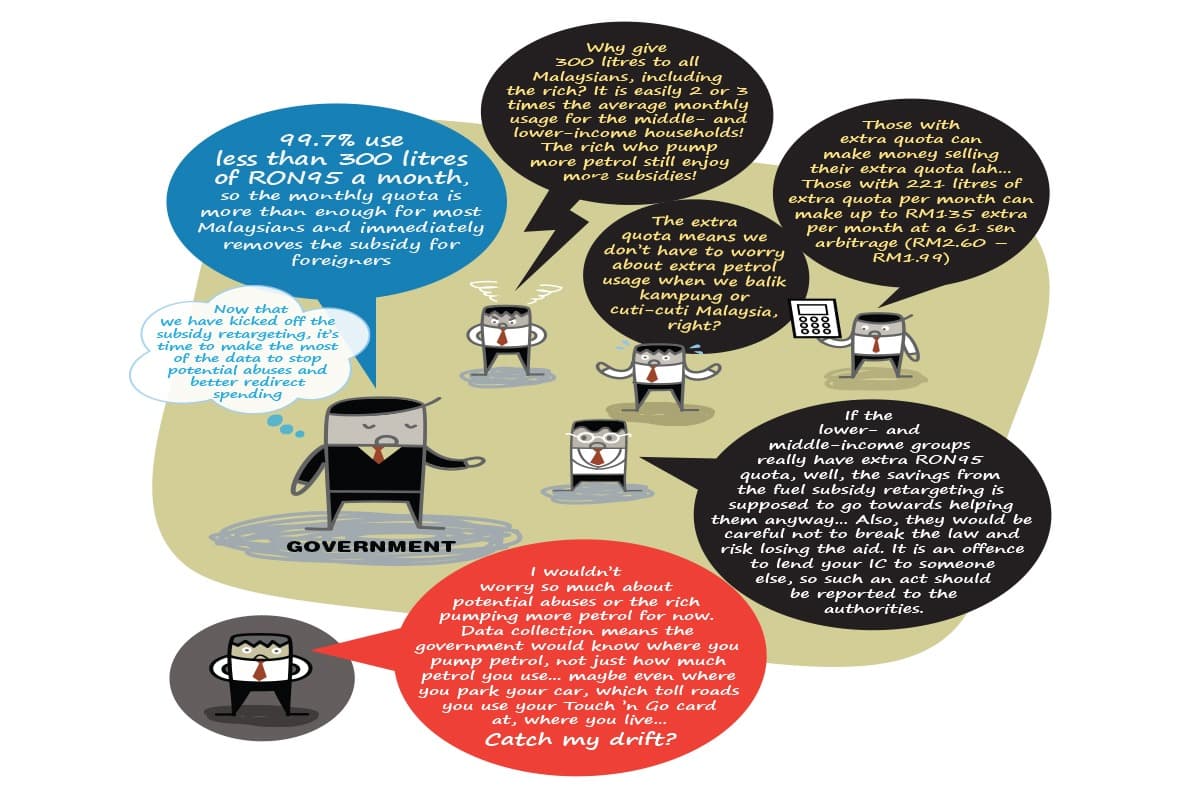
At a media briefing on Sept 23, Amir Hamzah admitted the government considered capping the fuel quota at the 90th or even 95th percentile (180 litres per month) but opted to start at the 99th percentile (300 litres) because it is “comfortable” with savings of at least RM2.5 billion, affecting only 0.7% of users who consume more than 300 litres monthly.
“Is RM2.5 billion small money or big money? To me, at this point of time, every single dollar saved is worth it because it is money that we can use for other needs. We either reduce the [budget] deficit that we have or we invest that in things that are necessary for the rakyat. So, if I can get RM2.5 billion to RM4 billion, I’m very happy compared to not getting anything at all,” Amir Hamzah said, in response to criticism about the lack of fiscal savings.
“The hypothetical positions are always hypothetical in terms of what we want to do. The earnest approach by the government is to manage in the current circumstances; we are comfortable with the savings we will get today and we’ve [taken] away subsidies from the groups that will never get it back again.”
But there could well be positive surprises in the months ahead.
He explained that the full impact of diesel subsidies was unclear until the price “went to market”. He acknowledged that “even today, there is still cross-border movement of diesel because arbitrage exists between Malaysian and Thai diesel prices”, as Thailand is where most of the diesel is going to. On Sept 22, diesel retailed at RM4.21 and RON95 at RM5.68 in Thailand — significantly higher than the RM2.93 for diesel and RM2.05 for RON95 in Malaysia.
Amir Hamzah noted that, at the very least, subsidised diesel is no longer smuggled across Malaysian borders and the government hopes to achieve similar control with RON95. Reflecting on savings, he said that “when we talked about diesel last year, we estimated savings of RM4 billion” but, now, those savings have grown to nearly RM6 billion to RM7 billion, with some fluctuations and welcome surprises along the way.
According to Ministry of Finance data, the government spent RM18.4 billion subsidising 18.1 billion litres of RON95 in 2024 — slightly lower than the RM19.8 billion spent on subsidising 17.6 billion litres in 2023. This translates into an average subsidy of RM1.13 per litre in 2023 and RM1.02 in 2024, with RON95 retailing at RM2.05 per litre.
By comparison, average subsidies peaked at RM2.05 per litre in 2022, based on The Edge estimates using the official subsidy figure of RM23.1 billion that year. In 2019, the government spent just RM2.9 billion to subsidise 15.9 billion litres — highlighting the potential for sizeable savings through retargeting (see chart on Page 10).

Possibilities from data analytics
While Amir Hamzah declined to confirm whether Putrajaya would maintain the RON95 retail price at RM1.99 per litre if global oil prices climbed back to US$100 per barrel, there is still room to adjust subsidy levels if needed. Additional areas of savings could also be identified once data collection under the RON95 subsidy rationalisation begins.
“The reality is that, today, our ability to analyse is much better than it used to be,” he said, noting that access to data and trend analysis allows the government to flag anomalies and intervene where necessary.
As an example, he pointed to the flexibility granted to e-hailing drivers to apply for a higher fuel quota. “We can go back and check whether their commissions align with full-time work. If not, we ask: Why are you getting more quota?” he said.
He added that while the verification process requires more effort, much can now be done through server-side data analytics without deploying enforcement officers. “Just data screening itself allows us to detect irregularities. Do we catch 100%? Probably not. But do we deter enough to underpin our savings? I think we do,” he said, when asked about potential leakages from the 300-litre monthly quota, which does not roll over to the following month.
Do the poor really benefit less?
It is probably no coincidence that the Budi95 subsidy backend digital database is managed by TNG Digital Sdn Bhd. That means the system that administers RON95 subsidies can — if it does not already — track not only how much and where you refuel, but also your Touch ’n Go e wallet activity such as toll and parking payments. In theory, that makes it straightforward to remove subsidies from users who abuse the system.
Moreover, data from RON95 users with high monthly consumption may be of particular interest to the Inland Revenue Board, which could cross-reference their spending patterns with income tax filings — especially in the case of luxury car owners.
What about those in the low-income group who try to profit by selling their fuel subsidy quota? Under the National Registration Act 1959 and the National Registration Regulations 1990, it is illegal to possess or use someone else’s identity card (IC). This means any “seller” would have to be physically present at the pump to offer their excess RON95 quota — making such abuse both logistically difficult and legally risky.
While there is no limit on the number of daily fuel transactions, individuals without a vehicle can purchase only up to 20 litres of fuel — including in emergencies — unless they hold a special permit from the Ministry of Domestic Trade and Costs of Living.
The government also emphasises that, under the Personal Data Protection Act (PDPA), payment apps such as Touch ’n Go may access only the personal information that users explicitly consent to share. With comprehensive data already maintained on car ownership, this poses little concern for those who comply with tax obligations and operate within the law.
Economists expect minimal impact on inflation, particularly since Malaysians already benefit from lower pump prices, and approved businesses can apply for concession rates at the current RON95 price of RM2.05 per litre.
The perception that the wealthy gain more than the poor likely arises from fuel usage data based on household expenditure. Specifically, DoSM figures show the top 20% of households (T20) spend an average of RM541 monthly on fuel — substantially more than the RM289 spent by the middle 40% (M40) and RM161 by the bottom 40% (B40).
At the RON95 price of RM2.05 per litre, this translates into roughly 264 litres for T20 households, 141 litres for M40, and 79 litres for B40 (see table on Page 10). Assuming usage patterns remain unchanged, the six sen per litre reduction under the Budi95 subsidy from Sept 30 would save the B40 roughly RM5 per month, compared to nearly RM16 for the T20.
This comparison overlooks, however, that savings from retargeting RON95 subsidies would be redirected to aid those most in need. It also ignores the fact that the rich can afford the unsubsidised RON97, often live closer to their workplace and may actually consume less RON95 than B40 households, who face longer commutes.
As such, data collection from this exercise will be essential to improve implementation. Economists at Maybank Investment Bank, led by Suhaimi Ilias, note in a Sept 24 report that “assuming all eligible Malaysians make full use of the 300 litres per month quota for the lower subsidised RON95 price of RM1.99 per litre, this would generate expenditure savings — or additional disposable income — of RM0.9 billion in 4Q2025 and RM3.5 billion in 2026”. They add that if fully spent, these savings could boost real GDP growth by 0.1 percentage points in 2025 and 0.3 percentage points in 2026, compared to their current forecasts of +4.2% and +4.1%, all other things being equal.
Whether this optimistic projection holds true remains to be seen, since current estimates suggest that 95% of Malaysians consume less than 180 litres of RON95 monthly. Nonetheless, the rollout of targeted fuel subsidies marks a positive step towards fiscal flexibility ahead of the tabling of Budget 2026 on Oct 10.

Save by subscribing to us for your print and/or digital copy.
P/S: The Edge is also available on Apple's App Store and Android's Google Play.