

This article first appeared in Forum, The Edge Malaysia Weekly on September 29, 2025 - October 5, 2025
Malaysia assumed the chair of Asean at a moment of growing global economic fragmentation and uncertainty. The global economy has been drifting into disorder, but nothing could have prepared Asia and the international trading system for the wave of protectionist measures unleashed by the US on April 2, Liberation Day.
The US’ policy of reciprocal tariffs based on trade deficits has profoundly impacted Asia. Southeast Asia, already coping with increased volumes of Chinese goods diverted from the US market due to the ongoing trade war, now faces additional economic pressure. The threat of further tariffs on imports into the US from other regions compounds these challenges.
This escalation of protectionist measures signals a deeper systemic threat: the erosion of the rules-based economic order that has long supported Asean’s prosperity and security, as well as global stability.
While few countries in Southeast Asia — or anywhere else — have the individual leverage or capacity to directly counter US actions or mount an effective multilateral response, Asean’s strength is rooted in its unity. The grouping has and continues to benefit from an established institutional framework, built upon trusted relationships and a shared understanding that the region’s economic and political security depends on sustained openness and collaborative action.
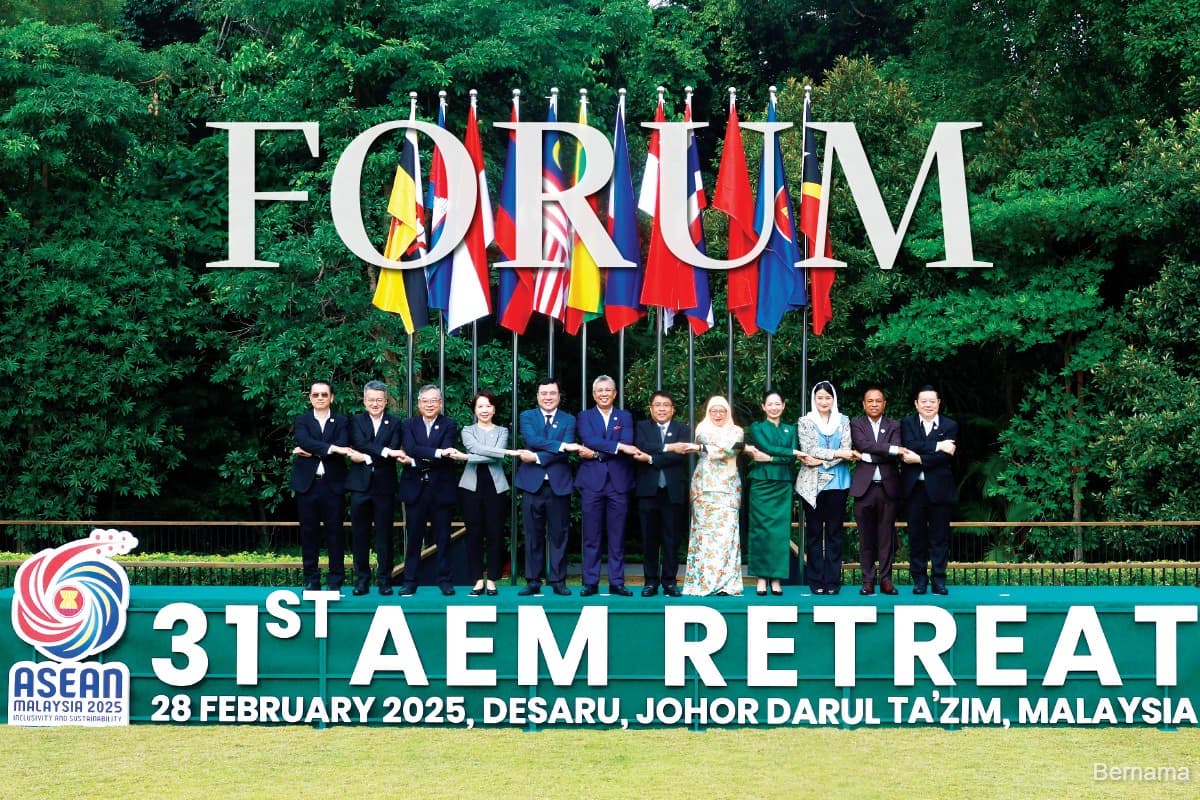
Anticipating the impact of the disruption to global trade, Asean Economic Ministers (AEM) convened in late February and agreed to avoid retaliation, reaffirm multilateralism and deepen integration and step up domestic reform to boost competitiveness. They established the Asean Geoeconomics Task Force (AGTF), comprising policymakers and think tanks, to monitor global developments and coordinate Asean’s collective response to the rapidly deteriorating external economic environment. The aim is to steer away from escalating tensions and focus on a coherent regional strategy, particularly given the increasingly negative entanglement of economic and security challenges.
Under Malaysia and Indonesia’s joint leadership of the AGTF, Asean is making significant changes in the way it works. Acknowledging the urgency for a deliberate and strategic response to the region’s mounting challenges, the task force has actively collaborated with a diverse range of stakeholders — including think tanks, security specialists and economists — to propose a unified, action-driven strategy grounded in Asean’s regional framework.
The AGTF’s focus underscores the necessity for Asean to accelerate regional integration and assume a more assertive role in shaping the rules of regional and global trade. Recognising the interconnectedness of economic and security concerns, the task force will present its recommendations for coordinated action to both the Asean economic and foreign ministers at their inaugural joint meeting scheduled for October this year.
A key recommendation from the task force is for Asean to fast-track the implementation of the Regional Comprehensive Economic Partnership (RCEP). This agreement, with Asean members at its core, brings together Australia, China, Japan, New Zealand and South Korea. It stands as the region’s strongest mechanism for maintaining openness, economic security and the resilience of supply chains.
Recent modelling conducted by the East Asian Bureau of Economic Research and the Jakarta-based Centre for Strategic and International Studies reveals substantial risks posed by Liberation Day tariffs. According to their findings, this could lead to a reduction in Southeast Asia’s gross domestic product (GDP) by 2.3%, while employment across the region could decline as much as 5.9%.
Their analysis further suggests that if countries across the world were to adopt similar tariff measures as those introduced by the US, and raise tariffs by say, 15%, the consequence for Southeast Asia would be even more severe. In such a scenario, the region could face a staggering reduction in GDP of up to 11.1% and employment levels could fall by as much as 25%. This would present a significant threat to political stability throughout the region.
On the other hand, should RCEP member economies fully implement their commitments and refrain from enacting retaliatory tariffs in response to global protectionism, Asean countries stand to benefit. Under such a scenario, projections indicate that Asean could see GDP growth of 1.9% and employment gains of 2.1%. The contrast between these scenarios — an almost 13 percentage point difference in GDP — underscores the crucial role of RCEP in maintaining regional economic stability even as global uncertainties persist.
This week, Kuala Lumpur is hosting the annual gathering of RCEP trade and economic ministers. In addition, under the leadership of Prime Minister Datuk Seri Anwar Ibrahim, the RCEP leaders are set to convene for their fifth meeting — the first such summit since the agreement entered into force.
Effective leadership at this moment is crucial for fostering stability in an increasingly unpredictable global environment. Signalling strong support for the multilateral trading system that underpins regional prosperity, and security is a top regional priority. The leaders will need to emphasise implementation of the agreement and encourage reform towards a more resilient regional economy that will increase East Asian consumption, helping to rebalance both regional and global demand. RCEP’s organisational capacity also needs to be boosted by the establishment of a full secretariat, a senior officials process and capacity to track progress.
Tan Sri Dr Rebecca Fatima Sta Maria is director of the Institute for Democracy and Economic Affairs (IDEAS) and Dr Shiro Armstrong is professor at The Australian National University
Save by subscribing to us for your print and/or digital copy.
P/S: The Edge is also available on Apple's App Store and Android's Google Play.