

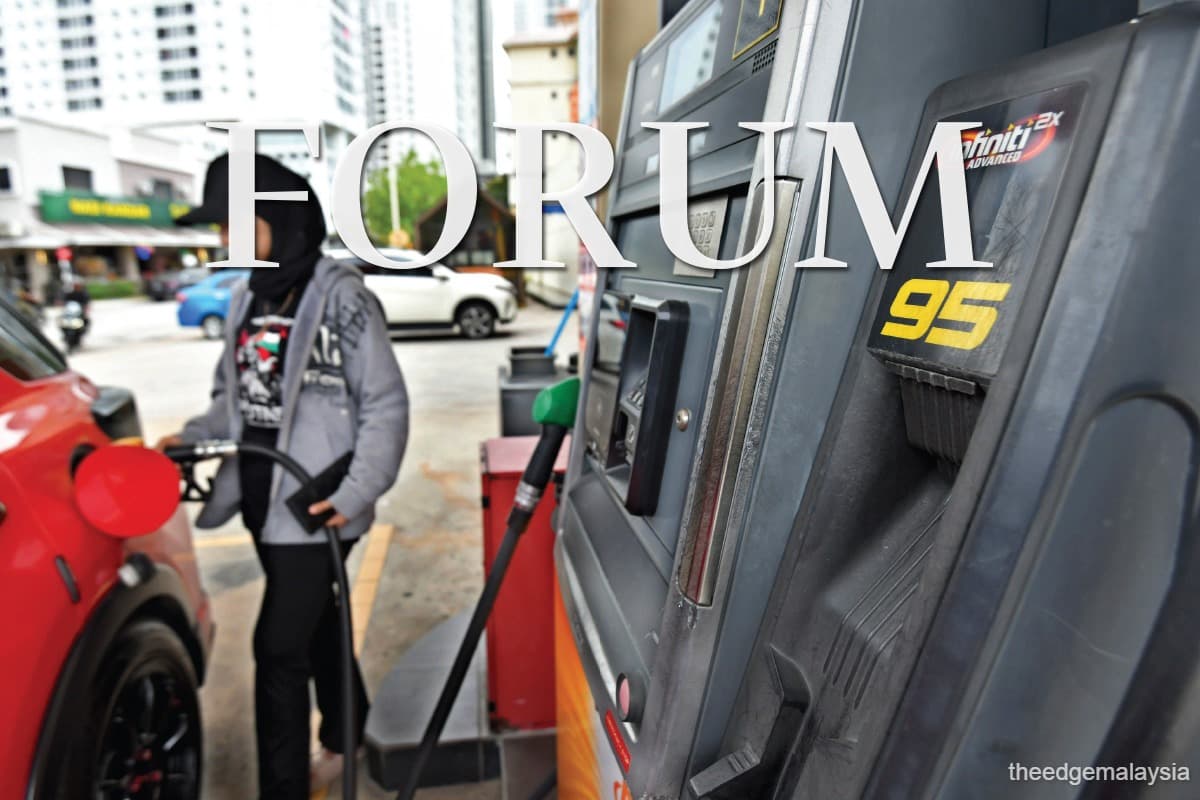
This article first appeared in Forum, The Edge Malaysia Weekly on September 29, 2025 - October 5, 2025
The simple mechanics and implementation process of the Budi95 targeted fuel subsidy system has come as a surprise.
Contrary to the earlier belief that the government would use demographic data and other information to determine the subsidy levels for various income groups, the scheme is anchored on MyKad and driving licence records with the Road Transport Department (RTD).
All Malaysians who are 16 years old and above and who have a valid driving licence are entitled to 300 litres of RON95 per month at a subsidised price of RM1.99. For those who do not qualify for the subsidy, the price will be around RM2.60, based on the prevailing global prices of Brent crude.
Foreigners, vehicles with foreign number plates and corporates are excluded from the scheme and will have to pay the full price at the pump.
Malaysians without an active driving licence are also not entitled to the 300 litres unless their records are updated at the RTD.
This is not the first time the government has talked about rationalising the price of petrol. This is because the cost of keeping fuel prices artificially low eats up the biggest chunk of the country’s subsidy bill.
The beneficiaries of a the current blanket subsidy scheme include foreigners and smugglers, especially at border towns up north.
Generally, any tinkering with the fuel subsidy is met with resistance. In the past, the pushback was so intense that proposals to remove it never left the drawing board. The reasons are a fear of a political backlash and the lack of consensus within the administration on the mechanism to implement the targeted subsidy scheme.
This time around, the switch from a blanket subsidy to targeted subsidy has met with little resistance for a few reasons.
First, the parameters on eligibility are simple, with minimal ambiguity. All Malaysians are entitled to subsidised RON95 at RM1.99 per litre, irrespective of their income levels. The less privileged will receive the same amount of subsidised petrol as the wealthy.
While some such as former economic minister Datuk Seri Rafizi Ramli contend that the mechanism is not fair to the less privileged groups, one also has to take into account the higher taxes that those in the T20 category pay relative to poorer households.
Second, the scheme is based on the consumption pattern of the majority of Malaysians. It captures the monthly fuel requirement of 99% of motorists in the country.
According to Ministry of Finance statistics, almost all motorists consume less than 300 litres per month. By and large, that is probably true as most motorists do not incur a petrol bill of more than RM600 per month.
And finally, the scheme comes at the right time as global Brent crude prices are hovering at less than US$70 per barrel, which paves the way for a lower price of RM1.99 per litre under the targeted subsidy regime.
The lower price coupled with the inclusivity of the scheme has significantly mitigated any possible political fallout for Prime Minister Datuk Seri Anwar Ibrahim as a result of the implementation of Budi95.
While Anwar has been criticised for not undertaking institutional reforms, he has implemented difficult economic reforms that his predecessors tended to shy away from.
He started with electricity tariffs, followed by the diesel price. Now he has gone on to petrol.
The removal of the RON95 subsidy is tricky because it can be inflationary and turn into an unpopular policy, costing leaders their positions.
In June 2008, Tun Abdullah Ahmad Badawi removed the subsidy on fuel. He gave selected segments of Malaysian motorists one-off cash and road tax rebates. But inflation spiked from 2.3% to 8.5% that same month. Abdullah’s political foes used it, among other issues, to remove him from office less than 18 months later.
Among all the subsidised items, petrol is the most widely used by the general population. The government forked out RM19.8 billion in 2023 and RM18.4 billion in 2024 to keep the price of RON95 at RM2.05 per litre at the pump.
The question now is whether the transition to a targeted subsidy will reduce the subsidy bill.
According to Finance Minister II Datuk Seri Amir Hamzah Azizan, the government expects the subsidy bill to be cut by between RM2.5 billion and RM4 billion.
Whether the government is able to achieve savings from Budi95 depends on how effectively the enforcement agencies can prevent leakages.
As with any other subsidy scheme, there may be unintended consequences. In this case, the most obvious is profiting from the subsidised petrol or the monthly unused allocation.
For instance, a family with five eligible members but who use motorbikes would not need the 1,500 litres of subsidised petrol allocated to them. Conservatively, selling 1,000 litres to foreigners at even RM2.30 per litre can net the family a few hundred ringgit a month.
Even the rich can benefit by getting access to more than the amount allocated to them. Or, as some are speculating, more people will opt to get a licence to be a Grab driver to obtain a bigger quota of subsidised petrol.
The long list of possible leakages will only become clearer after Budi95 is rolled out. For sure, critics of the scheme will have much to say in the next few months.
The leakages can only be plugged with consistent monitoring of consumption patterns. For instance, the MyKad cannot be used by anyone other than the owner, but who will ensure that this is adhered to?
On this score, Budi95 will be regularly fine-tuned over the next few months or years. The screws will be tightened further when the global Brent crude oil price rises, because the government’s subsidy bill will go up if the price of RM1.99 is maintained.
In the years to come, the subsidy for the T20 may even be removed if oil prices rise.
By then, hopefully, most of the holes would be plugged, leaving the government with more money to give to the less privileged, who are an important vote bank that Anwar is courting in preparation for the next general election.
M Shanmugam ([email protected]) is a contributing editor at The Edge
Save by subscribing to us for your print and/or digital copy.
P/S: The Edge is also available on Apple's App Store and Android's Google Play.