

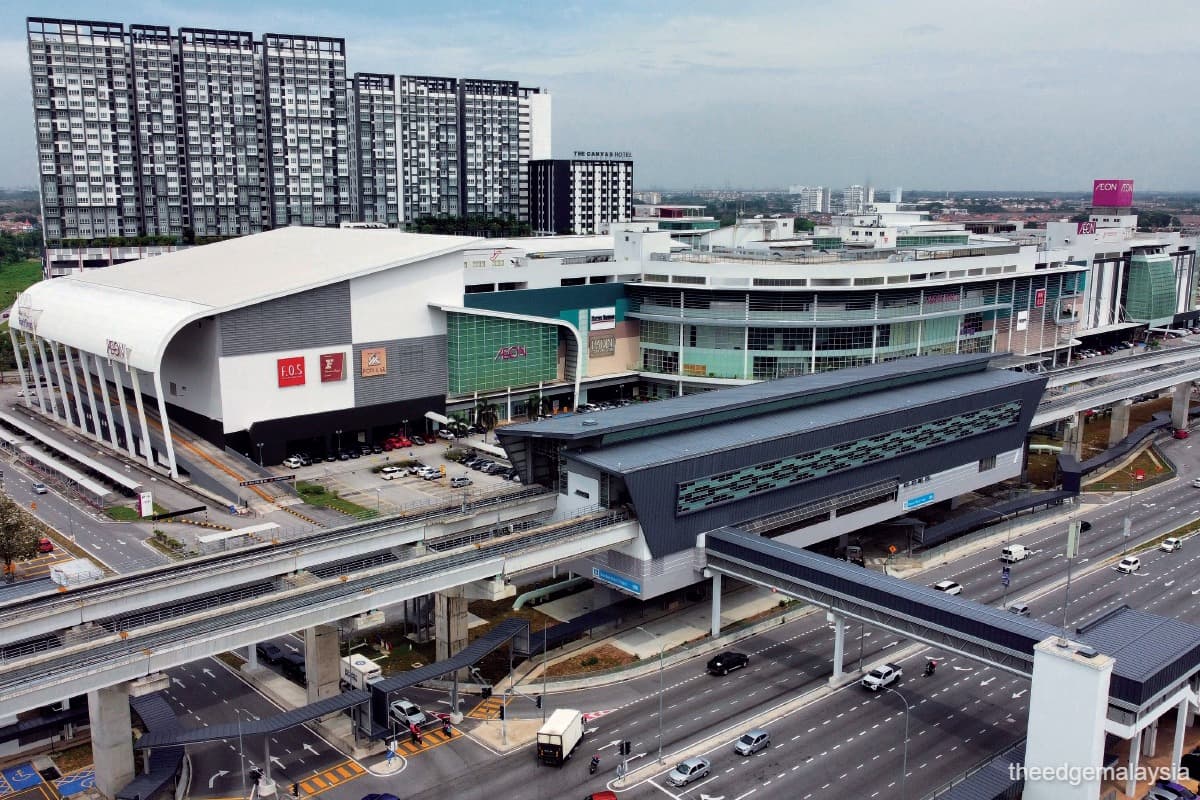
This article first appeared in City & Country, The Edge Malaysia Weekly on September 29, 2025 - October 5, 2025
The upcoming opening of the Light Rail Transit 3 (LRT3), or LRT Shah Alam Line marks a long-awaited addition to the Klang Valley’s transport network, enhancing connectivity between its eastern and western corridors. Initially targeted for completion in 2024, it faced delays due to the Covid-19 pandemic, funding adjustments and design changes. Transport Minister Anthony Loke has announced that the line will be operational at year-end.
Built at a cost of RM21.93 billion, it will have the capacity to accommodate about 67,000 commuters daily.
There are 20 stations on the 37km line, which stretches from Bandar Utama in Petaling Jaya to several locations in Shah Alam and ending at Johan Setia in Klang. There are two interchange stations — at Bandar Utama, which connects to the MRT Kajang Line, and at Glenmarie 2, which links to the LRT Kelana Jaya Line. There are also five provisional stations, which are Tropicana, Temasya, Raja Muda, Bukit Raja and Bandar Botanik.
City & Country asked PA International Property Consultants Sdn Bhd group managing director Subramaniam Arumugam, Nawawi Tie Leung (NTL) Property Consultants Sdn Bhd executive director and regional head of research and consulting Saleha Yusoff, and CCO & Associates (KL) Sdn Bhd executive director Chan Wai Seen for their insights into the impact of LRT3 on property values along its route.
For this article, we have divided the stations into three groups. The first section covers the Bandar Utama, Kayu Ara, BU11, Damansara Idaman, SS7 and Glenmarie 2 stations. The second section encompasses Kerjaya, Stadium Shah Alam, Dato Menteri, UiTM Shah Alam, Seksyen 7 Shah Alam, Bandar Baru Klang and Pasar Besar Klang. The third covers Jalan Meru, Klang, Taman Selatan, Sri Andalas, Klang Jaya, Bandar Bukit Tinggi and Johan Setia.

How the new line impacts value
According to Saleha, properties within walking distance of train stations generally enjoy a price premium due to their superior connectivity. “Easy access to rail networks enhances convenience for residents and tenants, resulting in consistently higher demand, which translates into stronger rental values and consequently, greater capital appreciation over time.”
She adds that it also encourages more vibrant, walkable communities. “The ease of access reduces reliance on private vehicles, encourages mixed-use development and fosters a more sustainable urban form. This way, proximity to rail is both a financial advantage and a catalyst for long-term neighbourhood growth.”
She cites the Sri Rampai LRT and Lembah Subang LRT stations, which are part of the LRT Kelana Jaya Line, as examples.
The Sri Rampai LRT station, located between Taman Sri Rampai and Wangsa Maju in Kuala Lumpur, is surrounded by residential neighbourhoods and commercial developments. The opening of the station in 2010 added a premium transit-oriented development (TOD) positioning for Desa Putra Condominium (launched between 2003 and 2004).
The average price for the condominium in the secondary market grew at a compound annual growth rate (CAGR) of 5% from 2004 to 2010. Upon the opening of the LRT station, it grew at a CAGR of 16% from 2010 to 2015. Some of the factors behind the price growth are its excellent transit link, proximity to the employment hub in KL city centre and its market positioning as a TOD.
“Today, we see more residential projects completed and under construction around this LRT station, the nearest being Wangsa 9, The Hamilton and Quinn, and many more in the Sri Rampai area. This reflects successful TOD dynamics.”
However, one cannot say the same for the Eve Suite serviced apartment near Lembah Subang LRT station in Petaling Jaya. Despite its direct link to the station via a covered walkway, Eve Suite has experienced declining secondary values. This is largely due to the oversupply of SoHos (small office/home office) products in the Ara Damansara/Subang corridor.
“The corridor has experienced a surge in SoHos, serviced apartments and small units such as Ara Greens, H2O Residences, Oasis Damansara and Pacific Place. Most of the sales were driven by investors, leading to high rental competition, resulting in low yields.The LRT linkage is not enough to offset oversupply pressure.
“[There is] a mismatch between small-format products (mostly SoHos of 600 to 1,200 sq ft) marketed as lifestyle or for investment, and the family-driven demand with preference for larger units,” Saleha points out.
Consequently, rental demand is limited, sustained primarily by niche tenant groups such as young professionals and singles. Additionally, the tenant pool is fairly small as Ara Damansara in Petaling Jaya is not a major employment hub.
Due to these factors, rental performance in the area is soft at only RM2.50 to RM3 psf, leading to weak rental yields.
Meanwhile, Eve Suite’s retail podium is unable to gain traction with many units vacant or some converted to secondary uses such as F&B, tuition centres and offices, which according to Saleha, undermine the “live-work-play” positioning of a TOD and making it a less attractive residential location.

“The overall tenant mix is not a typical retail mix that makes going there exciting to shop and dine,” she says.
Eve Suite’s surrounding environment is car-oriented. “Without a wider network of walkable amenities, the LRT linkage alone is insufficient to sustain long-term amenities.”
Saleha notes, “True TOD value creation requires more than transit adjacency; it relies on the right product, liveability and a vibrant urban ecosystem.”
Meanwhile, Subramaniam points out that the property trend in the LRT3 corridor has been uneven. Landed homes have been resilient. For example, a 2-storey terraced house in SS21 Damansara Utama, Petaling Jaya that transacted at between RM870,000 and RM1.2 million in 2014-2015 would still command RM888,000 to RM1.125 million today. Similarly, in BU11, larger 2½-storey terraced units once priced at RM1.17 million to RM1.65 million are now fetching between RM1.38 million and RM1.6 million.
It’s a different story for high-rise properties, however. Units at Pelangi Utama in Bandar Utama, which sold for RM525,000 to RM680,000 a decade ago, are now transacting at between RM398,000 and RM500,000 — showing that values have corrected despite the LRT3 announcement. Similarly, Kelana Puteri Condominium in SS7, which once sold for between RM378,000 and RM485,000, now trade in the RM310,000 to RM500,000 range.
“Back in 2014-2015, when the overall market sentiment was stronger, many properties were sold above market value, supported by catalyst developments such as Paradigm Mall Petaling Jaya in Kelana Jaya, 1 Powerhouse in Bandar Utama and the near completion of the MRT Kajang Line. When Covid-19 hit in 2020-2021, prices adjusted back to where they were meant to be and the prices have remained stable since,” says Subramaniam.
Meanwhile, Chan believes the market is less exciting in certain parts of Klang, with little to no upcoming developments in the pipeline. “After more than a decade since its announcement and years since its 2016 launch, the LRT Shah Alam project has lost much of its early momentum, with the market exhibiting signs of fatigue and scepticism amid an increasingly competitive market landscape.”
As such, between 2021 and 2025, the price trends of residential properties in some areas of Klang showed a mix of steady growth and fluctuations across different housing types.
“Generally, prices of most single- and double-storey terraced houses, as well as semi-detached houses priced below RM1 million in projects near the LRT Shah Alam Line stations, have remained stable or recorded marginal improvements between 2021 and 2025,” Chan observes.
Asking prices for two-storey terraced houses in Klang’s Taman Selatan, with an average built-up of 1,680 sq ft have risen from RM400,000 to RM505,000 price range in 2021 to RM510,000 to RM667,000 price range in 2025. In Sri Andalas, Klang, homes with an average built-up of 1,400 sq ft have remained relatively stable, moving from RM492,000 to RM500,000 price range in 2021 to RM540,000 to RM580,000 price range in 2025.
As for Bandar Bukit Tinggi in Klang, two-storey terraced houses with an average built-up of 1,540 sq ft have seen stronger growth, climbing from RM500,000 to RM685,000 price range in 2021 to RM780,000 in 2025. In Klang’s Bandar Parklands, homes with an average built-up of 1,500 sq ft, have surged from RM628,000 to RM765,000 price range in 2021, to RM830,000 this year.
With regard to two-storey semi-detached houses, Chan says prices of units in Taman Selatan, Klang with an average size of 3,595 sq ft have grown steadily from RM700,000 in 2021, to RM850,000 to RM968,000 price range in 2025, while homes in Sri Andalas, Klang with an average built-up of 3,714 sq ft have stayed relatively stable, at between RM1.48 million in 2021 and RM1.4 million to RM1.5 million price range in 2025.
While the landed residential market has remained relatively stable, Chan says the prices of serviced apartments in Klang are “facing downward pressure due to the competitive market situation”.
Asking prices for units at Impiria Residensi in Bandar Bukit Tinggi, Klang fluctuated from RM565 psf in 2023, to RM487 to RM565 psf price range in 2024, and RM530 to RM610 psf price range in 2025. GM Residence Remia in Bandar Botanic, Klang, with built-ups ranging from 815 to 899 sq ft, recorded transactions of RM552 psf in 2022; asking prices have risen to RM555 to RM650 psf price range this year.
In terms of rental yield, Chan highlights that properties located near LRT stations in Klang are expected to achieve favourable rental yields. “The competitive market situation for high-rise residential properties in the Klang Valley may limit the capital appreciation of high-rise residential developments in Klang, including those near LRT stations.”
Simply put, he believes high-rise residential properties in Klang will command good rental income, but it will be a slower growth process for long-term value.

Developer interest
Subramaniam says new projects are already springing up near these stations, each aiming to capture demand from future commuters. He points out several examples in the area.
In Kayu Ara, Petaling Jaya, OCR Group Bhd (KL:OCR) is developing Stellar Damansara (expected completion by 2Q2026), while 26 Ara Ville townhouses (by Aroma Vision Sdn Bhd) are set for completion in 2027. Around BU11 in Petaling Jaya, Grand Damansara (by The Grand Global Heights Development Sdn Bhd) will add 330 serviced apartments while The Capitol (by 1 Utama City Group) — two Grade A office towers with a lifestyle podium — will offer direct station access.
In SS7 in Petaling Jaya, Pinnacle Ara Damansara (by Pinnacle Armani AD Sdn Bhd), a project with 1,225 serviced apartments and a covered link bridge to the station, is due for completion by 2027. S P Setia Bhd’s (KL:SPSETIA) Temasya Prisma near Glenmarie 2 will be ready by 2026.
“These are classic examples of TODs,” says Subramaniam. “Being next to a station gives them higher visibility and convenience, which usually translates into slightly higher pricing than their surrounding stock.”
He notes, however, that the scarcity of land around the stations may limit further development.
Saleha says developers have already expressed interest in the areas around the Stadium Shah Alam, Kerjaya and Dato Menteri LRT stations. OSK Property Holdings Bhd and Perbadanan Kemajuan Negeri Selangor (PKNS) are among the early movers that have sought to capitalise on the LRT-driven momentum in these areas.
OSK Property established its presence there with the launch of Mori Park in Shah Alam, which is located between the Stadium Shah Alam and Kerjaya stations and is adjacent to Management and Science University (MSU).
“This development is positioned as the first TOD in Section 13, Shah Alam. With its position as a TOD at affordable pricing, it attracted first-time homebuyers, working professionals who will benefit from its proximity to both [the Stadium Shah Alam and Kerjaya LRT stations] as well as faculty, families of students and medical staff of MSU,” says Saleha. She adds that the first phase of Mori Park, called Alia, has achieved 80% sales. “The success of the first launch led to the launch of the second phase, Bayu, in May this year.”
She says PKNS has announced plans to rejuvenate Shah Alam city centre with the PKNS Square project, leveraging its proximity to the Dato Menteri station.
As the area is currently not a vibrant business hub, with mostly government agency buildings, Saleha says more effort needs to be made to draw the crowds.
This can be done by transforming the city centre into a vibrant “work, live, play” area by having residential components that will attract workers and professionals, lifestyle facilities (retail, wellness, education) as well as modern Grade A office space that will draw quality tenants from the private sector, she explains. In addition, the introduction of art, culture and entertainment elements will help make it more vibrant, Saleha adds.

Market outlook
Subramaniam expects conditions to remain resilient for the next two years, if there are no other major catalysts for development.
Mature neighbourhoods such as Bandar Utama and Damansara Utama in Petaling Jaya will continue to see stable demand, while retail hubs will benefit the most.
“1 Utama Shopping Centre will likely serve as a convenient stopover for the riders before continuing their journey. The Capitol, Bandar Utama’s latest landmark, will create a new integrated hub of offices, retail and lifestyle facilities by the end of 2027,” he adds.

Chan says in the near term, demand is expected to remain focused on landed residential properties, with limited new high-rise developments in Klang.
“Many developers are likely to hold back on high-rise projects until market sentiment improves and construction costs stabilise. The government’s emphasis on TOD has, however, strengthened the development prospects of land parcels in proximity to the LRT stations.
“Generally, completion of the LRT Shah Alam line is expected to have a positive impact on the property market in Klang. Overall, a stable to positive outlook is observed for this property market,” Chan says.
Saleha comments on the type of properties that could help raise the profile of areas around key LRT stations like Kerjaya, Stadium Shah Alam, Seksyen 7 Shah Alam and Bandar Baru Klang.
While the area around the Kerjaya LRT station in Shah Alam is predominantly industrial, residential and commercial developments are emerging to support the industrial park ecosystem.

“The station has high TOD potential to anchor more dense, mixed-use development, especially given the presence of educational institutions and retail. Given its strategic location, this area is a strategic investment frontier, not just in industrial logistics but the integration of living, learning and lifestyle within proximity of high-capacity transit,” she says.
Saleha has a positive outlook on the area as an employment hub.
“Upon the station’s opening, we expect a small uplift of between 0.5% and 1% for newer serviced apartments and condos as demand for these projects is likely driven by the student and professional tenant base. As more people move in, we expect good rental demand for commercial or shopoffices in this area, particularly from F&B and daily services with yields that could be in the range of 5% to 6% for well-positioned shopoffices,” she says, adding that the rental yield in the area has been modest at an average of between 3% and 3.5%.
“Around Stadium Shah Alam LRT station, apartments and SoHo clusters integrated with commercial corridors create strong potential for mid-density infill and TOD residential projects, anchored by AEON Mall Shah Alam, Giant Shah Alam Stadium, MSU and the new flagship stadium (replacing the original Shah Alam Stadium). MSU sustains steady housing demand, while the expanding leisure and retail scene supports complementary services. The stadium’s redevelopment offers long-term upside, though the area’s outlook depends on its ability to attract the on-site population.”
Saleha says the Seksyen 7 Shah Alam LRT station could broaden the tenant and buyer base, addressing the area’s current lack of market liquidity.
“Currently, there is a large stock of apartments and student-oriented housing around UiTM and Hospital Shah Alam. But many resale units in the secondary market face slow transactions due to limited demand in the student/faculty segment ... The LRT will make it easier for owners to rent or resell units, which is a liquidity advantage.”
She adds that the area already benefits from strong foundational assets and believes that the opportunities will lie more in unlocking latent value, increasing density and capturing rental upside.
The Bandar Baru Klang LRT station will enhance mobility in the area and position it as a high-access neighbourhood node suited for TOD synergies.
“Given its residential character, the TOD should focus on ‘neighbourhood-scale’ demand — typically within a 400m to 800m radius of the station — integrating diverse housing, local retail, amenities and public spaces in a walkable, mixed-use setting. This reduces car dependency, enhances liveability and drives sustained residential and commercial demand, supporting capital appreciation and rental resilience.”
She adds that there is potential spillover growth from Bandar Bukit Tinggi to Klang town centre and new townships adjacent to the stations in the next three to five years.

Neighbourhood profile
Save by subscribing to us for your print and/or digital copy.
P/S: The Edge is also available on Apple's App Store and Android's Google Play.