

This article first appeared in The Edge Malaysia Weekly on September 22, 2025 - September 28, 2025
THERE is an old adage about how a family business goes from shirtsleeves to shirtsleeves in three generations — the first rolls up its sleeves and builds the business, the second either enjoys the wealth and preserves it or ends up in an ugly legal battle to split the business, and the third squanders the wealth, erasing the legacy of the grandparents.
A rocky succession is a nightmare to anyone with an interest in a solid business with huge assets. A smooth transition to the next generation is always the desired outcome of any business continuity plan.
But that is easier said than done. More often than not, the transition falls into a succession trap, where the outcome can be tricky and fraught with legal battles. What’s worse is the spat opens up family differences to public scrutiny.
In a change from the norm, the Penang-based Boon Siew group has managed to see through an unusual but smooth transition to the third generation. This comes after a series of internal restructuring exercises that can be traced back to 2022.
The outcome was the emergence of Soaring Success Sdn Bhd, a private entity controlled by three Boon Siew-related families, as the largest shareholder of Oriental Holdings Bhd (KL:ORIENT).

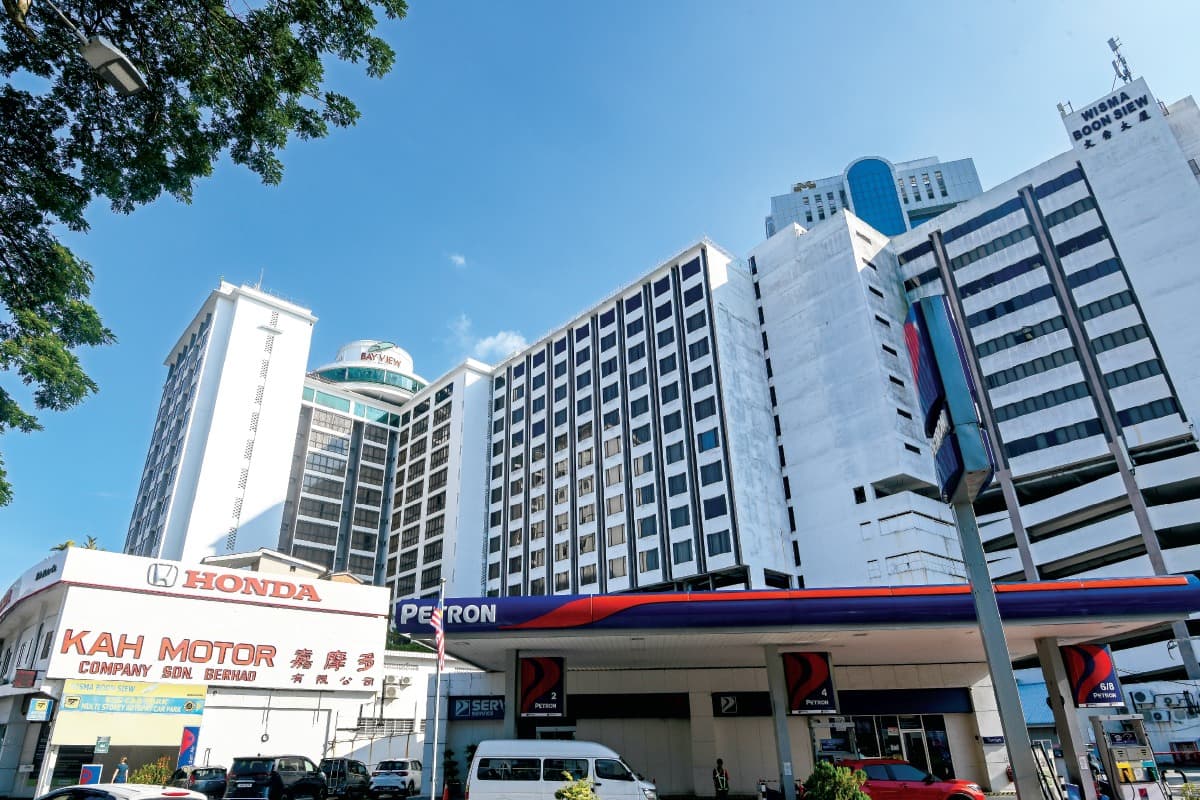
Oriental got its start from the astuteness of the late Tan Sri Loh Boon Siew, who imported the famous Honda motorcycles into Malaysia in the late 1950s.
The group is headed by 49-year-old executive chairman Datuk Loh Kian Chong and 44-year-old deputy chairman and executive director Datuk Seri Tan Hui Jing, the grandsons of Boon Siew. Kian Chong is the son of Loh Kar Bee, the eldest son of Boon Siew, while Hui Jing is the son of Datuk Dr Tan Chong Siang and Datin Loh Gim Ean, the daughter of the founder.
The other members of the Boon Siew family with executive positions on Oriental’s board of directors are Datuk Seri Lim Su Tong and 59-year-old Tan Kheng Hwee, who heads the Singapore operations. Kheng Hwee is the daughter of Datuk Loh Cheng Yean, who is a daughter of Boon Siew and is based in Singapore.
There are several others from the third generation who sit on the boards of subsidiaries of the group of companies under Oriental.
The 80-year-old Su Tong is one of the sons-in-law of Boon Siew and the oldest on the current board following the retirement of Datuk Robert Wong at the last shareholders’ meeting in June this year. The 84-year-old Wong, who is the eldest son-in-law of Boon Siew and former group managing director of Oriental, was not re-elected at the shareholders’ meeting in June this year.
Su Tong’s successor appears to be Datuk Lim Kean Seng, who sits on the boards of subsidiaries under Oriental. Kean Seng is said to be active in the private side of the family business. For instance, his family vehicle, Loh Phoy Yen Holdings Sdn Bhd, has a 20% stake in the SRS Consortium that has the mandate to build the Penang Light Rail Transit (LRT) project and reclaim an island in the south of Penang. He is also involved in the development of new hotels in the Gurney Drive area, which is the most in-demand location in the state.
The birth of Soaring Success
Sitting across the table in a swanky meeting room of a hotel overlooking the sea along Gurney Drive, Kian Chong and Hui Jing display admirable openness in relating the rationale behind the transition in the management of the group to the third generation.
In reply to a question from The Edge, Hui Jing spells out the reasons for the internal restructuring. He says when Oriental group started, the shareholding was held by a few private companies such as Boon Siew Holdings Sdn Bhd, The Yellow Bus Company Sdn Bhd and Bayview Hotel Sdn Bhd.
“There were cross holdings between the companies. It was designed to keep the six families together. But over time, as the family expanded, there were different aspirations among the members of the family. In addition, not all were in the business and not all were based in Penang,” he adds.
Boon Siew’s six children who inherited his wealth were Kar Bee, Cheng Yean, Datin Loh Ean, Datin Seri Loh Phoy Yen, Gim Ean and Loh Kah Kheng. Of the six, four have passed away.
Broadly speaking, the aspirations of their families can be divided into three groups. The first group wants to exit the business, the second group is keen on remaining in the business but wants to maintain the status quo and the third group wants to remain in and grow the business.
“So, there was an internal restructuring. Discussions started several years ago. We had to plan the restructuring to suit the needs of each and every family,” says Kian Chong.

In October 2022, the first signs of the internal restructuring emerged with the consolidation of the plantation business. It was the first corporate exercise by the group after many years. In the RM1.2 billion cash deal, Oriental took up all the stakes held by the families in the plantation companies that were co-owned by both parties.
Then in March 2024, Boon Siew Holdings Sdn Bhd, The Penang Yellow Bus Company, Bayview Hotel and several private companies disposed of their shareholding in Oriental to a newly formed company, Pacific Carnival Sdn Bhd. The principal shareholders of Pacific Carnival were Loh Wei-Lyn, Kian Chong, Hui Jing and Su Tong.
By the end of last year, Wei-Lyn, the daughter of the late Kah Kheng, exited the group. Three Penang-based families, headed by Kian Chong, Hui Jing and Su Tong, took up her stake in Oriental. The vehicle used was Soaring Success Sdn Bhd, now the single largest shareholder of Oriental with 38.64%.
According to Kian Chong, the families who wanted to remain in the business and grow it bought out the cousin who wanted to exit.
“The primary family vehicle now is Soaring Success. We bought out the shares of a cousin who wanted to exit. As for those who wanted to remain in the business but contented with the status quo, their shares were carved out to them,” says Hui Jing.
Following the internal restructuring, Oriental is now controlled by five families through their private vehicles. They are Loh Kar Bee Holdings Sdn Bhd, Loh Ean Holdings Sdn Bhd, Loh Cheng Yean Holdings Sdn Bhd, Loh Phoy Yen Holdings Sdn Bhd and Loh Gim Ean Holdings Sdn Bhd.
Kian Chong has the largest block through his direct and indirect stakes via Loh Kar Bee Holdings Sdn Bhd. Loh Cheng Yean Holdings has 6.81% while Loh Ean Holdings has 5.12% (see chart).
Aligning the private and public businesses
The main business of Oriental group is the automotive division. To diversify the business because of the volatile nature of the industry, the group also has assets in the property development, hospitality, healthcare and plantation sectors.
The Loh family also holds similar assets privately. For instance, there are two Bayview hotels on Penang Island that are not part of Oriental group, which has several hotels in Malaysia, Singapore, Australia and New Zealand.
In the healthcare sector, Oriental has a hospital in Melaka while some family members have interests in some private hospitals in Penang. Some family members are also very much involved in property development.
Prior to the 2022 consolidation of the plantation business, there had not been any major corporate exercises in Oriental to realign the interests of the family that are held privately with similar businesses of the listed company.
In a move to tidy up the plantation segment, the group consolidated the family holdings in several plantation companies in which Oriental also has an interest in a RM1.2 billion cash deal. The corporate exercise that was completed between September 2023 and early 2024 paved the way for the group to increase its plantation land bank in Malaysia to 12,054ha from 4,958ha and to wholly own 96,168ha in Indonesia.
When the deal was proposed, crude palm oil averaged about RM3,700 per tonne. The commodity is currently hovering above RM4,400 per tonne. In the first half of this year, the plantation business was the second largest contributor to the group’s bottom line after the automotive business.
Hui Jing says there are many assets under Oriental and outside the listed company owned by the family whose returns can be improved with more investment.
However, history has shown that the ownership structure is one where some shareholders do not want to put in more money, which has hampered the optimisation of the assets.
An example is the Bayview hotels on the island that have different groups of shareholders. The occupancy rates of these hotels are relatively lower than the other hotels on the island mainly because not much investment has been put in to spruce them up despite their prime locations.
The younger generation of the Boon Siew family owns several hotels on the island. One of which is the Marriott Hotel in Gurney Drive, where the occupancy rates and returns are much higher.
The challenge for the third generation helming Oriental is to cut through the shareholding, consolidate the assets and improve the returns for shareholders. In the longer term, it is in the best interests of the Boon Siew family and his legacy.

Save by subscribing to us for your print and/or digital copy.
P/S: The Edge is also available on Apple's App Store and Android's Google Play.