

This article first appeared in Wealth, The Edge Malaysia Weekly on September 22, 2025 - September 28, 2025
With an ageing population, declining birth rates and rising medical inflation, a growing number of seniors — particularly those in need of assisted living or nursing care — may face an uncertain future as affordability becomes an increasing concern.
Assisted living refers to services and support provided to individuals who need help with daily activities — such as bathing, dressing or managing medications — but do not require intensive medical care. These services are often offered in retirement homes or aged care centres. In contrast, nursing services involve round-the-clock medical care and supervision for individuals with complex health needs.
According to industry players, basic or lower-range aged care centres typically cost between RM1,500 and RM3,000 per month. Fees rise to between RM3,000 and RM5,000 for mid-tier facilities, and higher-end centres can range from RM5,000 to RM12,000 per month.
Lower-range facilities typically serve seniors with limited financial means who require only basic custodial care, such as accommodation, meals and supervision. These facilities are often subsidised by the government or operated by charitable organisations.
Middle-tier facilities offer more comprehensive services and amenities, including independent living arrangements and limited nursing care. Residents typically reside in self-contained units — such as apartments or landed homes — and receive assistance with daily activities, including bathing, dressing, medication management and housekeeping. These facilities often provide round-the-clock staff support, with personnel responsible for meal preparation and organising a range of social and recreational activities to foster engagement and community.

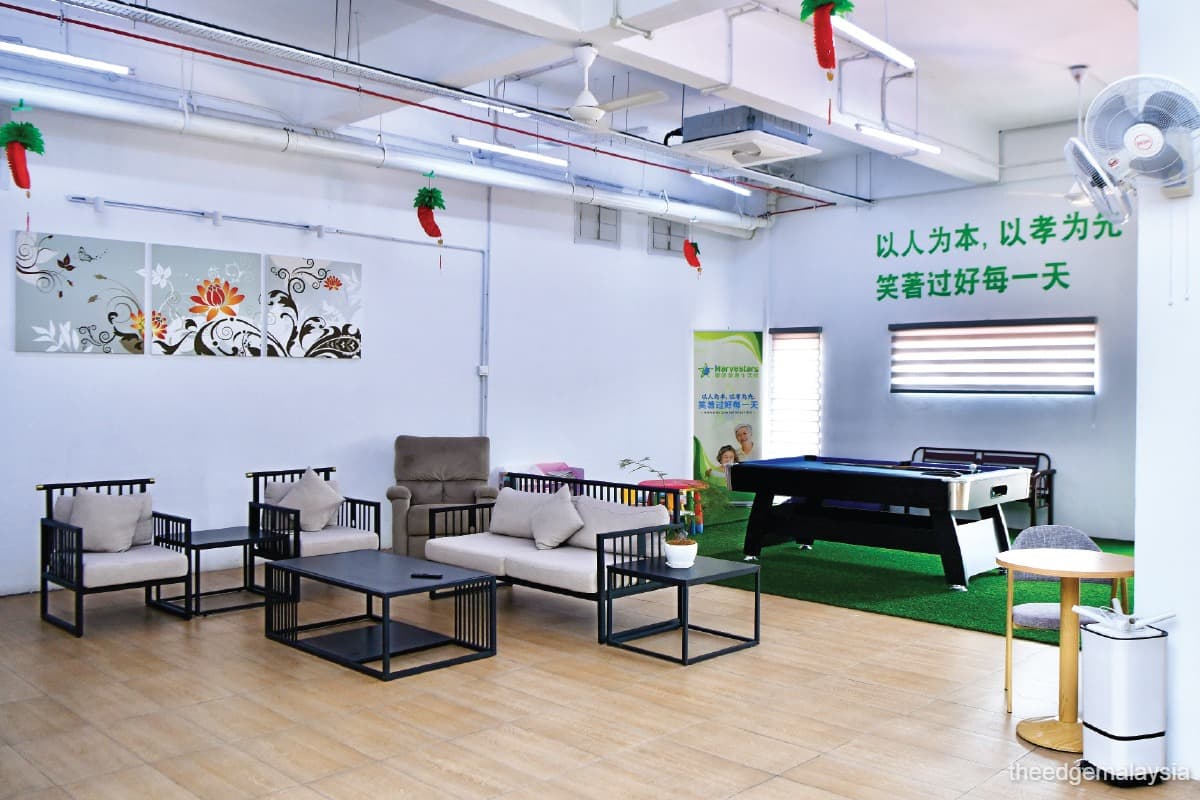
Harvestars Care Centre Sdn Bhd, which charges its customers RM3,000 to RM6,000 per month, considers itself a mid-tier aged care centre, says its director Lee Chen Han.
“Our costs are more affordable in comparison to high-end facilities since we are in an apartment-style building located in a residential area in Klang. Our rooms are a little bit like houses.The Klang branch is in an apartment style, single bedroom and twin beds room set up. The Puchong branch is a triple story superlink house, which has lifts to transfer our residents too,” he says.
The location of Harvestars’ facilities is another selling point, he adds. According to the company’s website, its standalone condo-style aged care and nursing home is situated near Sri Kota Specialist Medical Centre, Pantai Hospital Klang and a government hospital — offering residents added reassurance through proximity to medical services.
The company operates another branch in Puchong, with both branches accommodating more than 20 care patients.
Harvestars also offers daycare services, enabling seniors to socialise and familiarise themselves with its facilities and new living arrangements before deciding on a longer-term stay.
Meanwhile, the high-end aged care centres or retirement homes are designed for seniors who can afford a premium lifestyle with extensive amenities and personalised care. These facilities often resemble resorts, offering luxurious accommodations, a comfortable dining experience, well-equipped fitness centres, a wide array of recreational and social programmes, and even spas and salons. These high-end facilities are often associated with senior living residences such as Sunway Sanctuary, operated by the Sunway Healthcare Group.
Leonard Theng, its general manager, says high-end places are costly mainly because of advanced amenities, integrated technologies within the residences, and comprehensive support for daily living activities.
“Sunway Sanctuary has an integrated infrastructure, where the residences are connected to Sunway Medical Care Centre. If there is an emergency, a doctor will be right in front of you in 10 minutes, which is something not many centres have access to,” he says.
Elaborating, Theng explains that under its senior retirement care programme, the residence is divided into Independent Living Units (ILUs) and Assisted Living Units (ALUs). Monthly fees for these packages range from RM8,000 to RM20,000 for ILUs, and RM10,000 to RM30,000 for ALUs.
Mid- to high-end facilities elusive to most
If a senior were to choose ILU at Sunway Sanctuary and spend an average of RM10,000 a month, he would need about RM2.4 million to sustain that lifestyle for more than 20 years, without factoring in inflation.
For the mid-tier centres that cost at least RM2,500 per month, a senior would need at least RM600,000 in hand for the corresponding period. These price tags are way beyond what most Malaysians can afford.
While not all seniors require aged care services, only 2.65 million, or 36.2%, of the Employees Provident Fund’s (EPF) 7.33 million active formal members aged 18 to 55 had achieved the basic savings target set by EPF, as at October last year. According to the Ministry of Finance, the basic savings target is RM240,000 for an individual at age 55.

Two months later, in December, the EPF launched the Retirement Income Adequacy (RIA) Framework, outlining the adequate, basic and enhanced savings amount required for retirees.
The basic savings amount for retirement for an individual aged 55 was revised last December to RM294,000. The adequate amount was RM476,000 and the enhanced amount was RM935,000.
For those aged 60, the amounts were RM390,000 (basic), RM650,000 (adequate) and RM1.3 million (enhanced).
Affordability aside, the price tag offered is not unreasonable compared with market rates. Sunway’s Theng says: “Say, you stay independently but need assistance; a good caregiver could cost RM3,000 to RM5,000 per month.
“If you take RM5,000 and multiply it by 375, you’re already looking at more than RM1.7 million in 30 years. There are many other factors to consider. Taking them into account, the cost of staying at Sunway Sanctuary isn’t as high as it seems when viewed across three decades,” he says.
Theng made the calculation above by following the “Rule of 375”, a simplified method to estimate the total retirement savings needed for a comfortable retirement.
Echoing similar sentiments about higher-end retirement homes, Estee Tan, chief executive officer of ReU Living Sdn Bhd, another high-end aged care centre operator, says these facilities offer additional benefits, such as opportunities for community engagement.
“Many older people these days are staying at home alone and facing the TV most of the time. There is also that element of social and community engagement that should be taken into account when planning for retirement,” she says.
In 2022, ReU Living launched MiCasa Retirement and Recovery Village. Tan says the company was the first in Malaysia to introduce a luxurious hotel-style retirement facility for senior living, blending in hospitality, healthcare and lifestyle. MiCasa offers seniors an assisted-living environment equipped with trained caregivers and professionals.
“Eighty per cent of those who initially stayed with us for a few months and experienced our services have continued to stay with us because they realised they had a better quality of life with the care here,” says Tan.

A national scheme for long-term care?
Various datasets pertaining to the Malaysian demographic points towards growing demands for aged care services. According to the Department of Statistics Malaysia (DoSM), the country is projected to see a significant rise in the proportion of older adults, with those aged 65 and above expected to make up 14.5% of the total population by 2040.
The World Bank projects that Malaysia will become a super aged society by 2056, with more than 20% of the population aged 65 and above.
The crude birth rate, the number of live births occurring per 1,000 people in a population per year, had also fallen from 17 in 2013 to 12 from 2021 to 2023, according to the World Bank.
Meanwhile, DoSM data shows that Malaysia’s life expectancy has increased slightly to 75.2 years in 2023 from 74.5 years in 2013.

An ageing population, lower birth rate and longer life expectancy are expected to fuel demand for aged care services. As it stands, however, Malaysians who need these services will need to start planning their finances early on, says Yap Ming Hui, managing director and head of Whitman Independent Advisors.
Ng Kai Chong, head of marketing at Eastspring Investments Bhd, agrees, saying that Malaysians should start learning about personal finance early on, which includes getting the most suitable life and medical insurance and savings plans, as well as investing early for retirement.
Harvestars’ Lee proposes that the government consider adopting a mandatory and comprehensive system, such as the Long-Term Care Insurance (LCTI) system adopted by Japan, one of the most aged nations in the world.
According to Japan Health Policy Now, the Japanese health policy platform, the LCTI provides broad coverage for a range of long-term care services, including retirement homes through dedicated premiums and public funding.
Under the system, all persons aged 40 and above are mandated to contribute to the LCTI by paying a premium that varies according to their income level. Once they turn 65, they will be eligible for long-term care benefits, including institutional, home and community-based services, which they can access through a care manager.
Furthermore, eligibility for the LCTI is based on a needs assessment, with each level of need setting a maximum limit on the services covered for retirees.

“Malaysia currently lacks such a [mandated] national [long-term insurance care] scheme. The financial burden of long-term care in Malaysia falls largely on individuals and their families, relying heavily on informal care and private funding for formal facilities,” says Lee.
He adds that EPF is a retirement savings scheme that combines multiple financial objectives into a single fund. The LTCI system is a specialised programme that addresses the funding of long-term care services for the elderly in Japan, on top of the existing public pension system.
Lee observes that such a move would ensure a more dignified and secure future for Malaysian seniors by providing a collective safety net for the significant costs associated with aged care, including specialised retirement homes.
On June 17, during the International Social Wellbeing Conference 2025 held in Kuala Lumpur, Prime Minister Datuk Seri Anwar Ibrahim called for increased investment in health and care infrastructure for the ageing population.
He said Malaysia now has more than 1,000 centenarians, compared to fewer than 10 in the early 1970s, according to the United Nations World Population Prospects database.
“The real question now is not whether we are ageing, but whether we are adapting. Public policy must take heed that longevity is a transformation of society, not just a trend. We must ask: Are our institutions, our policies and our thinking prepared for this shift?” he said.
He also mentioned that as the population ages, the global longevity economy is projected to exceed US$65 trillion (RM275.63 trillion) by 2030.
Save by subscribing to us for your print and/or digital copy.
P/S: The Edge is also available on Apple's App Store and Android's Google Play.