

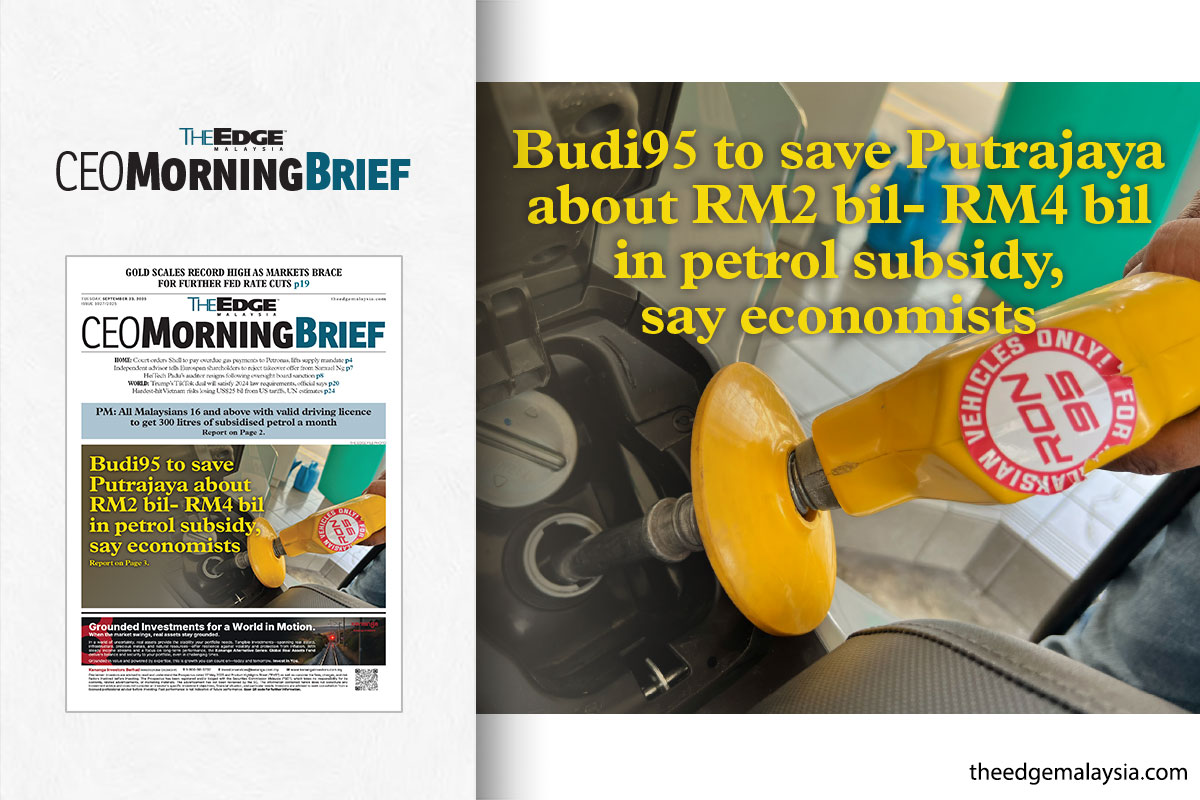
KUALA LUMPUR (Sept 22): The long awaited RON95 rationalisation plan — Budi95 — could yield the government fiscal savings of up to RM2 billion to RM4 billion a year once fully implemented, according to economists.
However, they cautioned that global oil prices remain a swing factor.
UOB economist Julia Goh commented that the key component of the Budi95 framework lies in “distinguishing between citizens and non-citizens and enforcing a monthly cap to ensure benefits are channelled to genuine domestic users”.
She added that while eligibility criteria have not been finalised, the bulk of savings is expected to come from reducing subsidy leakage to smuggling activities, foreign nationals and large corporations.
Economists concurred that the quota-based system — capping subsidised RON95 purchases at 300 litres per person a month and verifying eligibility through MyKad — will gradually curb long-standing leakages such as cross-border smuggling and excessive domestic consumption.

The government announced that starting Sept 30, every Malaysian aged 16 and above with a valid driving licence can buy up to 300 litres of RON95 petrol a month at RM1.99 per litre. Verification requires no pre-registration: motorists simply present their MyKad at pumps, counters or participating station apps.
Early access begins Sept 27 for police and military personnel, and Sept 28 for Sumbangan Tunai Rahmah recipients. Drivers for ride-hailing services can apply for extra allocations, while non-citizens will pay the market price — estimated at about RM2.60 per litre initially.
IDEAS Malaysia economist and public policy thinker Doris Liew told The Edge that these savings are material, particularly as global crude prices remain depressed, cushioning the fiscal position even as pump prices are lowered slightly from RM2.05 to RM1.99.
Yet, this artificially low price point could create a “stickiness” problem: once consumers anchor expectations at RM1.99, any upward adjustment in the future, especially in a rising oil-price environment, would risk significant political and social resistance, undermining the sustainability of the reform, Liew commented.
At the time of writing, Brent crude was trading around US$66 per barrel. Crude oil prices have been trending downward this year, falling from last year’s peak of around US$90 in the second quarter. International crude oil prices are generally expected to remain soft as Opec+ members have been ramping up production over the past few months.
“If crude prices rise, the gap between market and subsidised prices widens, meaning that government spending on subsidies could balloon, potentially eating into funds for other development priorities,” TA Securities economist Farid Burhanuddin warned.
"On the flip side, Malaysians will still enjoy stable pump prices as oil price is expected to trend lower next year, which helps cushion inflation and keep spending momentum steady. But the risk is that this policy may become fiscally unsustainable if oil stays elevated for too long," he explained.
Farid noted that at that point when crude oil prices are higher, the government might be forced to revisit the subsidy structure, maybe by cutting quotas, introducing caps for certain groups like e-hailing or luxury car owners, or accelerating subsidy rationalisation.
Farid estimated that for the final quarter of 2025, the government would have subsidised around 14.4 billion litres (based on the estimation of 900 litres times 16 million people) of RON95 — about RM8.8 billion at a 61 sen per litre gap. Combined with diesel and other fuel subsidies, the total 2025 fuel bill could reach RM24 billion.
The estimate is on the assumption that all drivers consume 300 litres of petrol a month. The fuel subsidy bill would be lower if a majority of drivers pump less than the quota.
Furthermore, should crude oil prices drift lower, this would also bring down the subsidy bill.
Forecasting for 2026, Farid assumed a lower pump price of RM2.40 per litre (based on Brent crude averaging US$55 per barrel) and a narrower 46 sen subsidy gap; he projected an annual subsidy cost of RM23.6 billion.
While these numbers remain high, he believes that the Budi95 programme creates a foundation for long-term savings. “With tighter controls, leakage from diesel subsidies and cross-border smuggling could fall, and a quota system should reduce excessive RON95 consumption,” he told The Edge.
“RON95 carries a 5% weight in the consumer price index and is the most consumed fuel among Malaysians. Rationalising it is key to fiscal consolidation,” Bank Muamalat Malaysia Bhd chief economist Dr Mohd Afzanizam Abdul Rashid told The Edge.
Afzanizam added that once the MyKad-based delivery system is proven, the government could “gradually move to income-tiered subsidies”, further enhancing fiscal discipline.
The present environment of stable inflation and full employment makes now a good time to introduce reform, Afzanizam said. He views Budi95 as part of a holistic fiscal strategy that includes tax measures and e-invoicing to broaden revenue while controlling spending.
To receive CEO Morning Brief please click here.