

This article first appeared in Forum, The Edge Malaysia Weekly on September 22, 2025 - September 28, 2025
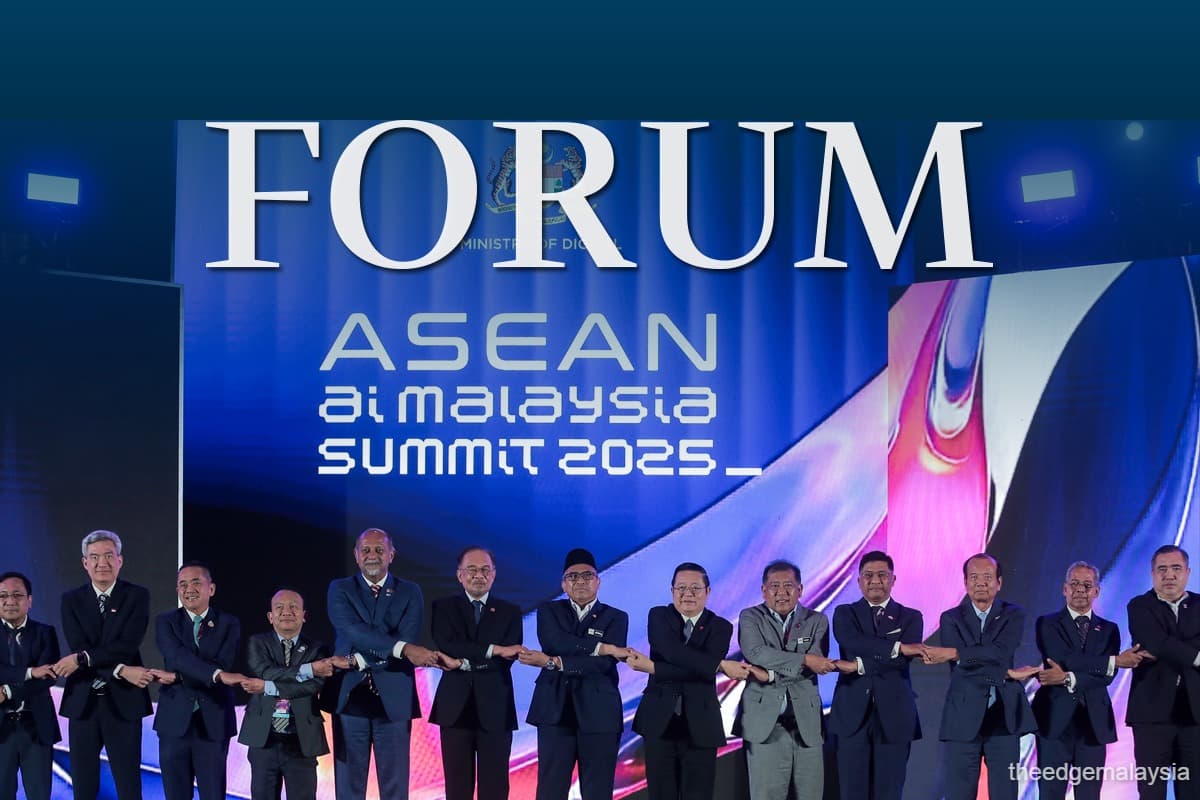
Prime Minister Datuk Seri Anwar Ibrahim used the Asean AI Summit in Kuala Lumpur to declare that Southeast Asia could lead in artificial intelligence, not just catch up. The promise is compelling. The danger, unspoken, is that AI could widen the gaps that already threaten Asean’s unity.
Seven hundred million people, a booming digital economy and unmatched diversity. The raw material is there. What is missing is proof Asean can turn potential into power before its divides shred its cohesion. So, can it?
The promise is bold but the obstacles are brutal.
Asean’s regulatory landscape is fragmented. AI readiness ranges from Singapore’s world-class ranking to Laos and Myanmar near the bottom. The bloc’s ethics guide is voluntary, leaving members to drift apart and putting regional integration out of reach.
Digital development is uneven. Singapore races ahead while others struggle with patchy infrastructure and weak readiness. The divide isn’t abstract — it threatens to turn strategy into a two-tier system that benefits the few, not the bloc.
Then comes the talent gap. Across Asean, 72% of employers can’t find AI talent. Malaysia reports 81% hiring struggles; Thailand scrambles to train 50,000. Without skilled regulators and engineers, ambition collapses into hollow rhetoric.
Public trust is fragile. Adoption is high — 66% in Thailand use AI and 83% expect benefits. Yet only 46% trust it and 92% demand disclosure. Misuse, bias and deepfakes abound — if ethics slips, confidence collapses.
Layer on regulation. Too much strangles innovation; too little invites chaos. Asean must strike a balance or watch opportunity dissolve into either paralysis or reckless risk.
The danger isn’t only stagnation from these existing challenges. AI risks turbocharging Asean’s internal drift. Stronger states sprint ahead, weaker ones are left behind and cohesion frays. Unity doesn’t vanish but it weakens — collateral damage in the race for readiness.
Even if Asean holds together, the outside world won’t wait. The US–China tech war is already reshaping the terrain. Asean’s AI future will be defined as much by this rivalry as by its own choices.
The fracture begins with hardware. Washington’s bans on Chinese chips, cloud and AI gear are dividing the world into rival ecosystems. Asean is caught — forced to choose sides or risk exclusion from both.
The money follows. US and Chinese firms are redirecting capital to “friendly” hosts. Vietnam, Malaysia and Singapore land chip plants and data centres. Others watch from the sidelines. The gap within Asean only grows wider.
Data deepens the split. Washington demands open flows; Beijing insists on state control. Asean tilts both ways. If the bloc can’t agree on rules, region-wide AI platforms collapse before they even get off the ground.
Security pressure drives the wedge further. AI is dual-use — civilian today, military tomorrow. US allies face curbs on Chinese tech while others double down on it. The digital divide hardens into strategic mistrust.
Yet opportunity exists. Asean could claim neutrality — non-aligned but reliable. A hub for testing, governance and deployment. But without standards, coordination and talent, that dream dissolves. And even if Asean builds capacity, the window for neutrality is already narrowing.
Bottom line: the tech war could supercharge Asean’s AI push — if the bloc seizes it. But dithering means its future may not be written in Jakarta, Bangkok or Manila. It could be dictated elsewhere. And the rivalry extends beyond tech.
The technology competition merely reflects a deeper US-China struggle for global influence. It’s about power, rules and who writes the future. Chips and data are just proxies. Asean cannot escape that gravity.
Geography makes the region the arena. The South China Sea, choke points, supply chains — every fault line of US–China tension cuts through Southeast Asia. Even without tech restrictions, the rivalry appears set to shape investment, security and political choices across the bloc.
The danger is existential. Asean’s unity depends on neutrality, yet neutrality itself is shrinking. Washington demands alignment; Beijing rewards loyalty. As space for hedging narrows, the bloc risks being stretched thin by outside pressure, not shattered by its own weakness.
That is why Asean’s AI push cannot be divorced from geopolitics. Hardware and skills matter. But the deeper question is alignment — where Southeast Asia positions itself in a world split by two powers intent on writing tomorrow’s rules. This alignment question has concrete consequences for Asean’s future relevance.
A bloc divided digitally is a bloc without power. Fail to close the tech gap and Asean won’t just lag economically. It will be sidelined strategically — watching as US influence ebbs and China moves to dictate terms.
Even ambition carries danger. A bold AI drive without cohesion could deepen inequality, hardening divides between fast and slow adopters. Instead of closing gaps, Asean could turn inward — squabbling while the outside world races ahead.
That is the double edge. Mishandled, AI accelerates fracture. Managed with discipline, it turns into leverage.
The harder path is coordination. Invest in infrastructure, skills and binding governance, and Asean turns AI into leverage. It won’t erase US-China rivalry but it could give the bloc bargaining power and credibility in a fractured order.
Governance is the hinge. Voluntary rules aren’t rules at all — they are theatre. Asean needs enforceable rules to stop AI from deepening elite capture, eroding trust and letting outsiders dictate terms. Without this, neutrality is a slogan, not a shield.
Delay carries a crushing cost: irrelevance. Asean risks becoming a test bed where great powers trial their technologies, not a bloc shaping outcomes. A bloc without rules or strength doesn’t project neutrality — it radiates weakness.
Three doors lie ahead. Dependency, where others write the rules. Fracture, where divides strip Asean of cohesion. Or discipline, where AI becomes leverage. Neutrality survives only if discipline makes it credible. Only one path keeps the future in Asean’s hands.
Quah Boon Huat is a former policy analyst with a global intergovernmental institute and sovereign credit rating analyst
Save by subscribing to us for your print and/or digital copy.
P/S: The Edge is also available on Apple's App Store and Android's Google Play.