

This article first appeared in City & Country, The Edge Malaysia Weekly on September 22, 2025 - September 28, 2025
For cities to endure, it is essential to understand their fundamentals and lifecycle, said Kuala Lumpur mayor Datuk Seri Maimunah Mohd Sharif.
“A city is fundamentally a habitat. It is a human-made settlement,” she said in her keynote at the inaugural RICS-MIPFM International Property Conference 2025, held on Sept 9 at Hilton Petaling Jaya. “Buildings have a lifespan, but the best-built ones often outlive their builders.”
She called for an ecosystem approach to future-proof cities and extend the life of the built environment. “It is people who decide whether a city lives, thrives, dies or renews. Infrastructure is not only steel and concrete — it is about equity, trust and care.
“Designing for resilience, accessibility and longevity is not a burden — it is foresight and wisdom. It is the responsibility we share. This is an ‘ecosystem’ approach. It is time to bring the built and natural environments together — a key imperative if we want urban renewal to be an opportunity to develop future-fit cities.”
Maimunah noted that building resilience is not just about completing an asset’s lifecycle, but recognising its role within a broader metropolitan ecosystem. “From planning and financing to construction and operation, to renewal and even repurposing, the value of an asset lies in how well it adapts to its ecosystem.”

She also emphasised that facilities management plays a critical role in lifecycle value. “It should not be ignored until something breaks. Also equally important is embedding ESG (environmental, social, governance) into lifecycle decisions.”
In his pre-recorded speech at the conference, Housing and Local Government Minister Nga Kor Ming said the ministry is mulling the introduction of the Building Managers Bill, which would address long-standing gaps in property management and extend the lifecycle of built assets.
“However, legislation alone is not enough. Real transformation requires a whole-of-nation approach, guided by strong public-private people partnership. This is why ESG integration and digital innovations such as AI (artificial intelligence), IoT (Internet of Things) and big data are critical,” said Nga. “This conversation will shape how we build smarter, manage more effectively and future-proof our assets for the next generation. Together, we can ensure that our built environment is resilient, sustainable and a cornerstone of prosperous and inclusive communities.”
Sharing similar views, Malaysian Institute of Property and Facility Management (MIPFM) committee member and conference organising chairman Datuk Firdaus Musa highlighted in his welcoming speech the need to manage assets sustainably throughout their entire lifecycle. “As cities continue to evolve, it is essential that we not only develop and manage assets but also ensure they are operated sustainably, efficiently and responsibly across their entire lifecycle. ESG principles must be at the heart of how we plan, develop and manage our built environment.”
He added that ESG financing plays a critical role in influencing asset value, investment decisions and long-term performance. “Integrating ESG considerations into our asset strategies ensures we remain aligned with sustainable imperatives while enhancing asset value and resilience for the future.”
Jointly organised by the MIPFM and the Royal Institution of Chartered Surveyors (RICS), the full-day RICS-MIPFM International Property Conference 2025, themed “Built Environment and Asset Lifecycle”, featured presentations by industry professionals on key trends shaping property and facilities management, focusing on the asset lifecycle and addressing challenges such as ageing infrastructure, sustainability and technology integration in real estate.

Adequate budget allocation for lasting buildings
In his session titled “Asset Lifecycle and Cost Management,” Henry Butcher Malaysia (Mont Kiara) Sdn Bhd (HBMK) managing director Low Hon Keong said effective asset lifecycle and cost management are important, especially for older buildings that face higher maintenance costs and frequent infrastructure breakdowns. Allocating an adequate budget can help.
“We need to have an adequate budget to ensure the building is able to carry out proper maintenance for both operating expenses and capital expenses. This is the fundamental of preventive maintenance. And with the availability of statistics and data [due to technology advancement], we’re able to do predictive maintenance too unlike in previous years.”
He also stressed the need for a comprehensive asset management plan. “For any buildings that we manage, it is very important that we must be able to advise the building landlord or management body on what assets they have in their building.”
Noting that management bodies often change with each new committee, he said a structured asset lifecycle schedule helps property managers anticipate future maintenance needs.
He said stratified buildings typically have hundreds of assets that require scheduled maintenance, and property managers must document them from the outset to plan effectively. “It’s very important to advise the management body that their building comes with a list of assets that need to be maintained on a scheduled basis.”
He added that asset lifespans can range from five to more than 20 years, and turning that into a clear schedule helps committees plan ahead. “Whether they continue to engage a property manager or choose to self-manage, this list should be the blueprint for the building.”

Impact of proper maintenance on property value
Effective maintenance has a direct impact on investment returns, said Knight Frank Malaysia executive director of asset management Sasitheran Subramanian in his presentation titled “Impact of Property Maintenance and Upkeep on Internal Rate of Return (IRR)”. It influences key investment metrics such as net operating income, capitalisation rate and IRR by preserving asset quality, optimising cash flow and enhancing exit valuations.
He added that good maintenance reduces unexpected costs, improves tenant retention and occupancy, and supports stronger rental yields and resale values. “Regular upkeep safeguards and enhances the inherent value of the property, protecting it from depreciation and extending its useful lifespan. It also reduces emergency repair costs and disruptions.”
Sasitheran noted that well-maintained buildings improve tenant satisfaction and loyalty while reducing turnover and legal risks. “Adherence to maintenance schedules ensures continuous compliance with critical legal statutes, safety regulations and environmental standards.”
Sasitheran concluded that maintenance is not merely operational but strategic. Well-managed upkeep protects income streams and asset value, boosting IRR, which should guide maintenance budgeting and capital planning decisions.
Following Low and Sasitheran’s presentations, a fireside chat moderated by JLL Malaysia managing director Jamie Tan explored the future of office buildings in a competitive, evolving market. A key theme was the urgent need for asset enhancement initiatives (AEI) to prevent obsolescence.
Sasitheran stressed that AEI is essential for older buildings, warning that without timely planning, they risk becoming obsolete both functionally and physically, especially as newer buildings boast smart technologies. Low agreed, noting the traditional office is evolving into a multifunctional workplace where ESG considerations are driving change. He added that non-ESG-compliant buildings will face increasing pressure as people seek more than just a workspace.
Sasitheran emphasised that going green is essential. “The flight-to-quality trend is real. Tenants are looking for buildings with strong ESG policies.” He noted that, for export companies, ESG compliance is non-negotiable — a lack of it reduces export potential, especially in markets such as Europe and Australia. This applies to landlords too. MNC tenants will leave non-certified buildings even if it costs them more, because their global policies demand it.”

On capital expenditure, Low warned that many joint management bodies and management corporations are considering deferring capex if it is not urgent; he stressed that timely investment is crucial to avoiding costlier repairs later.
He also advocated strengthening the Strata Management Act by making certain capex mandatory at specific intervals — such as repainting after seven or eight years and annual water tank cleaning — to provide parcel owners with a sense of security and ownership.
Best practices for property management
According to Mohd Mazhar Mohd Marzuki, vice-president 1 of the Malaysian Association of Facility Management, property management goes beyond preserving asset value. In his presentation titled “Good Property Management Practice for Enhancing Property Value”, he stressed that integrating facilities management is essential to ensuring functionality, safety and tenant satisfaction.
Citing the Malaysian Property Management Standards from the Board of Valuers, Appraisers, Estate Agents and Property Managers, Mazhar highlighted the importance of asset inventories, building condition assessments, maintenance SOPs and energy-saving measures.
He said: “As a property manager, you must know the building thoroughly ... If the building does not function, your tenant is not satisfied. You will lose tenants and, eventually, the value of the property.”
Mazhar urged managers to adopt preventive and predictive maintenance strategies. “By adopting a whole-life approach and lifecycle costing, [property and facility] managers can anticipate capital expenditures, justify budgets and avoid costly surprises. If you focus only on reactive maintenance, you will always be ‘firefighting’. Preventive maintenance is especially crucial for ageing buildings, helping schedule corrective action before breakdowns occur,” he said.
“Not every building is the same; there is no one-size-fits-all solution. Some require more preventive maintenance, others, because of age, may need more predictive maintenance and business continuity planning.”
Championing ESG in real estate
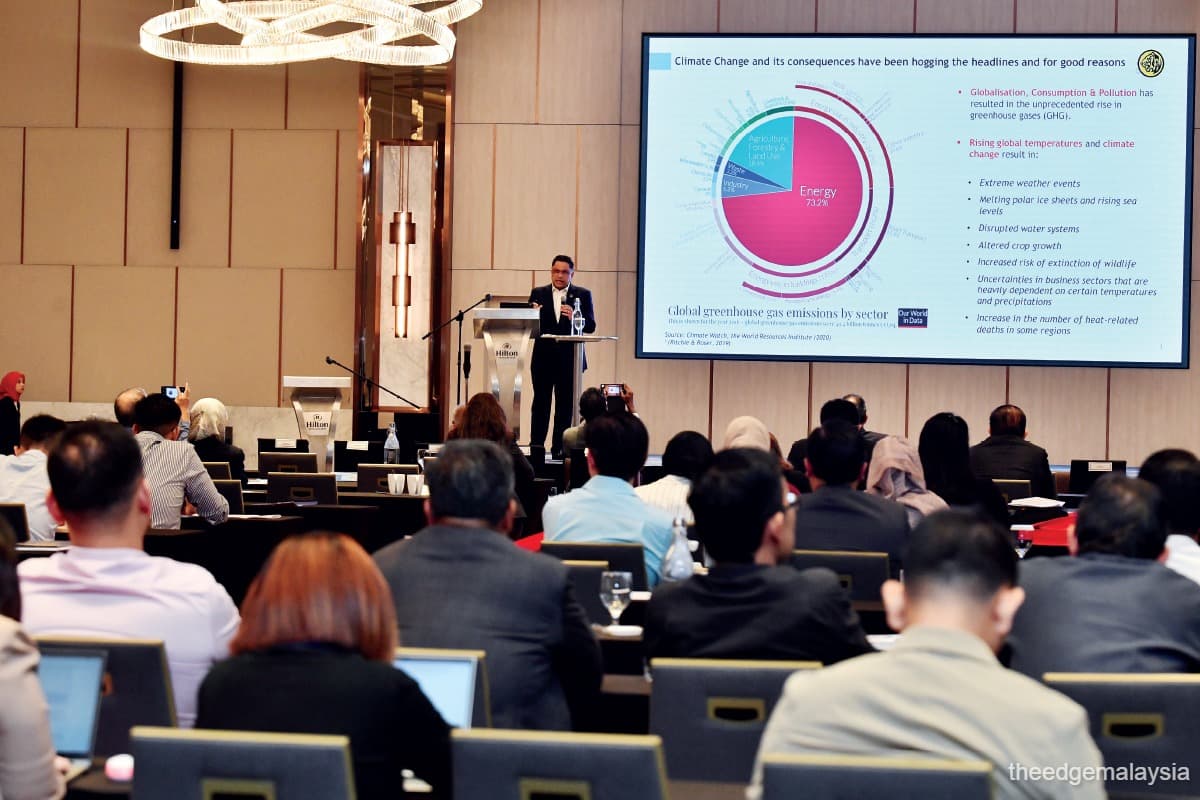
Datuk Shahril Azuar Jimin, group chief sustainability officer of Malayan Banking Bhd (KL:MAYBANK), acknowledged the crucial role of ESG elements in real estate for banks in managing risks, ensuring regulatory compliance and enhancing asset resilience.
In his presentation titled “Sustainability Reporting and Green Financing — Measuring and Reporting the Value Impact of Sustainability Initiatives”, Shahril said: “Banks use ESG criteria to assess the sustainability and long-term viability of real estate projects, which are a significant part of their lending portfolios.”
He noted that buildings contribute significantly to energy consumption and carbon emissions. Therefore, integrating ESG factors helps drive the shift toward greener, more energy-efficient properties, in alignment with global climate goals.
Shahril emphasised that sustainability efforts extend beyond new green buildings to include retrofitting existing properties. He said banks such as Maybank play a catalytic role by offering financing and advisory solutions to help developers, real estate investment trusts and corporations transition their portfolios. Tools such as emission calculators enable Maybank to quantify the carbon impact of every loan, enhancing transparency and accountability.
Shahril outlined key reasons that ESG is critical for banks: risk management and regulatory compliance, financial performance and asset valuation, market demand and reputation, and supporting climate goals. “The bad news is that the real estate industry is central to the climate problem, but the good news is that the sector is also part of the solution. With great power comes great responsibility. As the country’s largest bank, we are not the custodian of public funds but are positioned to move capital away from harm to the environment and towards positive social development.”
Save by subscribing to us for your print and/or digital copy.
P/S: The Edge is also available on Apple's App Store and Android's Google Play.