

This article first appeared in City & Country, The Edge Malaysia Weekly on September 22, 2025 - September 28, 2025
Once a pioneering force in the development of Desa Sri Hartamas in Kuala Lumpur, Malaysia Land Properties Sdn Bhd (Mayland) has kept a relatively low profile in recent years. But that is about to change.
“We are gearing up for a strong comeback,” Mayland managing director Lee Han Ming tells City & Country in an exclusive interview. “In the fourth quarter of 2025, we will unveil two new projects in Kuala Lumpur — one on Jalan Kuching and the other in Desa Sri Hartamas. I believe this will be the last opportunity to own landed property in the latter.”
Lee joined Mayland a year ago and has more than 20 years’ experience in township planning and development, having worked at companies such as Sunway Property, Naim Holdings Bhd (KL:NAIM) and Tropicana Corp Bhd (KL:TROP). He leads the group’s new property launches, with a mandate to elevate the brand and steer its next phase of growth.
“Mayland holds several prime land parcels in the Klang Valley and Johor — their value is waiting to be unlocked. My first task is to drive new launches, tapping into the potential of these sites while creating value for the company, refreshing the brand and rebuilding market trust,” says Lee.
For the remainder of the year, Mayland plans to launch two upscale residential projects in Kuala Lumpur: Majestic @ Kiara Reserve (Majestic Kiara) in Desa Sri Hartamas; and Royal Garden — the fourth phase of the master plan of Sri Putramas, on Jalan Kuching. The projects have a combined gross development value (GDV) of RM1.15 billion. The company also aims to almost double its sales this year to RM680 million, from RM380 million in 2024.

Lee says: “[Mayland founding chairman] Tan Sri David Chiu is a visionary; he has many ideas and sharp eyes. He is also very good at identifying high-potential land. Over the years, he has built up a total undeveloped land bank of 92 acres across prime locations like KL city centre, Damansara, Cheras, Semenyih, Sungai Buloh and Johor. These parcels carry an estimated total GDV of RM7.7 billion.
“We have ‘awakened’ now [after keeping a low profile in the past few years]. We plan to launch more consistently every year.”
Mayland’s subdued presence in recent years was partly because Chiu shifted his focus to his businesses in China after the pandemic.
“As much as he wanted to accelerate Mayland’s development, he simply couldn’t be in two places at once,” Lee explains.
Chiu is also chairman of Hong Kong-based conglomerate Far East Consortium International Ltd (FEC), whose core businesses are in property development, hotel operations and management, carpark operations and facilities management, as well as gaming operations across Mainland China, Hong Kong, Malaysia, Singapore, Australia, New Zealand, the UK and other parts of Europe. Founded in 1950 and listed on the Hong Kong Stock Exchange in 1972, FEC has gradually expanded its presence internationally, with significant growth in regions such as Australia and Europe from the mid-1990s onwards.

In 1994, Chiu entered the Malaysian property market through his private vehicle, Mayland. Two years later, the company launched its first project, Plaza Damas, which created a buzz in the local market. Since then, Mayland has grown steadily from a team of just six into a sizeable property developer with a diverse portfolio spanning property development, shopping malls and hospitality.
Development in Desa Sri Hartamas began with the MBF Property Services building, terraced houses and shopoffices in 1996 and 1997, recalls Mayland managing director Datuk Kevin Woo, who oversees the company’s other business divisions, apart from new property launches. Back then, a commercial hub was not a common feature of a residential area, unlike today. The integrated master plan — which includes a shopping mall, hotel, shoplots and high-rise residential towers such as Plaza Damas — was also rare.
“But Tan Sri’s vision was to create a small, capsule-style serviced apartment here, similar to those in Hong Kong, where apartments were already very compact 30 years ago, unlike Kuala Lumpur at the time,” explains Woo, a professional architect who also designed Plaza Damas.
“Tan Sri wanted shoplots without a back lane as well as a smaller built-up area for Plaza Damas to maximise space efficiency. Like many, I initially questioned this approach, especially given the challenges and criticism we faced from both the market and authorities. But we persevered, guided by Tan Sri’s motto: ‘You must always break thresholds and new ground.’”
The team built the first shophouses in Malaysia without back lanes, and later developed and fully sold the serviced apartment blocks in the Plaza Damas master plan — Windsor, Waldorf, Dorchester and Mayfair.

Woo recalls: “In our first 10 years, we focused on micro-apartments averaging 500 sq ft — very small units, very Hong Kong-style. Dorchester and Mayfair sold from RM280,000. The market was strong at the time. Rent for such a unit was about RM2,000 a month, which meant a yearly rental income of RM24,000. For a RM280,000 unit, that was an 8% return, unheard of in the market then. Those units sold extremely well and many buyers enjoyed good returns for years. This is how Mayland made its name in the market.”
The breakthrough product and success model propelled the company’s rapid growth in its first 10 years. Afterwards, management shifted its market strategy towards more premium offerings such as Sri Putramas, Dorsett Waterfront Subang in Subang, and Hampton Residences in Country Heights Damansara.
“When our product prices reached RM800,000 to RM1 million, we encountered some market resistance, followed by the Movement Control Order (MCO). Before and during the MCO, most of our products were priced between RM800,000 and RM1.5 million, which slowed growth,” Woo explains.
The team also faced internal challenges; despite project and staff expansion, company culture lagged behind. “We tried to transition from a small business into a corporate body before the pandemic. We launched Dorsett Waterfront Subang in 2018 and Hampton Residences in 2019. Then the pandemic and MCO hit, and sales fell short of expectations. Still, we have managed an average of RM380 million in annual sales since the MCO. Now, we’re optimistic about our two upcoming launches: Majestic Kiara and Royal Garden.”

New offering in Desa Sri Hartamas
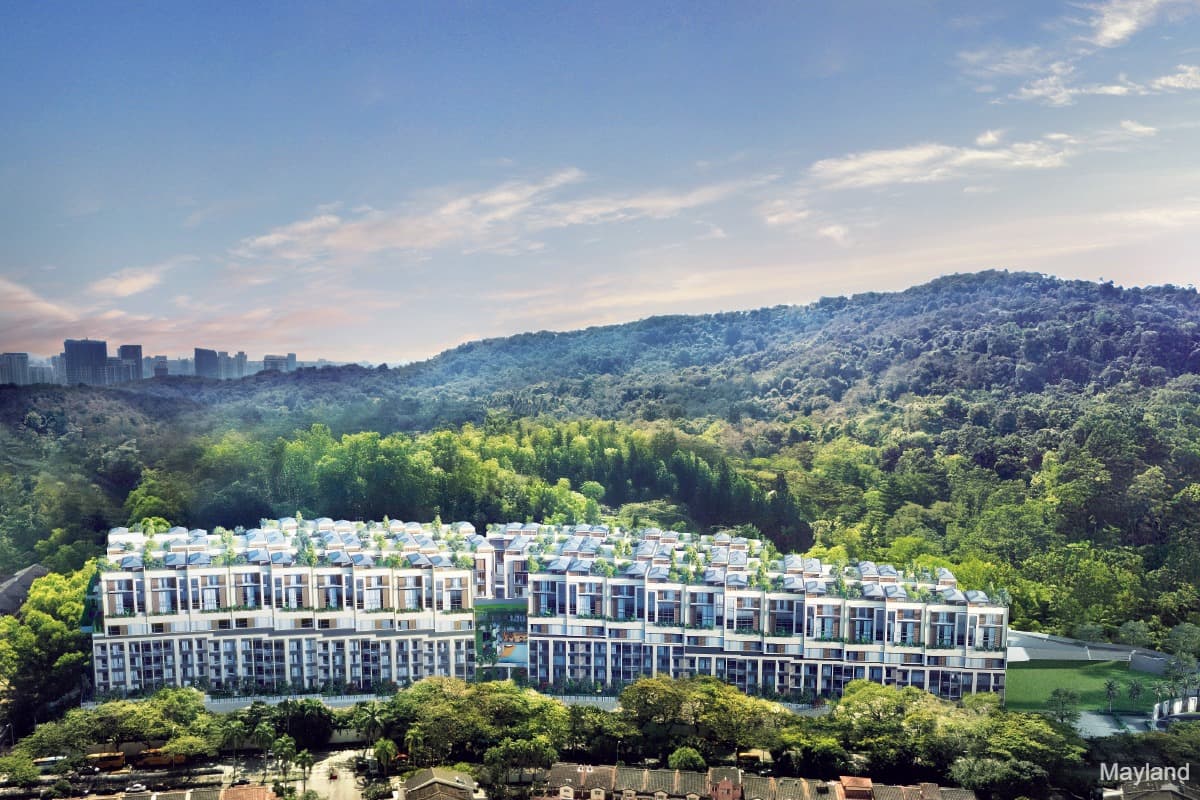
Majestic Kiara is a freehold, 4.8-acre residential development in Desa Sri Hartamas featuring villas, parkhomes and condominiums. The project, which has a GDV of RM551 million, will be developed in two phases, with the first phase comprising 79 villas and 57 parkhomes, set for launch in 4Q2025.
The 4-storey villas offer built-ups ranging from 3,800 to 4,941 sq ft, with three to five bedrooms. Prices start from RM3.2 million. Key features include EV charging points, solar panels, a rainwater harvesting system, sky deck and courtyard garden or private terrace. Selected units will also have private home lifts.
The parkhomes, located on a 4-storey podium beneath the villas, have built-ups between 2,293 and 2,314 sq ft, each with 3+1 bedrooms and five bathrooms. Prices start from RM1.6 million.
Lee points out that, whereas some high-rise projects offer a limited number of units with same-level parking — often marketed as “landed homes in the sky” — Mayland’s parkhomes take the concept further. “All 57 units have at least three side-by-side carpark bays right at your doorstep, just like landed homes. We also provide a parcel locker and storage cabinet at the car porch.”
He adds that, with the pillars in place, installing a gate to enclose the car porch — like a landed home — is possible, subject to approval from the joint management body or management committee after handover.

The elevated parkhomes concept leverages the site’s natural hilly, elongated terrain, which the developer preserved instead of flattening to maximise buildable space.
“As we grow, we are more aware of our environmental responsibility,” Lee says. “We want to minimise construction impact, especially since our site borders the Bukit Kiara forest reserve. That’s why we built a 4-storey podium to ‘flatten’ the terrain.”
He points out that the podium’s height offers unobstructed views of Desa Sri Hartamas and Mont’Kiara. “We thought, ‘What a waste if only the cars get to enjoy the view!’ So, we spread 57 parkhomes across the podium, all with clear views, making these sky landed homes with private car porches a reality.”
Apart from the parkhomes and underground parking for villas and condominiums in Phase 2, the podium also houses a 4-storey clubhouse exclusive to parkhome and villa residents. Facilities include an infinity pool, gym, children’s indoor and outdoor playgrounds and a lounge. Maintenance fees are estimated at 60 sen psf.
The podium design also created space for a row of premium 4-storey villas with city views, says Lee.

Phase 2, Majestic Kiaraview, features a 10-storey block atop the last eight 4-storey villas and is located at the site’s highest point. It comprises 93 condominiums with built-ups ranging from 1,300 to 1,500 sq ft and that are priced from RM1.3 million.
“We don’t want to overbuild next to the forest reserve. Ninety-three units in a 10-storey building is just right, allowing us to maximise forest and city views, natural sunlight and ventilation for every unit,” Lee explains.
Condo residents will enjoy an infinity sky pool with city views, sky garden and sunset lounge, gym, sky jogging track, children’s playground and EV charging bays. Maintenance fees are estimated at 55 sen psf.
“We planned to launch Phase 2 next year, but may bring it forward because Phase 1 has received overwhelming response. Registration of interest is three times the total units of Phase 1, with most potential buyers from the neighbourhood and many showing strong buying profiles,” he adds.

Resort in the city
Also launching in 4Q2025 is Royal Garden, located off Jalan Kuching. It marks the fourth and final phase of the larger Sri Putramas high-rise master plan. The first three phases — Sri Putramas 1 (completed in 2004), Royal Domain (2007) and Royal Regent (2013) — comprise a total of 2,896 units.
“The location is superb,” says Lee. “It’s just minutes from MiTEC and the KL city centre. The first three phases are thriving and have delivered good returns to buyers. We no longer need to highlight the site’s potential.”
Carrying the theme of “resort in the city”, the 2.3-acre freehold Royal Garden has a GDV of RM600 million. The low-density development will offer 600 condominium units across two adjoining, L-shaped towers of 30 and 31 storeys. Unit sizes range from 1,230 to 2,241 sq ft, each with at least three bedrooms and two bathrooms. Prices start from RM650,000.
“The market has changed. There is strong demand for larger high-rise units close to amenities,” Lee notes. “Every unit includes a maid or utility room with a small bathroom, a sizeable yard that can be converted into a proper wet kitchen, and a balcony large enough for a table and chairs — perfect for morning coffee,” Lee adds.
Level 6 features 50,000 sq ft of landscaped facilities, including an infinity pool, Jacuzzi, sunken seating, yoga garden, mounding lawn, terrace garden and urban farming. Thanks to the L-shaped configuration, all units face either the facilities level or the city skyline. “There are also 11 cabana units overlooking the 50m pool, each with terraces more than 12ft wide,” says Lee, adding that six penthouses with rooftop landscaping are already fully booked.
Mayland is planning an official launch in October. “Given the location and pricing, we’re confident in the product’s appeal,” Lee says, noting that the fully booked penthouses — the largest units — are a clear indicator of strong demand.

Repositioning Mayland
While Mayland is confident of achieving RM680 million in sales this year — driven mainly by the two upcoming launches and remaining inventory from earlier projects — it is also working on corporate exercises to strengthen its financial position and structure.
“We’re preparing a REIT (real estate investment trust) IPO for our hospitality division, with plans to inject all six Dorsett hotels in Malaysia owned by Tan Sri into the REIT,” says Woo. The goal is to reach RM1.3 billion in assets under management and raise RM600 million from the market, part of which will fund the company’s student housing venture.
In July, JLand Group, the real estate and infrastructure arm of state-owned Johor Corp (JCorp), signed framework agreements with Chiu’s Far East Consortium Australia (FEC Australia) and Mayland to explore joint development opportunities in Australia and Malaysia.
JLand will partner with FEC Australia on mixed-use projects, including purpose-built student accommodation, in major Australian cities such as Melbourne and Perth. Meanwhile, the Mayland partnership will focus on activating JLand-owned land in Johor Bahru through joint ventures aligned with the Johor-Singapore Special Economic Zone.
Woo says the company plans to jointly develop two parcels totalling 13.5 acres in Johor Bahru with JLand, with one earmarked for 1,000 landed houses. Mayland is also looking to launch student housing projects in the Klang Valley. The details of both projects are still being finalised.

Lee adds that property development contributes about two-thirds of the company’s revenue, followed by hospitality. “We are satisfied with this balance but aim to grow through the ongoing REIT IPO and new property ventures. But property development remains our core business,” he says.
Next year, Mayland plans to launch three projects with a combined GDV of RM1.53 billion: Regent Park in Damansara (RM530 million); Sorrento Semenyih Villa in Semenyih (RM400 million); and Parc Regency 2 in Johor (RM605 million). The company is also targeting RM800 million in sales.
This signals a clear expansion path for Mayland to re-enter the premium market, with launches exceeding RM1 billion in GDV and larger township and integrated developments.
Lee envisions the company transforming into a growth-driven developer with both immediate and long-term impact. “With a pipeline exceeding RM7 billion GDV, and new launches progressing from RM1.15 billion in 2025 to RM1.53 billion in 2026, we aim to build not merely projects but also communities, trust and sustainable futures,” he says.
Save by subscribing to us for your print and/or digital copy.
P/S: The Edge is also available on Apple's App Store and Android's Google Play.