

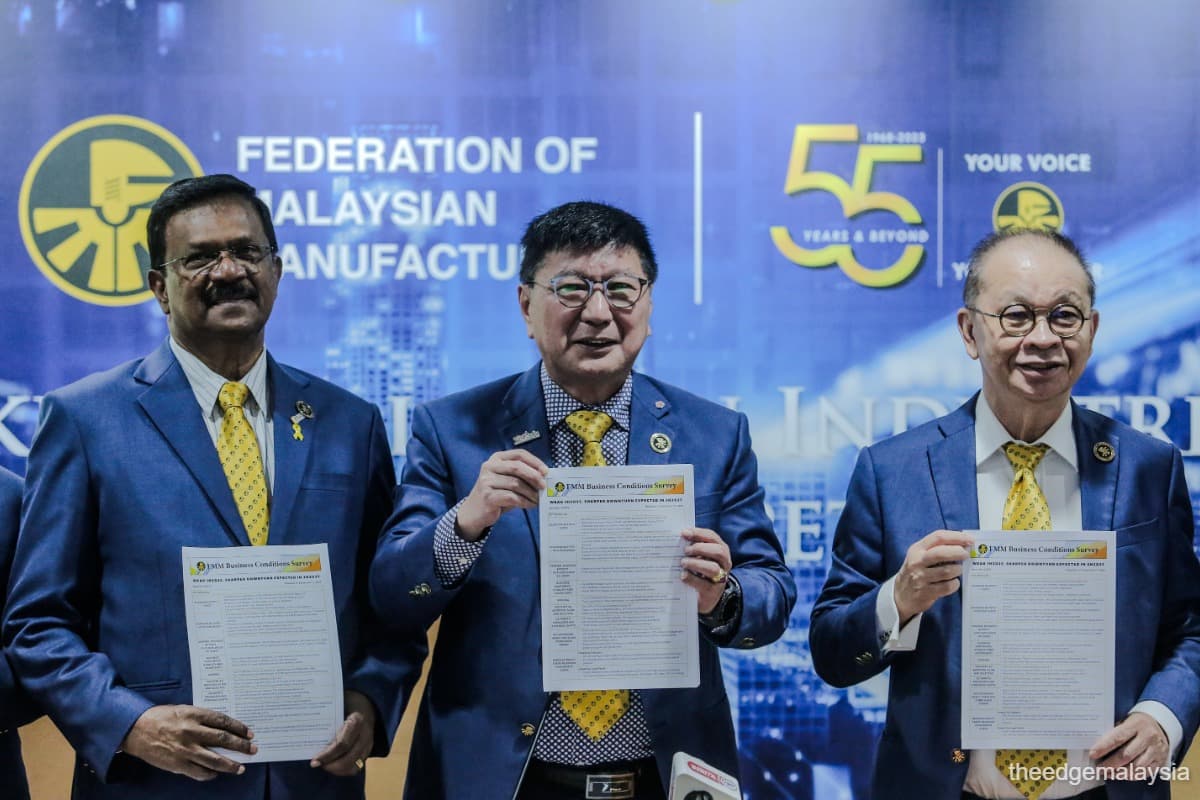
KUALA LUMPUR (Sept 17): Barely over a month after US tariffs come in force, three out of four Malaysian manufacturers are already reporting a hit to export sales.
More than half of exporters affected by US tariffs reported under-10% fall in sales while about one-third saw decline of between 10% and 30%, according to a poll by the Federation of Malaysian Manufacturing (FMM). The remaining 13% suffered a drop of over 30% in shipments to the US.
While US tariffs are borne by importers, American buyers are likely to squeeze Malaysian exporters on pricing, which will reduce margins for Malaysian exporters, said FMM president Tan Sri Soh Thian Lai.
An exemption of electrical and electronics products however softened the blow, he said following the release of latest Business Conditions Index survey.
The survey, which drew 627 respondents nationwide, was conducted from July 2 to Aug 15.
Malaysian goods exported to the US will be subjected to a 19% tariff effective Aug 1 while transhipments now face an additional punitive 40% tariffs. Semiconductor exports to US, however, are exempted from the tariffs for now.
In response, Soh said manufacturers are diversifying export markets, re-evaluating supply chains, increasing automation and efficiency and adjusting product pricing to mitigate the adverse effects of US tariffs.
Manufacturers are also calling for stronger government support, particularly through trade promotion for market diversification and financial incentives for re-shoring and local content to help companies remain competitive, he added.
Taxes and tariffs
An expansion in the sales and service tax effective July this year is adding to burdens of manufacturers, affecting 94% of the respondents.
Of the affected firms, 44% indicated significant impact due to added compliance burdens and cost increase, 11% reported major disruption, such as the need to alter business models or scale down operations, and about 39% faced minor impact.
Manufacturers are facing difficulty in determining the correct sales tax classification and obtaining or applying exemptions for raw materials and input, the need to upgrade internal systems, and uncertainty or delays in obtaining customs rulings, among other challenges.
To avoid cascading costs, Soh is renewing the call for the reintroduction of the goods and services tax as a fairer tax system.
Further, 60% of firms saw higher costs following the increase in electricity tariffs, spurring growing interest in the adoption of renewable energy for the manufacturing industry.
However, the adoption for renewable energy today is still limited and there is significant momentum building towards solar and grid-linked renewable schemes, making renewable energy a growing focus for manufacturers going forward, Soh added.