

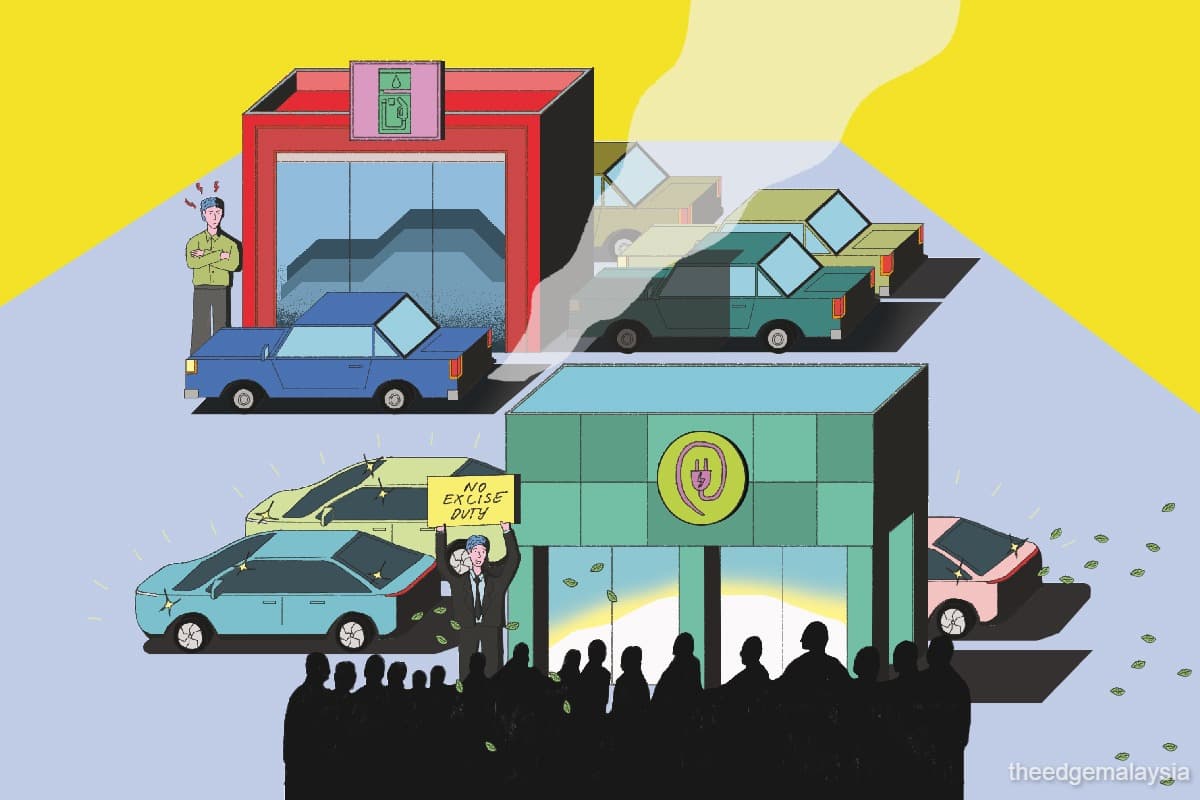
This article first appeared in The Edge Malaysia Weekly on September 15, 2025 - September 21, 2025
THE Thai and Indonesian automotive industries have been under pressure since 2024 as the demand for new cars shrank by double-digit percentage points in these top two car markets in Southeast Asia. While economists blamed the decline on household indebtedness in Thailand and eroded purchasing power in Indonesia, auto players point a finger at Chinese carmakers’ price war.
Car sales in Thailand fell 25% year on year (y-o-y) to 633,000 units in 2024, while the Indonesian market saw 13% fewer vehicles sold at 865,700 units. Thailand slipped to third largest in the region in terms of total industry volume (TIV), behind Malaysia, where sales of new vehicles reached an all-time high of 816,747 units, thanks to the government’s favourable policy on electric vehicles (EVs) and backlog of orders.
While the Malaysian auto market is still rather protected compared with its regional peers, the situation in Thailand and Indonesia should serve as an alarm bell for Putrajaya, given that the auto industry is a major sector in Malaysia’s economy, contributing 5% or RM82 billion to the country’s gross domestic product (GDP) and employing more than 700,000 workers.
“The Malaysian automotive sector is still rather insulated compared with Thailand and Indonesia, thanks to the protectionism measures that the government has put in place over the last three decades. What’s happening in Thailand and Indonesia is a result of their governments’ liberal approach to promoting the automotive sector,” says an industry player.

In Malaysia, it is hard to miss the Chinese automakers’ aggressive marketing strategies. This is evident driving around Petaling Jaya’s Section 13. What used to be a neighbourhood dominated by long-established Japanese and continental brands is now a battlefield for Chinese carmakers like BYD, Chery Automobile Co Ltd, Great Wall Motor and GAC.
Since 2022, Chinese automakers have rushed into Southeast Asia in search of new markets hungry for competitively priced products. This came as the economy at home softened while an oversupply of EVs led to irrational pricing strategies by the automakers, forcing them to look outside China.
Malaysia and Thailand have set targets of 20% and 30% EV out of their respective TIVs by 2030, while Indonesia is aiming for 2.2 million EVs on the road by then. Achieving these targets means opening their markets to imports as a way of “market seeding”.
Generous incentives have been offered by Malaysia and Thailand to encourage EV adoption. In Malaysia, tax exemptions have been given to imported EVs from 2022 to 2025 and to locally assembled completely knocked-down (CKD) units until 2027.

Under pressure at home and supported by the country’s massive industrial ecosystem, Chinese automakers rushed into these markets, armed with cut-throat pricing strategies made possible by their unparalleled low cost base.
Malaysians now have more options than ever and at attractive prices. At the last count, there are at least 15 Chinese auto brands in the country.
The price war that ensued has led to market distortion. The incumbents, which priced their cars between RM100,000 and RM200,000, are finding themselves in a fierce competition, especially for those selling internal combustion engine (ICE) and hybrid vehicles.
The sales of Mazda and KIA cars, for example, which are distributed and sold by Bermaz Auto Bhd (KL:BAUTO), have already felt the impact from the influx of Chinese brands. Tan Chong Motor Holdings Bhd (KL:TCHONG), which distributes and sells Nissan cars, is falling deeper into the red (see accompanying story).

However, as Malaysia’s automotive market is still dominated by national brands Perusahaan Otomobil Kedua Sdn Bhd (Perodua) and Proton Holdings Bhd, analysts are not expecting car sales to collapse like in Thailand and Indonesia last year.
But cracks are appearing in the automotive industrial complex in Malaysia. Foreign carmakers that have invested millions of ringgit in the past are now in a quagmire.
“For every 10 cars sold in Malaysia, at least two units are likely to be CBU (completely built-up) EVs, meaning that at least two CKD players and their auto parts suppliers are seeing their market share shrinking,” says a market observer. “The question is, how will auto companies that have been investing here cope with the newcomers that are getting tax exemptions for CBUs?”
Automotive groups cannot withstand Chinese onslaught
In Malaysia, Stellantis NV, which took over the distribution and sale of the Peugeot and Citroen brands in 2023 from Bermaz, is taking a back seat with these two marques for a while, avoiding the ongoing price war by the Chinese brands.
Stellantis managing director for Asean Isaac Yeo says that without the kind of supply chain ecosystem that China has, European brands, which are operating on a higher cost base, will not be able to compete against the Chinese carmakers.
“Today, the market in Malaysia is being strongly affected by Chinese brands — price, positioning, product, specs. In the past, when we saw an auto tailgate or electric seats … that’s not basic, that’s something I want and I’m going to pay for it. Today, it’s different. It’s a basic standard feature — your want has become a basic need. And this is what the Chinese products bring to us,” he points out.
Yeo acknowledges that Peugeot’s cost structure is too high for it to be competitive in today’s market. As a result, the group is scaling back while working on its cost structure by increasing the supply of parts locally and in the region.
“In order to be able to manage a good costing, your supply line is very important. China’s supply lines are all inbuilt, where they don’t have extra, hidden costs like they have in Europe that creates a lot of unseen fixed costs,” he says.
Stellantis has an assembly plant in Gurun, Kedah, which Yeo says is its most important assembly facility in Asia-Pacific. The facility has a manufacturing capacity of up to 60,000 units annually, for sale domestically and export to Thailand, Cambodia and the Philippines. It is not known at what level of capacity the Gurun plant is currently operating.
The influx of Chinese-made cars has also led to unsold inventory, or pre-registration cars, being sold as “used cars” in Malaysia, according to a used-car dealer. As these cars — often EVs — are sold at marked down prices, it makes the new cars less competitively priced.
“Why would you want to buy a new EV at RM150,000 if you know that in a year or two, the same model will be sold for RM90,000? A depreciation of more than 30% within two years is too much for anyone to stomach,” says the dealer. He also highlights that the price war in Thailand and Indonesia is among the factors that led to shrinking car sales last year.
The practice of selling new cars as used adds to the hyper-competitive landscape of a market already rife with cheaper models, putting more pressure on distributors to further slash prices, or risk being priced out entirely.
No doubt, the tax exemptions given to imported EVs have lowered the cost of ownership in a mobility technology that can still be considered rather niche in the country. The EV market share grew to 4.2% between January and July 2025, from 2.9% in the same period in 2024.
However, the policy resulted in a price war instituted by automotive companies, especially those from China, creating a situation where some consumers are waiting for car prices to drop further. This then cascades into fewer orders for automotive parts manufacturers and other supporting vendors, slowing the demand for other goods and services consumed by the vendors themselves. As a result, Malaysian automotive groups — mostly distributors and assemblers — are facing a challenging time.

If you can’t beat ’em, join ’em
It is clear that legacy brands from Japan and Europe, especially those with cars priced in the RM100,000 to RM200,000 bracket — the market in which most Chinese automakers are playing — are losing out.
Mazda went from being the sixth-largest car brand in Malaysia, with 14,517 units sold in 2022, to ninth as at July 31 this year, with only 4,761 units sold. Nissan slipped further down the list of the top 10 most popular brands in 2024, from sixth in 2021.
Nevertheless, Bermaz and Tan Chong are not ready to throw in the towel. Instead, they have aligned themselves with Chinese automakers. Bermaz partnered with Xpeng in 2024, while Tan Chong recently announced a tie-up with SAIC-GM-Wuling Automobile to tap into the EV space.
Understanding that the market is driven by price, Stellantis too will leverage China’s industrial ecosystem for its own advantage. The group owns a 20% stake in Zhejiang Leapmotor Technology Co Ltd, a Chinese EV start-up, and 51% of Leapmotor International.
Stellantis has invested €5 million (RM24.67 million) to prepare its Gurun plant for the assembly of Leapmotor C10 — an electric SUV — which will commence at end-2025. The C10 was launched in October 2024 at RM149,000 — a steal in the SUV D-segment.
“If you want to be relevant in the market, naturally you would have to use the same supply chains and accounting methodology to play with the Chinese. This is why I [Stellantis] have Leapmotors,” says Yeo.
Mercedes-Benz Malaysia (MBM) CEO and president Amanda Zhang says that while there are clear signs that the consumers’ mindsets are shifting towards EVs, the transition will take time.
“That is why MBM continues to support customers in transitioning at their own pace. Our full ICE, PHEV (plug-in hybrid electric vehicle) and EV line-up, along with flexible ownership programmes, enable each driver to make the move when they feel ready,” she adds.
Zhang points out that the key considerations influencing purchase decisions remains cost and resale value. Drivers may hesitate to transition if they are unsure about the residual value of a vehicle at the end of the finance term. MBM addresses this through its financing plans that guarantee the future value of the Mercedes-EQ, the luxury car maker’s line of EVs.
Sime Darby Bhd (KL:SIME) had the benefit of foresight when it brought in BYD Auto Co Ltd in 2022. Sime Darby, which has long been associated with European brands BMW, MINI and Rolls-Royce, now commands the largest non-national EV market in Malaysia, with BYD becoming the best-selling EV brand in the country and seventh overall as at July 2025.
Sime Darby also benefits from the CKD operation of Chinese cars through Inokom Corp Sdn Bhd’s assembly plant in Kulim, Kedah. It is the largest shareholder of Inokom with a total equity interest of 56% through Sime Darby Motors Sdn Bhd and Sime Darby Hyundai Sdn Bhd.
The other shareholders of Inokom are Bermaz — which owns a 29% stake in the contract assembler of Mazda, KIA, Hyundai and, recently, Chery cars — and Hyundai Motor Co with 15%.
Within just eight months of the CKD operation for Chery vehicles, Sime Motors had produced 10,000 units by early March 2024 and already expanded the production lines to assemble even more models by the Chinese carmaker.
Although not isolated from the impact of slowing car sales in China, Sime Darby’s motor division registered a respectable performance in the financial year ended June 30, 2025 (FY2025), with revenue slipping only 7.85% y-o-y. However, the lower share of results from associates may be an indication of weaknesses in Inokom’s operations.

Perodua and Proton’s divergent strategies
While others seem to have jumped on the bandwagon by importing Chinese EVs, Malaysia’s largest carmaker Perodua is taking the road less travelled by developing its own EV model and technology.
This is especially so because Perodua’s major shareholder and technical partner, Toyota Motor Corp, is not as aggressive as the Chinese carmakers in pursuing EVs. The group is taking a multi-pathway approach when it comes to reducing carbon emissions, rather than focusing solely on EVs.
“We [Perodua] are not just going to roll over and take a beating from the Chinese carmakers,” says a Perodua executive, on why the group is investing perhaps billions of ringgit to develop its own EV.
Perodua is slated to launch its first EV, called the QV-E, by December this year. The model is expected to be priced as low as RM80,000, reportedly using a “battery leasing” concept.
It is imperative for Perodua to have a competitively priced product to protect its home turf from the onslaught of the Chinese carmakers. While it is currently still the nation’s largest carmaker, there is no certainty that the group will remain so in the future.
In line with the anticipated lower TIV this year, Perodua had expected lower sales. However, as the year progresses, it appears that the affordable market segment is more resilient than others.
As at July, Perodua’s sales had slipped 1.1% y-o-y to 199,674 units from 201,944 units in the previous corresponding period. This is better-than-expected results, given that the Rawang-based automaker had to halt production several times this year to install new equipment and upgrade some of its facilities.
Perodua has upgraded its sales targets for 2025 to 355,000 units from 350,100 units previously. The new target translates into a decline of only 0.9% from its sales in 2024, compared with an expected decline of 4.9% earlier.
At the other end of the spectrum, Proton is benefiting from having Zhejiang Geely Holding Group Co Ltd as its 49.9% shareholder. The Proton eMAS 7 — developed based on Geely’s EX5 EV — has become the best-selling EV model in the country this year, surpassing BYD.
However, the group is not immune to the disruptions in the automotive market. Its sales dropped 2.24% to 147,587 units in 2024. As at end-July, Proton had registered sales of 82,953 units, which if annualised, would result in the Shah Alam-based automaker recording lower sales this year than in 2024.
Proton had not responded to requests for comments as at press time.
EV tax exemption policy explained
The tax exemptions granted to imported EVs are part of a deliberate Phase 1 market seeding strategy aimed at raising awareness, stimulating demand and preparing for subsequent phases of local assembly and ecosystem development.
“The excise and import duty exemptions for CBU EVs introduced in 2022 have been instrumental in accelerating EV adoption in the country. Malaysia has already attracted substantial investments from leading Chinese automotive players across multiple segments, reinforcing the country’s position as a strategic hub for next-generation mobility,” says Azrul Reza Aziz, CEO of the Malaysia Automotive, Robotics and IoT Institute (MARii).
Besides the planned localisation of Proton eMAS 7 in Tanjung Malim, Perak, as well as Leapmotor C10 in Gurun, Chery and BYD are also investing in their own full-scale assembly plants.
After three years of benefiting from Malaysia’s tax-free policy for imported EVs, BYD is investing in a 600,000 sq m production plant in KLK TechPark, Tanjung Malim, with production expected to commence in 2026.
Meanwhile, Chery is investing RM2.2 billion in its assembly plant in the Beringin High-Tech Auto Valley in Hulu Selangor, Selangor. The plant will have an initial annual production capacity of 100,000 units, which can be expanded to 300,000 units.
“These investments go far beyond vehicle assembly. They facilitate technology transfer, create opportunities for local vendors, generate high-value jobs and open pathways for intellectual property development,” says Azrul.
“Collectively, they contribute to building a resilient and competitive automotive ecosystem, positioning Malaysia as a key player in the regional and global EV landscape,” he adds.
While the policy has led to the rapid growth of EVs’ share of the new car market, some believe it might not lead to a lot of investments in the manufacturing or assembly side, as the sales are not enough to justify the capital outlay.
“With just EV imports, this has not really helped the manufacturing side of EV component parts in Malaysia,” says Datuk Francis Lee Kok Chuan, group CEO of Bermaz, in a text message.
Although Bermaz is among the most affected by the influx of Chinese EVs and ICE cars, Lee is a believer in the government providing long-term incentives to encourage automotive companies to invest in the local assembly of EVs in Malaysia.
“The early adopters have already bought EVs. So, unless there is a holistic change in thinking to encourage more EV adoption, like giving cash subsidies to buy EV cars in certain countries, I do not see EVs having a huge impact on the TIV in Malaysia,” he says.
Chery Auto Malaysia vice-president Lee Wen Hsiang concurs, saying that to further strengthen EV adoption, the government could extend the tax exemption to individual EV owners, and not just manufacturers. “This would reinforce public confidence, lower the barrier to entry and incentivise more consumers to make the switch to electric mobility,” he adds.
The exemptions on excise duty and import tax for CBU EVs are ending this year, leading to major players Chery and BYD investing heavily in local assembly operations in order to continue benefiting from the tax holiday on CKDs up to 2027.
Without the tax exemptions, EVs will not be competitive in Malaysia, due to the high excise duty imposed on imported cars. If the policy is not extended or lifted gradually, it could result in another shock to the market as prices will increase dramatically overnight. Then there is the impending expiry of the RM100,000 minimum price on CBU EVs — by the end of 2025 — potentially leading to a price war with even cheaper imported models.
It looks like the automotive industry could still be in for a challenging time in 2026 unless a catalyst, possibly in the form of a more balanced policy, is put in place.
EV competition reshaping used-vehicle trends
The price war in the automotive sector is not something new. Walk into any showroom and one is likely to be greeted by a wave of discounts and rebates. Nevertheless, the intensity of the competition has escalated in recent months with the influx of Chinese automakers vying aggressively for market share, especially in the electric vehicle (EV) segment.
“Discounts and rebates are good for consumers in the short term, especially in gaining interest among consumers to opt for EVs. But in the long run, it is not sustainable as the value of cars remains uncertain and could drop drastically,” says a market observer.
“That is what is currently happening in Thailand as consumers opt to not buy cars today, waiting instead for more discounts or better promotions,” he adds.
In other words, while today’s deals might benefit new buyers, there is a growing concern. What happens to those who bought cars earlier, before prices started sliding? How is this impacting the second-hand car market, especially for relatively new vehicles?

Another market observer points out that many used-car dealers prefer not to stock up on vehicles aged less than five years as the price can change drastically due to competition from newer models that are entering the market.
“Owners of new cars may be reluctant to sell at a loss, especially when market prices are being driven down by ongoing promotions and newer models coming in at lower price points. This trend is putting pressure on the value of newer second-hand cars, creating a widening gap between new and used-vehicle pricing,” he says.
Nevertheless, Carsome Group chief business officer Aaron Kee says the used-car sector remains buoyant, and the group has not seen a major influx of almost-new vehicles, particularly those between one and two years old. “This is often due to the steep depreciation these vehicles experience shortly after purchase,” he tells The Edge.
Interestingly, demand remains strong for vehicles aged between seven and 10 years, he says. “This segment continues to attract buyers looking for a better balance of value, reliability and affordability in the used-car market,” he adds.
Buyers in this segment are typically less concerned about the latest technology or incentives, and more focused on practicality and cost of ownership, particularly with petrol and hybrid vehicles still dominating this range.
Looking at the data provided by Carsome (see chart), the gap between the prices of new and used cars narrowed between 2022 and 2024, which could potentially impact the used-car market in the near term.
According to Carsome, EVs tend to depreciate faster than internal combustion engine (ICE) vehicles in the first three to five years, subject to factors such as battery condition, technology advancement, limited number of used EVs for price comparison, brand longevity and reliability.
Having said that, Carsome is in the midst of opening its first EV inspection centre to create a more robust marketplace for this segment.
Giving used EVs a second life
As EV adoption gains ground in Malaysia, there is a need for a robust second-hand EV market. Recognising this gap, Sime Motors launched earlier this year EV NEXT, Malaysia’s first dedicated dealership for used EVs.
EV NEXT functions as a one-stop centre offering used EVs for retail, trade-ins, after-sales support and servicing — addressing key consumer concerns about battery health, resale value and maintenance.
“Since its launch, EV NEXT has been well received. We’ve seen encouraging interest from customers, with a wide selection of EV models across different segments and price points. This variety allows us to meet different needs and lifestyles, particularly among early adopters who are eager to experience driving an EV for the first time,” says Sime Motors managing director for Southeast Asia Jeffrey Gan.
“As the market for EVs grows, we believe EV NEXT plays an important role in making EV ownership more accessible while supporting the development of the wider EV ecosystem in Malaysia.”
What’s next for used-car market?
As the EV price war continues and more models enter the market, especially from aggressive Chinese brands, the second-hand car landscape is likely to shift further.
If prices keep falling, more almost-new vehicles may end up in the market sooner than expected, forcing dealers to rethink trade-in values and financing strategies. Meanwhile, initiatives like Carsome’s inspection centre for EVs and EV NEXT indicate that some players are already preparing for this new era — one where used EVs become as normal an option as used ICE cars.
Until then, for most Malaysians, the seven- to 10-year-old ICE vehicle remains the preferred choice for value and peace of mind.
Save by subscribing to us for your print and/or digital copy.
P/S: The Edge is also available on Apple's App Store and Android's Google Play.