

This article first appeared in The Edge Malaysia Weekly on September 8, 2025 - September 14, 2025
THE chaos at supermarket checkout counters as a result of allowing some 22 million Malaysians to claim RM100 credit each over the Merdeka long weekend should have been better anticipated, but Putrajaya may have a way to be fair to all Malaysians when it comes to the RON95 subsidy retargeting.
“The prime minister has said the government will study options where at least 90% or more Malaysians are not affected when RON95 subsidies are retargeted,” Finance Minister II Datuk Seri Amir Hamzah Azizan said in parliament on Aug 25, clarifying that the subsidies are not necessarily limited to the bottom 85% of the rakyat.
This was in reply to a question by Malaysian Chinese Association (MCA) president Datuk Seri Wee Ka Siong on the subsidy rationalisation for RON95 fuel, including the government’s definition of the T15 or so-called “Top 15%” that may no longer receive subsidies, and if there is an avenue for appeal.
If at least 90% or more could benefit from the RON95 subsidies, there is still a chance that every Malaysian will receive a subsidy but in a more equitable manner. More on this later.
In his reply, Amir Hamzah had also said the criteria for RON95 subsidy retargeting had not been finalised.
Yet, Prime Minister Datuk Seri Anwar Ibrahim must already have had a plan in mind when he announced on July 23 that the retail price of RON95 would be lowered to RM1.99 per litre for Malaysians, from RM2.05 per litre currently. Details on the subsidy rationalisation would be out by the end of this month, Anwar had said.

It is perhaps no coincidence that Malaysians above 18 are being given RM100 to be spent on necessities, ranging from food and personal hygiene to approved medication and school supplies, by producing their identity card (MyKad).
Malaysians who need the money the most are probably among those in the long queues since redemption opened on Aug 31. Others are waiting for the crowds to disperse as there are close to four months to Dec 31, 2025, when the RM100 credit redemption expires and unclaimed amounts are redirected to those who need them.
According to data from the Ministry of Finance (MoF), a total of 4.8 million persons — or 21.8% of 22 million Malaysians aged 18 and above — have redeemed a total of RM312.6 million or 14.2% of the RM2.2 billion allocation in the first four days of redemption for the special Merdeka RM100 Sumbangan Asas Rahmah (SARA) credit under MyKasih, which usually caters to 5.4 million SARA aid recipients (see Charts 1 and 2).
Notwithstanding reports of an initial system outage due to overwhelming usage on the first day, the MoF said the redemption success rate had increased from 79% on Aug 31 (day 1) to 95% on Sept 2 and 99.7% on Sept 3.
The MyKasih system had initially only prepared for about 2,000 SARA transactions per minute despite having 22 million potential users, given that transactions had averaged 540 per minute for the original 5.4 million SARA aid recipients. However, capacity was reportedly increased to 15,000 per minute on Sept 2 after redemptions surged above 5,000 per minute on Sept 1 (see Chart 3).
Why retargeting has to happen
What does this have to do with RON95 subsidy retargeting?
There are at least three key issues with continuing to keep Malaysia’s RON95 price artificially low over a prolonged period. The first is that cheap fossil fuel means less motivation to save money and the environment by car-pooling, walking short distances or moving to greener alternatives like electric vehicles (EV).
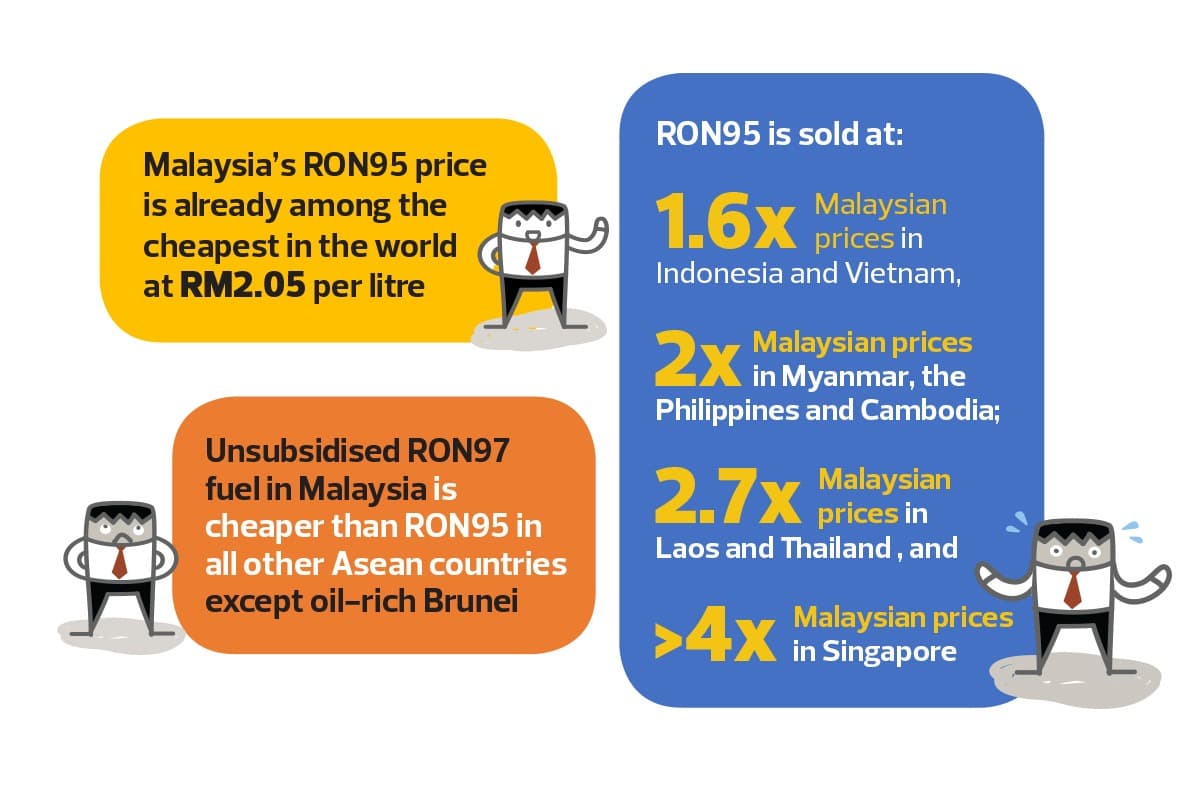
Second is heightened danger to local law enforcement officers who have to battle armed smugglers tempted by the huge arbitrage, as RON95 fuel is being sold at 1.6 times Malaysian prices in Indonesia and Vietnam; double Malaysian prices in Myanmar, the Philippines and Cambodia; 2.7 times Malaysian prices in Laos and Thailand; and more than four times Malaysian prices in Singapore (see table).
Third, and most importantly, is that past studies, including those done by Bank Negara Malaysia, show that 53% of fuel subsidies goes to the top 20% of households (T20), while 32% goes to the middle 40% (M40) and only 15% goes to the bottom 40% (B40).
Reworking subsidies to benefit the lower- and middle-income group more than the higher-income group is probably among Putrajaya’s key motivations in retargeting subsidies, on top of expanding fiscal resources.
Due to generally low wages in Malaysia, however, many professionals with families and middle managers who see themselves as middle income find themselves falling into the T20 or even the T15 group. Not only does the approach alienate those already paying personal income tax and contributing to their retirement savings, coming up with the right definition of who to exclude is also problematic. For instance, it is possible for a five-person household with three people earning less than RM5,000 a month living together to hit the RM13,000 a month so-called T15 income threshold.
Being fair to all
That a quota system was also being considered for the RON95 subsidy rationalisation has been mentioned by key MoF officials, including Amir Hamzah as well as Treasury secretary-general Datuk Johan Mahmood Merican.
They did not provide details apart from citing examples from the electricity and diesel rationalisation, where the lower- and middle-income group plus smaller businesses continue to enjoy lower concession rates up to a certain determined quota.
Compared with the more than 7,300 registered outlets nationwide where SARA credit can be redeemed, Malaysia likely has about half that number of petrol stations. The largest is Petronas with about 1,000 service stations nationwide, followed by Shell (over 950), Petron (over 810), Caltex (over 420) and BHPetrol (over 400).
Once capacity issues have been resolved, all Malaysians that have a motorcycle (above age 16), car (above age 17) or heavy vehicle (above age 18) licence can be allowed a monthly or quarterly quota for RON95 fuel — regardless of their income level.
Giving a quota to all Malaysians eliminates the need to decide who is T15 or even T5, and immediately eliminates foreigners. An appeal for concession rates can be given to those who live far from their workplace and need more than the given quota.
Those who think flashing their MyKad when fuelling up is too troublesome are welcome to pay market prices.
The ability to limit what SARA credit can be used for shows that Malaysia already has a system that can work to ensure that cash aid is not used in unintended areas.
A quota on how many litres of subsidised RON95 every Malaysian is entitled to per month, per quarter or per year with some rollover allowances also makes room for any surge in demand during holiday seasons and prevents long queues to beat any common quota expiry date.
The government should already have enough data to match one’s IC number with whether one has a valid driver’s licence, should Putrajaya decide to only give a RON95 quota to those with a valid driver’s licence. When the system becomes well-oiled, this may also be extended to those who have paid their road tax and do not have any unpaid traffic summons.
Putrajaya’s upcoming announcement will be worth watching, not just for Malaysians wondering if they will continue to enjoy subsidised RON95, but also for experts looking to gauge the country’s fiscal flexibility.

Save by subscribing to us for your print and/or digital copy.
P/S: The Edge is also available on Apple's App Store and Android's Google Play.