

This article first appeared in City & Country, The Edge Malaysia Weekly on September 8, 2025 - September 14, 2025
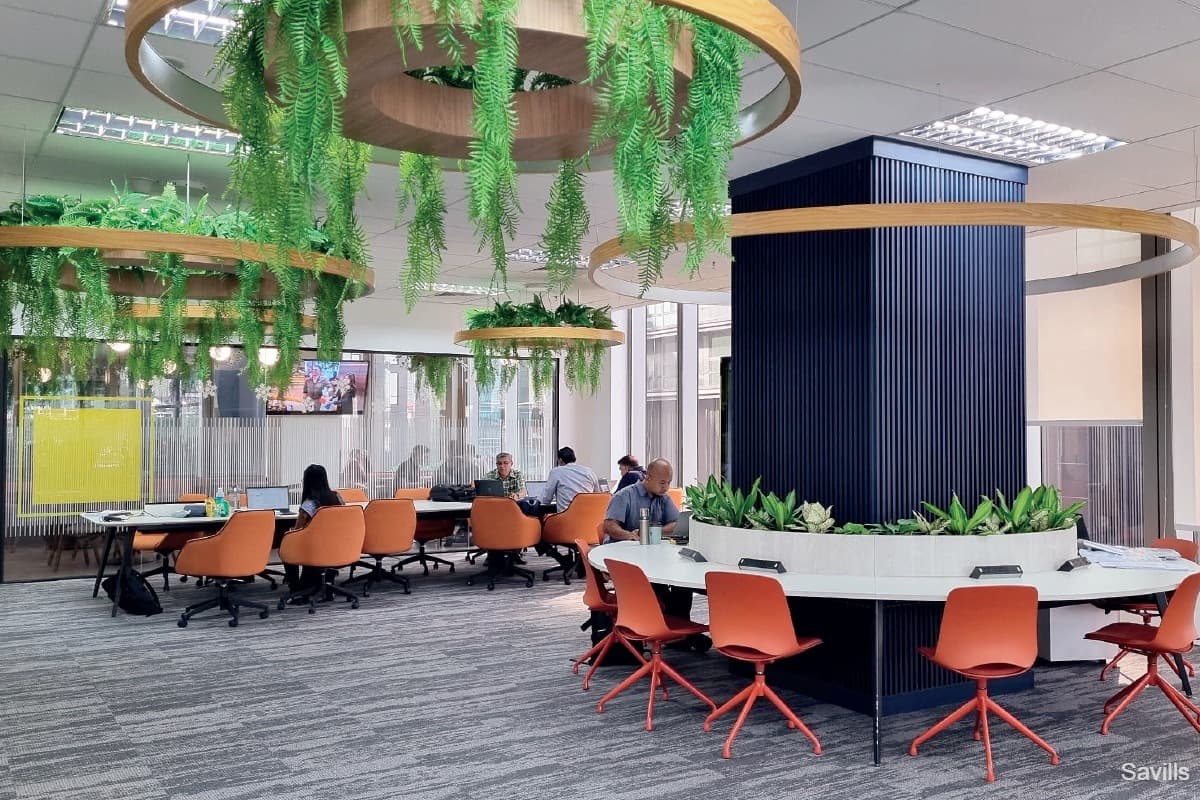
The workplace of the future marries the remote-work environment with the in-office experience. A prime example is Savills (Malaysia) Sdn Bhd’s new office in Pavilion Damansara. On entering, we are greeted by wide windows and a large lobby area which, according to group managing director Datuk Paul Khong, can double up as an event space.
Beyond the welcoming lobby is the work area with windows that wrap around the space as it is a corner unit — affording an abundance of natural light that complements the diffused lighting. The office has an open concept with strategically placed privacy “phone booths” to allow for private conversations, while leafy plants provide some greenery.
There are also interactive spaces such as the canteen, which has soft and welcoming colours to help reduce stress levels and acts as the “third place”. The third place theory, conceptualised by Ray Oldenburg, describes informal public gathering spaces that foster social interaction and community beyond the home (“first place”) and workplace (“second place”).
Khong says, “We believe that there is a strong correlation between good office designs and both productivity and social cohesion. These well-planned workspaces promote creativity, strong support and collaboration where employees’ well-being is ensured, which influences performance and engagement.”
Other property consultants also believe in the importance of office design, as a well-designed office space can promote interaction and bonding, foster the physical and mental well-being of users, and support sustainability initiatives.

JLL Malaysia managing director Jamie Tan says, “We have observed a definitive trend towards rightsizing among office tenants, particularly in the central business districts. As hybrid work arrangements become the norm, companies are re-evaluating their spatial needs.
“This shift reflects a broader evolution in workplace strategy, where the focus is less on square footage and more on creating an experience that supports the various working arrangements, whether in-office, hybrid or remote.”
For Knight Frank Malaysia director of office strategy and solutions Kamini Palany, the shift from in-office to hybrid and remote work has redefined the need for a physical workspace.
“Companies now incorporate features that support collaboration, flexibility, wellness and employee experience. Open-plan layouts are being balanced with quiet zones, collaboration pods and videoconferencing-enabled meeting rooms,” she says.
“Work has become more flexible and employee-centric. Office design now plays a critical role in attracting talent, encouraging collaboration and justifying the purpose of a physical office space in a hybrid world.”

CBRE | WTW group managing director Tan Ka Leong concurs with his fellow experts on how current office design prioritises flexibility, social cohesiveness, comfort and employee well-being.
“According to the CBRE 2024-2025 Global Workplace & Occupancy Insights — published in October 2024 — organisations are increasingly prioritising workplace experience as a key factor in real estate success.
“Effectiveness has overtaken efficiency as the primary indicator of performance. In fact, employee satisfaction rose by 75% in client rankings this year, while traditional metrics like space density fell by 67% over the past four years. These findings reflect a growing recognition that a successful office is … about creating meaningful, productive experiences for the people who use it,” he says.
Besides attracting and retaining talent, good office design also ensures the overall health of staff, according to Unispace senior design principal Daniel Du. “There is a much greater focus on designing spaces that support the mental and physical health of employees, fostering a sense of culture and belonging.”
Elements of good office design
The office designs of today take into consideration both tangible and intangible elements to create a workspace that caters for the body, mind and soul.

JLL’s Jamie says, “What’s needed is a holistic approach to the employee experience, one that encompasses purpose, personal development, culture and people connection.”
He adds that the focus now is on meaningful content and experiences, where the office is a place where people “want to be”, not “need to be”.
“At the heart of it, employees want to feel that their time at the office is productive, engaging and valued. Companies that succeed in creating this sense of purpose and community will be far better positioned to encourage a sustained return to the workplace,” says Jamie.
His colleague, JLL Malaysia strategy and workplace senior consultant Timothy Wong, breaks down the key design elements: they include flexible workspace — quiet zones, collaborative hubs and social lounges; technology integration for seamless hybrid collaboration; biophilic design, which incorporates natural light and greenery in the office; ergonomic and wellness features that help reduce stress levels; and social spaces such as informal areas for spontaneous interaction and bonding.
Savills’ Khong concurs and adds that smart workspace designs, with clear sight-lines and intuitive access, are also something to consider.

“An appealing and modern workplace would be the main draw factor for the return-to-office concept. Employees continue to seek flexibility, meaningful work and a supportive culture. Therefore, a holistic approach that combines these thoughtful designs with the organisation culture is essential,” he says.
CBRE’s Ka Leong says key elements like smart space allocation, natural lighting, ergonomic furniture, good acoustics and integrated technology are the way forward. However, there needs to be a balance between expectation and reality, he cautions.
“Design alone may not be enough to bring employees back or attract new talent … it must also be supported by a clear purpose for being in the office, strong leadership and a culture that values flexibility and trust. Office design is an important part of the equation, but it works best when aligned with the broader employee experience and company value,” Ka Leong adds.
This notion is supported by Knight Frank Malaysia director of project management Joshua Matthew de Souza, who says, “In today’s evolving work environment, companies must go beyond offering attractive physical spaces. It is crucial to deeply understand the unique functions, workflows and culture of the organisation and design the workplace to genuinely support these needs.
“When it comes to talent attraction, a company’s brand image and credibility remain powerful magnets for new hires. However, the physical office must now also embody and personify the company’s values, beliefs and culture. A well-designed space that authentically reflects the organisation’s identity sends a strong, reassuring message to both current and prospective employees,” he points out.

For JLL Malaysia head of project and development services Leslie Zweistra, there is a need to consider other reasons why current and potential employees are reluctant to return to the office, or prefer remote work.
“Remote work offers flexibility and work-life balance that some employees prefer. Commuting time and costs remain significant factors for many workers. Personal circumstances like childcare, health concerns … may influence work location preferences. Also, some roles may not require frequent in-person collaboration,” he says.
Zweistra opines that companies need to embrace the hybrid work model as well as provide amenities such as childcare services or a fitness centre, and encourage a company culture of growth and support.
Apart from creating workplaces that cater for diverse needs and encourage productivity, collaboration and social connectivity, the space also needs to have a personal element, according to Unispace’s Du. “Embedding cultural and emotional narratives into the physical design helps foster social cohesion and a shared sense of belonging. This might be achieved through the use of artwork, company motifs, storytelling in design elements and the inclusion of community-centric areas such as town hall spaces, or multifunctional hubs for events and social interactions.”
Enhancing existing office space
While having a newly designed office is ideal, there is much to be said for existing office spaces that are given a facelift. What can companies and landlords do now before they find a suitable time for a total renovation?

Savills’ Khong highlights that companies can implement flexible workspaces first “by creating breakout areas that can easily be adapted for different uses” and to integrate technology for hybrid work.
He adds that landlords should consider upgrading or retrofitting the building whenever they can, to meet market demand and tenants’ environmental, social and governance (ESG) expectations.
CBRE’s Ka Leong concurs, saying, “Simple updates like adding greenery, improving air quality and offering wellness-focused amenities can also enhance the employee experience.”
As for landlords, Ka Leong says they need to upgrade their buildings to meet tenant expectations of energy-efficient systems, smart building technologies, wellness certifications and modern common areas.
Knight Frank’s Kamini adds that other factors to consider include creating inviting common areas such as breakout zones and lounge-style pantries to foster spontaneous interaction and community as well as using design to strengthen the corporate culture and identity.

“Companies that invest in experience-driven design, and landlords that think beyond leases to create value-rich environments, will be better positioned to attract and retain both people and businesses in the evolving world of work,” she says.
Unispace’s Du agrees that consideration should be given to elements that have a direct impact on employee experience and that landlords need to think out of the box to create greater intrinsic value. “Landlords must now offer more than just physical space. They should offer amenities that enrich the day-to-day experiences. This includes creating high-quality, hospitality-style environments with services like a concierge, as well as providing end-of-trip facilities, rooftop gardens and other respite spaces.”
The strong demand for a more conducive workplace has led to the rise in co-working spaces, which reduces the need for much refitting work.
JLL’s Jamie says, “One of the more notable trends in recent years has been the strong resurgence of co-working spaces. Driven by the demand for greater flexibility and cost efficiency, co-working spaces offer shorter leases and plug-and-play solutions that appeal not only to start-ups and small and medium enterprises (SME) but also increasingly to large corporations seeking ‘swing spaces’ during periods of transition or renovation.”
He highlights that the younger generation is attracted to co-working spaces with modern amenities, which include a stocked pantry, flexible networking areas, event space, gym, wellness zones and technology infrastructure for videoconferencing and hybrid meetings.

“However, relying solely on co-working tenants is not a long-term solution for landlords. A more sustainable and value-driven strategy is to retrofit or refurbish existing office spaces to ensure they remain competitive with newer developments entering the market,” Jamie says, adding that a carefully managed asset enhancement initiative programme can help boost the appeal, rental yield and long-term asset value of properties.
A longer term view
Having an office space that aligns with ESG initiatives is a top priority for many companies. This includes incorporating a circular design concept where office items can be reused or repurposed when their life cycle ends. However, as many products nowadays have built-in planned obsolescence, and with new products cheaper and better, is this even something worth considering? Our property experts believe that it has a place at the table.
CBRE’s Ka Leong says, “While it may seem more cost-effective in the short term to discard and replace office items, adopting a circular design approach offers long-term value that goes beyond immediate cost savings. Circular office design encourages reusing, repurposing and recycling materials and furniture to reduce waste, conserve resources and support sustainability goals. This aligns with increasing ESG priorities among companies, clients and investors.
“It is true that some products are built to be replaced, and newer options can be more affordable and efficient. But circular design doesn’t mean avoiding new technology; it means making smarter, more responsible choices about what we use, how long we use it for, and how we handle it at the end of its life,” he advises.
Knight Frank’s De Souza says, “Choosing products that are designed with a cradle-to-grave or cradle-to-cradle ethos can significantly reduce environmental impact over time. While the upfront cost of these sustainable solutions may be higher, largely due to the still-maturing technology and processes behind them, increased demand will eventually drive prices down and make circular office design more accessible.”

He adds that in response to this, furniture makers are also offering solutions aimed at circularity. “These include second-life programmes, refurbishment options and systems for recycling furniture into new products, thus extending the life cycle and value of the original piece. Embracing circular design is not just an environmental choice; it is a strategic investment in long-term sustainability and corporate responsibility.”
Savills’ Khong believes circular design provides several benefits other than minimising waste and the environmental impact it would have. “This allows the workspace to evolve alongside changing business needs or trends and reduces frequent overhauls. Prioritising reusability in spaces and materials helps retain value, preserving long-term performance, environmental gains and investment returns despite the higher initial costs.”
JLL’s Zweistra says, “As environmental regulations tighten, adopting circular principles would help companies stay compliant and reduce the risks associated with resource scarcity. It can lower waste disposal costs and potentially create new revenue streams through repurposing and reselling. Moreover, circular initiatives often boost employee engagement and attract talent who value sustainability.
“Companies can implement circular practices gradually, balancing immediate costs with long-term sustainability and economic advantages, ultimately contributing to a more sustainable and resilient business model.”
According to Unispace’s Du, the value of circular office design lies in its long-term thinking and strategic resource use. “Circular design principles aim to extend the life cycle of products by designing them to be modular, adaptable and easy to repair or repurpose. For example, designing a space with modular and repetitive components makes it easier to reuse or reconfigure items when a change is needed. When designing intentionally, these systems are not only environmentally sound but also cost effective over time, as they minimise the need for full replacements and support reconfiguration rather than demolition.”
Ultimately, the future of office design is about ensuring all factors and elements that make an office effective and efficient come together in a holistic and meaningful way. This will result in better returns for both investment and human capital.
JLL’s Jamie says, “Office spaces that successfully implement design strategies that align with tenant preferences are more likely to achieve sustainable premium rents and high occupancy rates. In turn, this enhances the overall capital value of the building, making it a more attractive investment asset. Forward-thinking landlords and developers who prioritise flexible, healthy and future-proofed designs will be well positioned to thrive in the evolving commercial property landscape.”
Save by subscribing to us for your print and/or digital copy.
P/S: The Edge is also available on Apple's App Store and Android's Google Play.