

This article first appeared in City & Country, The Edge Malaysia Weekly on September 1, 2025 - September 7, 2025
Climate change demands urgent adaptation and the adoption of eco-friendly strategies, particularly in the building and construction industry, given its significant contribution to global emissions.
“We are responsible for nearly 40% of global emissions, but that can and must be changed. We must stop being part of the climate problems and start becoming the structural backbone of the solution,” said GreenRE chairman Datuk Seri FD Iskandar in his opening speech at the International Green Building Conference (IGBC) 2025 held at One World Hotel, Petaling Jaya, on Aug 19.
Housing and Local Government Minister Nga Kor Ming stressed the need to build climate-resilient developments.
“Asean is undergoing rapid urbanisation, with the rate projected to rise from 56% today to 70% by 2050. Capitals such as Kuala Lumpur, Jakarta and Bangkok are already grappling with the growing pressures of urban growth, including severe traffic congestion and the rising challenge of housing affordability for local communities. The World Bank has cautioned that if left unchecked, urban sprawl could cost Asean economies as much as 2% of GDP (gross domestic product) annually by 2030, owing to congestion and pollution,” Nga said in his ministerial keynote address, adding that sustainability must be the foundation of future cities and communities.
Meanwhile, Deputy Prime Minister and Energy Transition and Water Transformation Minister Datuk Seri Fadillah Yusof, in his ministerial keynote address, stressed the importance of energy efficiency in the built industry.
“The Energy Efficiency and Conservation Act 2024 provides the legal foundation to advance our national efficiency agenda. This Act covers both electrical and thermal energy, placing focus on managing demand comprehensively while promoting efficient energy use across the industrial, commercial and domestic sectors. For the building sector, the Act is especially significant, as it encourages the adoption of energy-efficient designs in new construction as well as improved energy management in existing ones,” Fadillah said.
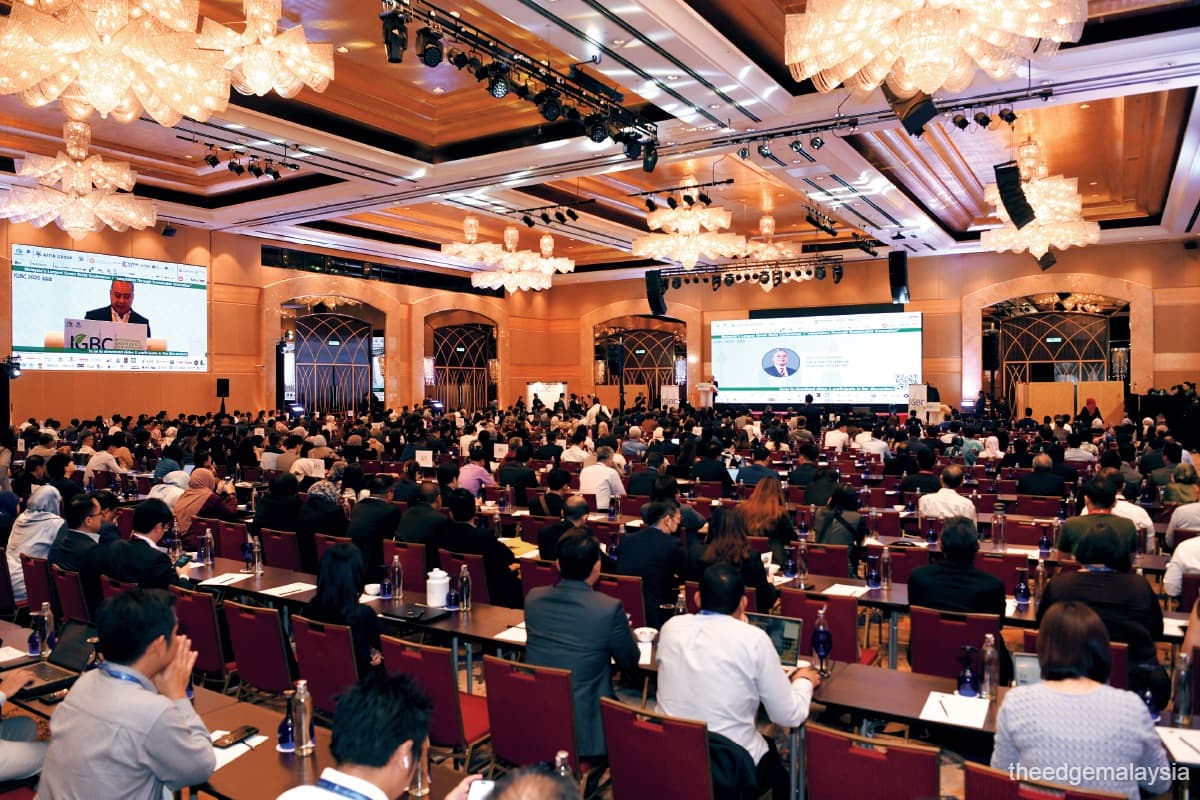
Co-organised by Real Estate and Housing Developers’ Association (Rehda) Institute and GreenRE Sdn Bhd, the one-day conference featured panel discussions and talks by speakers from across the globe and attracted more than 800 participants.

Mitigating climate threats through design
During the panel discussion titled “Adaptation and Resilience in a Changing Climate”, moderator Datuk N K Tong, who is Bukit Kiara Properties group managing director and immediate past president of Rehda Malaysia, posed a pertinent question: “What are the climate threats that you faced and what are some of your design approaches to mitigate these threats?” The panellists — Zaha Hadid associate director (Hong Kong, Shenzhen and China) Shao-Wei Huang, Foster + Partners director (Thailand) Sunphol Sorakul, Henning Larsen director (Asia Pacific) Leonard Ng and and Agung Sedayu Group director of integrated city development Kevin Lew — offered views on how heat is affecting buildings.
Zaha Hadid’s Huang said: “We’ve found that solar gain and daylighting significantly affect user comfort. That’s why we need to proactively understand their impact, especially since different regions have different conditions. We don’t want our building exterior to be disconnected from what’s happening around it. That’s why, when we begin the design process, this understanding becomes part of our early-stage thinking.”
He added that understanding the unique environmental conditions of each region allows the building exterior to respond effectively to key performance criteria. This leads to a more breathable relationship between the building and its surrounding, thereby creating an agile energy model that significantly improves the overall quality of the building.
“The real challenge is the climate. We need to forecast what’s coming in the next decade, or even in the next two decades, because this also plays a major role in a building’s life cycle management,” Huang said.
Foster + Partners’ Sunphol explained how heat gain can be effectively minimised by combining passive design with an active design strategy.
“A good survey can help us understand which direction the daylight is coming from, so we can prevent heat gain from becoming a problem,” Sunphol said.

While adding screens for sunshading is common, he emphasised the value of adaptive screening, as demonstrated in Foster + Partners’ The Forest Pavilion. This pavilion — an experience centre for The Forestias residential master plan in Bangkok — incorporates large overhangs to block direct sunlight, exemplifying passive design.
“For a taller building, however, we needed secondary vertical protection, along with other elements like high-performance glass, to bring in daylight without the heat,” said Sunphol.
Meanwhile, Henning Larsen’s Ng highlighted urban heat islands, flooding and sea level rise as key climate threats observed in Singapore, with developers striving to make their projects resilient. He noted, however, that developers also prioritised maximising returns on their investments in climate-resilient design.
“In the North-South Corridor [in Singapore], we’re building a car-like corridor that connects communities. It needs to be comfortable so that people will use it. In the end, it should help bind communities together and provide new spaces for businesses to gather,” he said.
Meanwhile, Agung Sedayu’s Lew talked about how strategic planning in the early stage is critical to minimising impact. He cited, for example, Pantai Indah Kapuk 2 township in North Jakarta, which involves reclamation works to integrate a golf course.
“What we’re doing differently is a balancing act. Normally, when we talk about land development, we talk about cut-and-fill. But [when it comes to] the ocean, it’s about how much to reclaim, how much to landfill. Right now, we’re running an RFP (request for proposal) for a visionary plan — even before the concept stage — to test the design programming and ensure we’re balancing between what we reclaim, what we landfill and what we leave untouched,” he said.

“By integrating the golf course design, we can plan early for features like bunkers, water bodies and water barriers. These elements allow us to ‘cut’ without unnecessary filling, which reduces the need for excessive reclamation. Many times, if projects are not planned properly, the entire site gets landfilled first, only to be dug up again later for ponds and sand traps. That’s double work.”
Learning from heritage conservation in London
In her presentation titled “Lessons from London: Applying Rejuvenation Insights through BIM Technology to Malaysia’s Urban Future”, UK Parliament architect Catharine Dass discussed how using building information modelling (BIM) was driving smarter, faster and more sustainable urban rejuvenation in London.
Malaysian-born Catharine was headhunted in 2019 to join the UK Parliament and is recognised for pioneering the integration of digital heritage requirements into conservation projects for historic buildings.
“I brought with me a strong knowledge of digital construction technologies but noticed a major gap, which is the use of digital tools in heritage, especially in capturing heritage data. To bridge this gap, I initiated the application of digital coding, using Uniclass classification, for heritage assets,” she said.
Catharine was involved in the conservation of Elizabeth Tower, also known as Big Ben, in London. “Designed by Augustus Pugin in Neo-Gothic style and completed in 1859, it stands at 96.2m tall, with 334 steps to the belfry. For comparison, Batu Caves has 272 steps. Conservation work began in 2017, just before I joined Parliament in 2019. Big Ben weighs 13.7 tonnes, and each clock dial is 7m wide,” she said.

Explaining how BIM was used to drive conservation works for Big Ben, Catharine said: “During the design stage, BIM supported surveys, planning, budgeting, collaborative working, health and safety assessments as well as asset management. Structured information also enabled environmental control — for instance, monitoring decay and changes, supporting preventive maintenance, improving decision-making, reducing costs and producing scalable data.”
In the conservation of Big Ben’s stonework, Catharine said surveys revealed damage caused by centuries of pollution and water exposure. “A tracing system was applied to the model to assess each stone, quantify repairs and plan maintenance for the next 30 years. By digitally recording stone sources, future repairs can be planned without starting from scratch.”
Catharine is also involved in the conservation of a cloister at the Palace of Westminster in London. “Over centuries, it has suffered water and bomb damage. We are now conserving and restoring it under a Conservation Management Plan. Normally, conservation sketches identifying stones of different periods are recorded on 2D drawings. Instead, I asked the team to capture this information in 3D,” she said.
“What is typically delivered as a 2D drawing was instead modelled in 3D, with data exported in COBie (Construction-Operations Building information exchange) format so that it could integrate with our asset information system. COBie structures model information into colour-coded tabs, like organising Lego blocks, making it easier to manage complex conservation data.”
According to Catharine, since BIM standards do not typically cover conservation-specific needs, she decided to adapt the attribute tab to include additional heritage requirements.
“To make this data machine-readable, we applied Uniclass coding. Similar to how every item in a supermarket has a barcode, Uniclass provides a consistent classification for elements, products, systems and entities. Before my involvement, heritage-specific coding was almost non-existent.

“Working with the National Building Specification (the provider of Uniclass), new categories for heritage elements have now been introduced. This benefits not only my work but also asset owners worldwide who use BIM.”
Concluding her presentation, Catharine said: “BIM can transform Malaysia’s urban future. You can start small by piloting BIM on a key heritage site, then learn, adapt and scale. What’s important is setting clear and specific requirements.
“Of course, it requires investment in skills like training local teams in digital tools, heritage care and technology. It may seem like a big initial investment, but the long-term returns are significant … and can cut project costs by 10% to 20% while reducing delays.”
Smart maintenance strategies
In the next presentation, titled “Future-Proofing Built Environments: Energy-Efficient Facilities Management and Green Data Centre Design through Predictive and Preventive Strategies”, Measurement & Verification (M&V) Pte Ltd managing director Steven Kang talked about strategies from his work on green-certified data centres and smart maintenance systems across Singapore.
In presenting a case study, Kang said: “In 2013, Singapore became one of the first countries in the world to impose minimum standards for chiller plant efficiency. More importantly, the government enforced very strict measurement standards.
“The law requires us to measure chilled water temperature to an accuracy of ±0.03°C. For flow, magnetic flow meters with ±0.5% accuracy, and power meters with ±1% accuracy are used. This allows us to measure the overall chiller plant efficiency, with a lifetime accuracy of ±5% over 15 years.”

Kang added that in 2021, Singapore introduced a legislation requiring Total System Efficiency (TSE) to be backed by accurate, continuous measurement. For context, TSE combines chiller-plant efficiency with airside efficiency, so the entire air-conditioning system is assessed holistically.
“Today, it’s standard in Singapore for all government and private contracts to include clear financial penalties for underperformance. If an energy services company or contractor fails to deliver the promised efficiency, they must pay the difference in utility charges.
“As a result, we’ve seen the rise of many energy services companies, while there has been a decline in the number of traditional ACMV (Air Conditioning and Mechanical Ventilation) companies. I hope this data-driven, performance-based approach will also be adopted in Malaysia, especially starting with the Johor–Singapore Special Economic Zone.”
Another case study Kang highlighted was the end of proprietary, or being held “hostage” by foreign Building Management System (BMS) software.
“In the 1990s, BMS systems were dominated by large American and European companies. Once you signed a contract with them, you were locked in for 10 years, often with expensive maintenance contracts and poor service … Now, however, the market in Singapore has shifted towards BMS platforms that do not hold owners hostage.”
In 2013, Kang said, M&V introduced the first open, non-proprietary BMS software, called Niagara, in Singapore.
“The Niagara BMS platform offers a powerful combination of open architecture, interoperability and strong SI (systems integrator) support, making it very attractive compared to traditional proprietary systems. This has become a major disruption for traditional BMS companies,” he said.

ESG-friendly centralised labour quarters
In the final presentation, titled “CLQs as a Green Commercial Asset Class: Unlocking Long-Term Income Streams and ESG Investment Potential for Developers”, Dormitory Association Singapore Ltd council member Alexander Wu discussed how centralised labour quarters could be integrated with sustainable materials, energy-efficient systems and improved living conditions while securing long-term recurring income.
“Workers’ dormitories are evolving into community living spaces, similar to co-living arrangements. The challenge is that Singapore has limited land. We must balance economic viability with building dormitories that are high-tech, well-operated and conducive places to live. The solution is to install technology and high-tech fittings to help dormitory operators run efficiently. Dormitories can then be valuable assets, not just for private investors but also for the government,” Wu said.
He was involved in a 19-week collaboration with a design think tank to enhance the dormitory living environment, encourage community engagement and foster a sense of ownership among residents.
“Like designing a home, dormitories now incorporate private areas, social spaces, kitchens and recreation facilities. This shift helps workers feel they belong, rather than viewing dormitories as temporary shelters,” he explained.
From an environmental, social and governance (ESG) perspective, Wu said centralised dormitories also reduced strain on neighbourhoods and utilities while enabling large-scale sustainability initiatives such as solar energy, rainwater harvesting and energy-efficient systems.
“For example, for a project housing 12,000 workers, we were burning 600 litres of diesel daily. By investing in solar panels and energy storage systems, we cut this down to almost zero, reducing 34 megatonnes of carbon dioxide annually,” Wu said.
In terms of financial benefits, dormitories provide recurring income, unlike one-off residential projects.
“Dormitories can also host ancillary services such as canteens, supermarkets and training centres, which generate extra revenue,” he said.
“All in all, they provide steady income, improve ESG compliance and make industrial parks more appealing to global employers. Being ESG-compliant means access to cheaper green financing, which makes a big difference in costs.”
Save by subscribing to us for your print and/or digital copy.
P/S: The Edge is also available on Apple's App Store and Android's Google Play.