

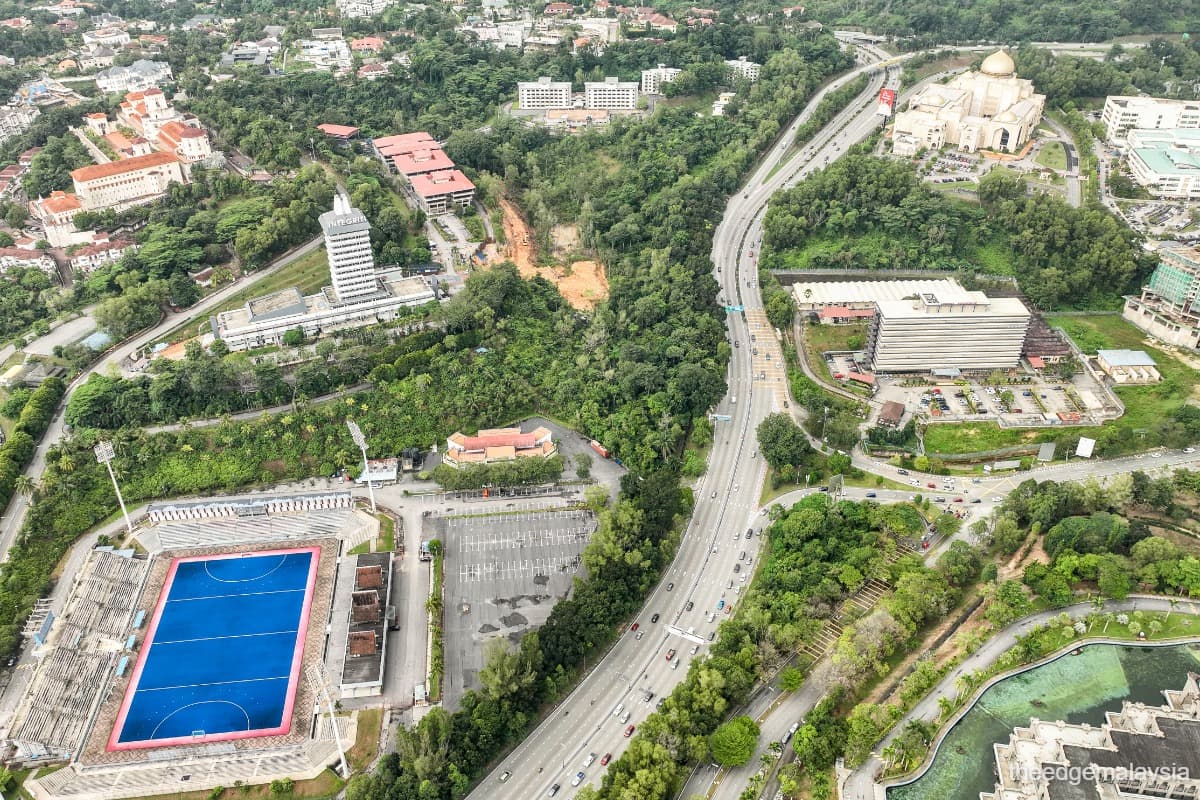
PUTRAJAYA (Aug 29): Semantan Estate (1952) Sdn Bhd on Friday obtained a stay on the whole Court of Appeal (COA) decision made on June 24, which ruled that the Federal Land Registrar need not register the 263.272-acre ‘Duta enclave’ prime land back to the company and that both the company and the government valuators are to value the compensation according to the 1956 rate.
The stay is pending the company’s notice of motion for leave to appeal, which has now been fixed for Nov 6.
The stay was granted by a three-member Federal Court bench led by Chief Judge of Malaya Tan Sri Hasnah Mohammed Hashim, after the government side, led by Senior Federal Counsel Shamsul Bolhassan, did not oppose, and consented to the stay application.
Hasnah, who sat with Federal Court judges Datuk Zabariah Mohd Yusof and Datuk Vazeer Alam Mydin Meera, directed an early date to be fixed to hear the motion, citing that the case, which has been going on since 1956, had been long standing.
Semantan Estate lead senior counsel Datuk Dr Cyrus Das, who appeared with Ira Biswas and Janet Chai Pei Ying, agreed that the motion is an urgent matter and would touch on possible landmark land matters for determination, as they had filed 26 novel questions of law.
Das also informed the bench earlier of the government’s consent over the stay.
Initially, the apex court had already fixed Nov 13 as the hearing date for the motion for leave to appeal, and Hasnah had wanted to fix the hearing in September or October, but Das said as this case is very important, they may need time to prepare the submissions and also that he was not free any earlier.
As a result, the Nov 6 date was fixed by the Federal Court to only hear the case, as agreed by both parties, as Hasnah had directed that no other appeals be fixed for hearing on that day.
In civil cases at the Federal Court, leave (permission) has to be obtained first, and the appeal must be based on novel questions of law for it to be heard on its merits.
If leave is not granted, the COA’s decision stands.
26 questions of law posed
Semantan Estate, which has gone under voluntary liquidation, is seeking a stay of the appellate court’s June 24 decision, which had specified that the High Court is to assess the compensation to be paid by the government over the illegal acquisition of land, based on the 1956 market rate with 6% annual interest until payment.
The COA had directed both the government and the company’s valuation experts to evaluate the 263.272-acre land within 30 days of the June 24 decision.
The company had already been compensated RM1.32 million in 1956 for the acquisition, but that has now been deemed insufficient following the High Court’s 2009 ruling that the government had trespassed on the land. This decision was later upheld by both the COA and the Federal Court.
Besides this, the company has also filed 26 questions of law to seek leave from the Federal Court in its appeal over the COA’s decision, which had allowed the government’s appeal to not have to register the land title back to the company, as was previously directed by the High Court.
The notice of motion includes an affidavit in support by the company's liquidator Dr Jim Lai Chee Chuen, who said that the questions fulfil the requirement under Section 96 (b) of the Courts of Judicature Act 1964 as they affect Article 13 of the Federal Constitution concerning rights to property and the validity of two pre-Merdeka laws, namely Section 29(1)(b) of the Government Proceedings Act 1956 (GPA) and Section 8 of the Specific Relief Act 1950 (SRA).
The 26 questions of law cover several areas, including Article 13 (right to property), alteration of a superior court order, questions relating to the GPA and Section 8 of the SRA (specifically on whether a return possession of land or transfer of land can be made by the government), and adequate compensation questions.
The questions include:
- As the court had ruled that the government had taken the land unlawfully and the landowner is entitled to possession of the land, does Article 13 permit the government to keep the land after the payment of compensation?
- Does Article 13 permit the court to order compensation for the compulsory taking of land from a landowner where it has been determined that there was non-compliance with the applicable law for compulsory acquisition?
- Does Section 29(1)(b) of the GPA apply to proceedings seeking prerogative relief such as a mandamus to an order under Section 417 of the National Land Code to give effect to a judgement against the government?
- Is Section 29(1)(b) unconstitutional and in violation of Article 13, if it is used to prohibit and bar the court from granting a mandamus order (to compel) an order under Section 417 of the National Land Code or cause the registration of and transfer of the legal title, and return possession of land to the lawful landowner when the court declared the land has been unlawfully taken by the government?
- Is an order of ‘adequate compensation’ based on market value prevailing as of December 1956 inherently unjust and oppressive?
Court of Appeal’s June 24 decision
In the appellate court decision, then-COA judge Datuk Lee Swee Seng (now a Federal Court judge) had ruled to dismiss Semantan Estate’s appeal to physically recover the land and its building.
Lee had sat with then-COA judge Datuk Wan Ahmad Farid Wan Salleh (now the newly appointed Chief Justice), who wrote a supporting judgement to Lee’s decision, where Wan Ahmad Farid had noted that the 2009 High Court decision by then-judicial commissioner (JC) Zura Yahya, that ruled that the government had trespassed on the land, had not made any order for the impugned land to be transferred back to Semantan Estate.
“There is no evidence before this court that Semantan Estate had sought clarification from the learned JC as to whether the impugned land ought to be transferred and registered by the Federal Land Commissioner [back] to Semantan Estate as a consequential order.
“In short, there was no attempt made to ‘work out’ the order so as to give effect to the initial order. It is to be recalled that the ‘liberty to apply’ rule for consequential order is implied in every court order. Semantan Estate did not exercise this right at the material time,” Wan Ahmad Farid had added.
The 263.272-acre land was acquired in 1956, and after a long-standing legal battle, Zura’s decision in 2009 found that the government had trespassed on the land. This was upheld by the COA and the Federal Court in 2013.
The land currently houses various government buildings, including the National Examinations Syndicate, the National Archives, the Inland Revenue Board, the Malaysian Anti-Corruption Commission Academy, the Institute of Islamic Understanding Malaysia, as well as the Tun Razak Hockey Stadium.