

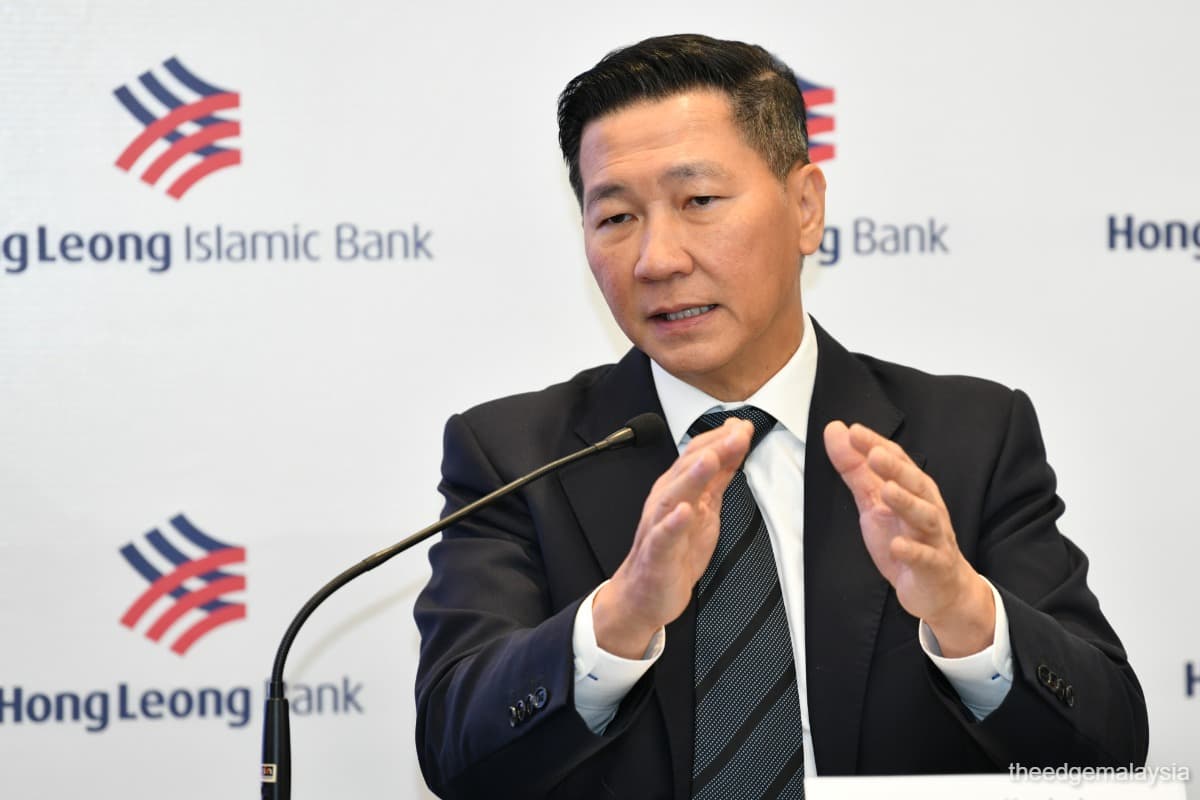
KUALA LUMPUR (Aug 27): Hong Leong Bank Bhd (KL:HLBANK) expects industry-wide margin pressure to continue in the financial year ending June 30, 2026 (FY2026), but said it will rely on efficiency gains and stronger fee-based income to sustain returns and maintain competitive dividends.
Group managing director and chief executive officer Kevin Lam said the bank has revised its net interest margin (NIM) guidance to 1.8%-1.9% from 1.85%-1.95%, following the July overnight policy rate (OPR) cut.
He explained that commercial banks face a structural lag when rates are reduced, with loans repriced faster than deposits.
“Certainly it is because of industry headwinds, because the OPR cut will definitely have an immediate impact on our NIM,” Lam said.
“When an OPR cut happens, the loan within a few days has to be immediately repriced down, whereas our cost of deposits, particularly fixed deposits, will take time to be repriced. So there is a lagging effect.”

Chief financial officer Malkit Singh Maan quantified the impact, saying the 25-basis-point OPR cut reduced the NIM by three to four basis points, but this was partly offset by the statutory reserve requirement (SRR), which added back about one basis point.
“So effectively, it is a two- to three-basis-point impact,” he said.
Malkit added that while NIM compression was unavoidable, the bank has partly offset this through active management of its funding costs and a shift towards higher-yielding lending products.
“The improvements really came from the cost of funds management,” he said. “At the same time, we also benefited from a better product mix, with more contributions from higher-yielding loans and wealth-related products.”
Despite margin pressure, Hong Leong Bank is guiding for loan growth of 6% to 7% in FY2026, ahead of the system’s projected 5%. The bank posted 7.8% growth in FY2025 and anticipates continued momentum on all fronts.
The bank is also closely monitoring asset quality, particularly within its small and medium enterprise (SME) portfolio. Lam noted that while SMEs are showing signs of caution amid external headwinds, domestic demand remains resilient.
“Domestic consumption is still quite strong,” he said, pointing to mortgage performance as a key barometer. “If there were fatigue, it would have shown up in mortgages — but so far, they are holding up well.”
For FY2026, the bank guided for gross impaired loans of under 65 basis points and net credit cost below 10 basis points.
Efficiency gains and non-interest income to uphold ROE
On profitability, Hong Leong Bank is targeting a return on equity (ROE) of 11.5% to 12%, higher than the 11.4% achieved in FY2025. Lam said the bank’s confidence stemmed from multiple growth engines rather than relying solely on loan growth.
“Our strength comes from efficiency, and that is reflected in our cost management and the adoption of AI,” he said. “We have also seen a strong pickup in non-interest income (NOII), especially wealth management and hedging solutions, as well as franchise sales.”
Lam added that productivity gains from AI investments are being realised faster than expected, which should help bring down the cost-to-income ratio.
“Initially, we had guided that AI would take time to deliver returns, but we are finding that some of the productivity gains are coming through earlier,” he said. “We have guided for a cost-to-income ratio of about 39%, but we are confident we can do better than that.”
NOII is expected to remain a key driver of profitability. Lam said the bank aims to sustain a higher NOII contribution relative to peers.
“Can we keep the 30% contribution we showed? We will have to see, because once we get to a higher base it is not as easy. But we should still maintain a higher trajectory relative to the market,” he said.
Dividend surge underscores capital strength
Hong Leong Bank’s dividend per share jumped over 40% to 96 sen in FY2025, up from 68 sen previously, lifting the stock’s yield to approximately 4.8%. The payout ratio rose to around 47% — its highest since 2010 — compared with a historical average of about 35%.
Lam noted that while the bank does not follow a fixed payout ratio, it strives to remain competitive within industry norms.
“We want to have a competitive dividend payout ratio,” he said, adding that the bank’s total capital adequacy ratio remains healthy at 16.3% post-dividend, providing sufficient capacity to support loan growth while rewarding shareholders.
Lam emphasised that capital management remains a priority, ensuring the bank does not need to raise fresh equity unless absolutely necessary.
“A bank must make sure that we never go back to our shareholders for capital unless absolutely necessary — definitely not for loan growth,” he said.
Lam reiterated that Hong Leong Bank’s strategy is anchored on multiple growth levers.
“Propelling our core growth by firing on all our key profit engines of loans, NOII and Casa (current account-savings account) remains the core guidance,” he said. “We remain committed to achieving our financial aspirations of sustaining our ROE at 11.5%-12% while maintaining prudent capital and asset quality.”
At the time of writing on Wednesday, Hong Leong Bank’s shares were up 10 sen or 0.5% at RM19.70, valuing the banking group at RM42.7 billion.