

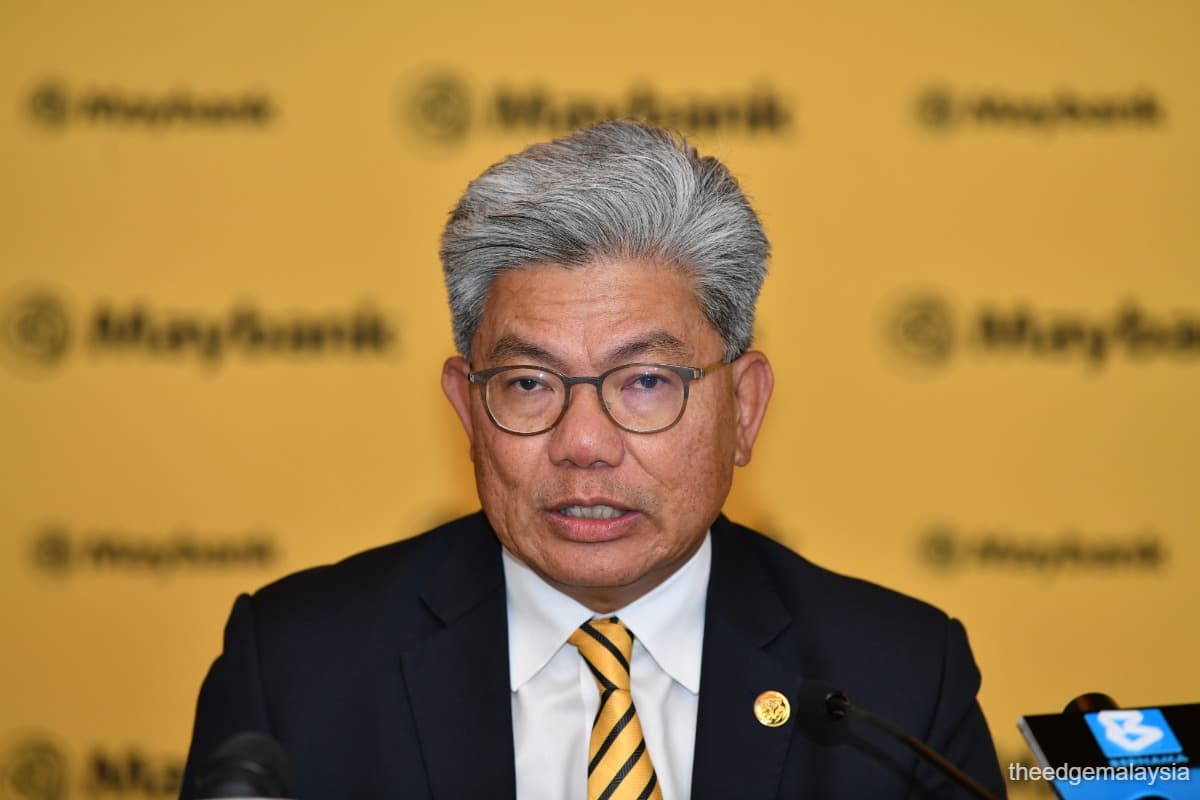
KUALA LUMPUR (Aug 26): Malayan Banking Bhd (KL:MAYBANK) remains confident of achieving its return on equity (ROE) target of at least 11.3% for the financial year ending Dec 31, 2025 (FY2025), underpinned by resilient non-interest income (NOII) and stable funding, despite trimming its loan growth forecast to 3% from 5%-6% and anticipating mild margin compression.
President and group chief executive officer Datuk Seri Khairussaleh Ramli said the downgrade reflects a “wait-and-see” stance among corporate clients across markets amid tariff uncertainty which delayed planned investments and capital raising activities.
On top of that, the slower loan expansion was partly strategic, especially in Indonesia, where the bank is allowing low-margin loans to state-owned enterprises (SOEs) to run off.
“Our SOE portfolio in Indonesia is very marginal in profitability. Rather than growing assets that don’t generate returns, we are releasing these loans as they mature,” he explained.
“We are exploring other growth areas, such as Malaysian and Singaporean conglomerates operating in Indonesia, but that won’t offset the SOE run-off immediately.”
Nevertheless, Khairussaleh noted that Maybank’s loan growth is expected to outpace the banking system’s in Malaysia, driven by continued expansion in mortgages and hire purchase on the retail side, alongside contributions from small and medium enterprise (SME) and corporate lending.
In Singapore, growth is expected to come from corporate and SME portfolios as well as hire purchase financing.
NIM situation across key markets
WATCH: Maybank sees mixed NIM situations across key markets
Maybank’s net interest margin (NIM) performance varied across its core markets, with Malaysia registering a modest two-basis-point (bps) improvement in the first half, Singapore slipping by 2 bps due to a sharp decline in the Singapore overnight rate average (Sora), and Indonesia falling 8 bps amid heightened deposit competition.
“To your point, Malaysia improved slightly, Singapore dipped, and Indonesia was hit hardest. That’s why we are selective about which segments to grow. We protect our NIM while ensuring deposit costs remain reasonable,” Khairussaleh said.
Although Maybank expects slight NIM compression for the full year, it is actively mitigating the impact.
In Singapore, the bank is releasing high-cost fixed deposits and growing cheaper current account and savings account (Casa) balances. In Malaysia, it plans to tap the medium-term note and commercial paper market, which has become more attractive following rate cuts.
“If we stood still, margins would compress significantly. But we are taking proactive steps,” he said, adding that the group’s loan-to-deposit ratio remains below 100%, offering room to optimise its balance sheet.
NOII momentum and brushing off provision concerns
WATCH: Maybank sees strong NOII momentum
Despite headwinds, Maybank is holding to its ROE target, thanks to strong NOII contributions from wealth management, global markets, and debt capital markets.
“Our wealth management engine is performing well. Global markets, especially rates and trading, are contributing positively. Debt capital markets have been strong — our income from helping clients raise funds in the first half was solid, and we expect that momentum to continue,” Khairussaleh said.
Asked whether Maybank could sustain the 7% NOII growth recorded in the first half, he replied, “We will try,” reiterating that NOII remains a critical earnings driver.
On asset quality, Khairussaleh downplayed concerns over an 11% year-on-year rise in gross impaired loans, stressing that the increase was isolated.
“These are specific accounts, not systemic. Our loan loss reserve coverage is above 100%, and we have a RM2 billion management overlay. Based on our portfolio and global developments, we don’t expect significant deterioration,” he said.
In banking, a management overlay is an additional, prudential provision for potential loan losses that banks set aside above and beyond what their standard credit risk models calculate.
Maybank also revised its macro-outlook across its three core markets. It now expects Malaysia’s economy to grow 4.2% in 2025, with system loan growth at 5% and the overnight policy rate holding steady at 2.75%.
Singapore’s gross domestic product growth could reach 3.2%, with system loans growing 3% and further easing in Sora. In contrast, Indonesia’s growth is projected to slow to 4.9% from 5.0% in 2024, with system loan growth at 8% to 9% and the reference rate potentially easing to 4.5%.
Looking ahead, Maybank is betting on digital transformation to sharpen competitiveness. Earlier this month, it announced a RM1 billion partnership with Microsoft over five years to accelerate adoption of artificial intelligence (AI), cloud, and productivity tools.
“This aligns with our strategy to leapfrog in digitalisation. It’s about empowering employees to serve customers better, accessing data instantly via cloud, and equipping our people with co-pilot AI capabilities,” Khairussaleh said.
At Tuesday's close, Maybank shares were down 10 sen or 1% at RM9.75, valuing the banking group at RM117.79 billion.