

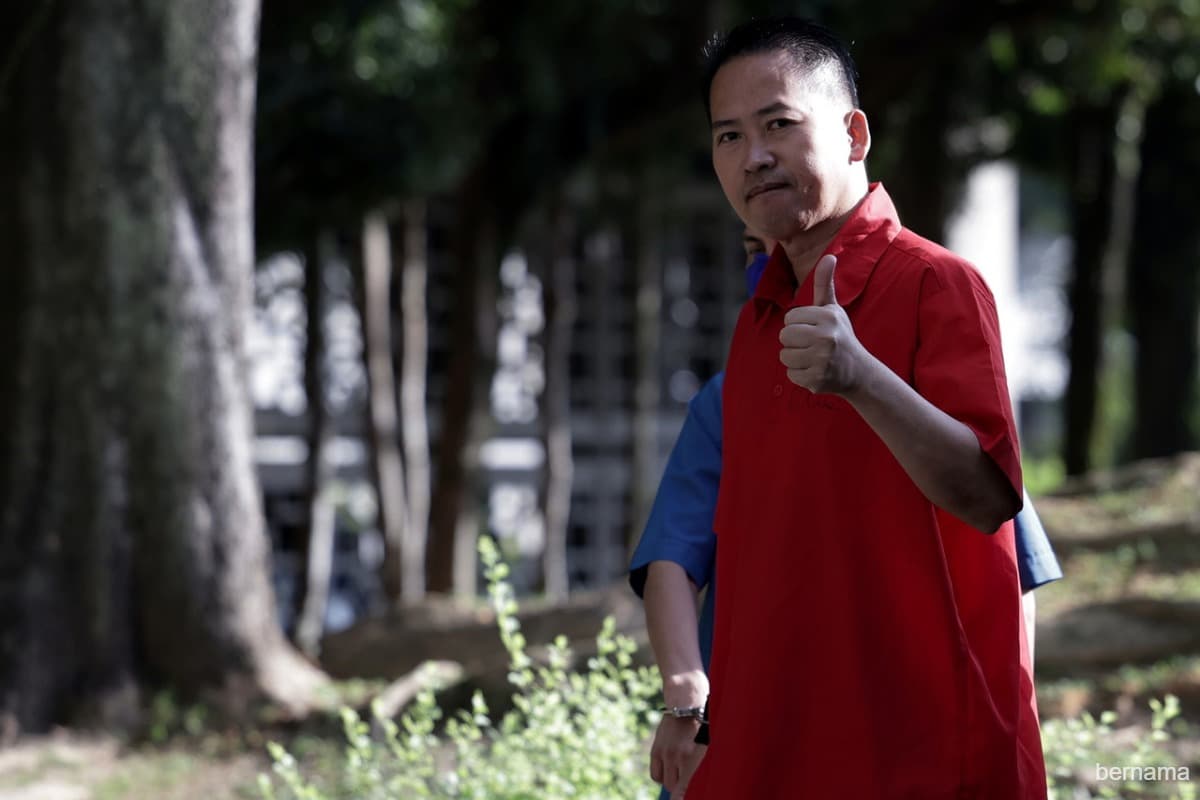
PUTRAJAYA (Aug 20): Sabah’s former infrastructure development minister Datuk Peter Anthony will remain in prison after a review panel dismissed his bid against his conviction in a document falsification case related to a maintenance and service contract at Universiti Malaysia Sabah (UMS) in 2014.
A three-member review panel, led by Court of Appeal (COA) judge Datuk Azman Abdullah, unanimously ruled that there was no breach of natural justice as Peter had been accorded the right to be heard at his appeal and there was no merit to his review application.
"Our assumption has been supported by the COA's full grounds of judgement of the COA panel, where the issue was discussed carefully. It is not the court's duty to hear evidence and the facts that have been decided on.
"There is no breach of justice as the applicant has been given the right to be heard, and we find no merit to this the application. The application is rejected," Azman said.
The other COA judges on the panel were Datuk Noorin Badaruddin and Datuk Hayatul Akmal Abdul Aziz.
Peter was charged in 2015 for forging the title in a letter of support, to secure the contract for his company, Syarikat Asli Jati Sdn Bhd. The contract had already been awarded to REMT Utama Sdn Bhd (REMT) via open tender. His company had already been doing work on another project for the university.
In May 2022, the Sessions Court found him guilty and sentenced him to three years’ jail and a fine of RM50,000. Upon appeal, the High Court in April 2023 upheld the lower court's decision and sentence.
Peter's final appeal at the COA was similarly dismissed earlier in March this year, and he began serving his prison sentence.
The 54 year-old, who is the Melalap assemblyperson, is most likely to lose his state assembly seat as he has exhausted all avenues for appeal. However, there has yet to be any formal announcement by the Sabah state assembly.
Central to Peter's review application was a police report made by UMS' then-deputy vice-chancellor, the late Mohd Shukur Mohd Din.
The police report — in which the Mohd Shukur, a prosecution witness, said that he had made his statement to the authorities under duress — was only discovered by Peter after the completion of his trial, and was admitted as fresh evidence at the COA.
It was Peter's stance that although the evidence was adduced and submitted on at the final appeal, the court did not address it in its broad grounds issued in March 2025. This, he claimed, amounted to a breach of natural justice.
On Wednesday, the review panel also noted that the absence of the issue in the broad grounds was not tantamount to a miscarriage of justice, as it was explained in the full grounds released later.
"It is difficult for us [to assume] that this issue was not considered just because [it] was not expounded on in the COA's broad grounds. [The issue] was [also] one of the main issues that were argued on during the appeal hearing," Azman said.
Peter seeks re-trial; prosecution maintains evidence has been thoroughly ventilated
During the proceedings earlier in the day, Peter's lawyer Mohd Haniff Khatri Abdulla argued that as the fact that the police report was not addressed in the board grounds, this indicates that the appeal panel may not have considered a crucial bit of evidence.
"[Our argument] is that the right to be heard is not [limited] to just being heard, but [the arguments] have to be considered," he said.
The appeals panel, which consisted of Datuk Ahmad Zaidi Ibrahim, Datuk Mohamed Zaini Mazlan, and Datuk Azmi Ariffin, however did include its deliberations on the police report in the full grounds of judgement.
But Hanif stressed that this was an afterthought, as the detailed grounds of judgement was only released Aug 1, months after Peter filed his review bid.
He said that Peter was seeking for the conviction to be struck out and for a re-trial.
Deputy public prosecutor Datuk Wan Shaharuddin Wan Ladin countered that Peter's application failed to meet the threshold for a review, as it was not a "limited or special case".
He added that Mohd Shukur's police report was argued by parties extensively at the appeal stage.
"There were dozens and dozens (berpuluh-puluh) of paragraphs submitted addressing the evidence. [Peter was not prevented] from arguing on the new evidence. We shouldn't put in on today's panel to re-hear the appeal," he said.
In the 24-page full grounds, the appeals panel questioned why Mohd Shukur had lodged his police report a year after his statement to the Malaysian Anti-Corruption Agency (MACC).
"[Mohd Shukur] could have maintained what he had stated in the police report during the trial. It was apparent that he did not. Now whether he had told the truth in implicating the appellant would have been tested through cross-examination, even without the police report," the full grounds read.
The appeals panel also added that the lower court's decision was not solely based on Mohd Shukur's evidence, but had taken into account other witness testimonies and circumstantial evidence.