

This article first appeared in The Edge Malaysia Weekly on August 18, 2025 - August 24, 2025
WITH 42% of Malaysians aged 65 and above living in relative poverty, Putrajaya’s consideration of a monthly pension payout through the Employees Provident Fund (EPF) — aimed at providing a more stable income stream for retirees while retaining the option for partial lump-sum withdrawals — is understandably drawing considerable attention among the ideas raised in the recently tabled 13th Malaysia Plan (13MP) that covers the period between 2026 and 2030.
The proposal — when implemented — would also benefit new civil servants from February 2024 onward, who are no longer eligible for the tax-funded defined benefit (DB) pension status by the federal government when they retire. In line with efforts to ensure long-term fiscal sustainability, Putrajaya is taking steps to integrate these employees into the EPF system, joining private sector wage earners who are legally required to contribute 11% of their monthly salary to retirement savings, with employers contributing a minimum of 12% or 13%.
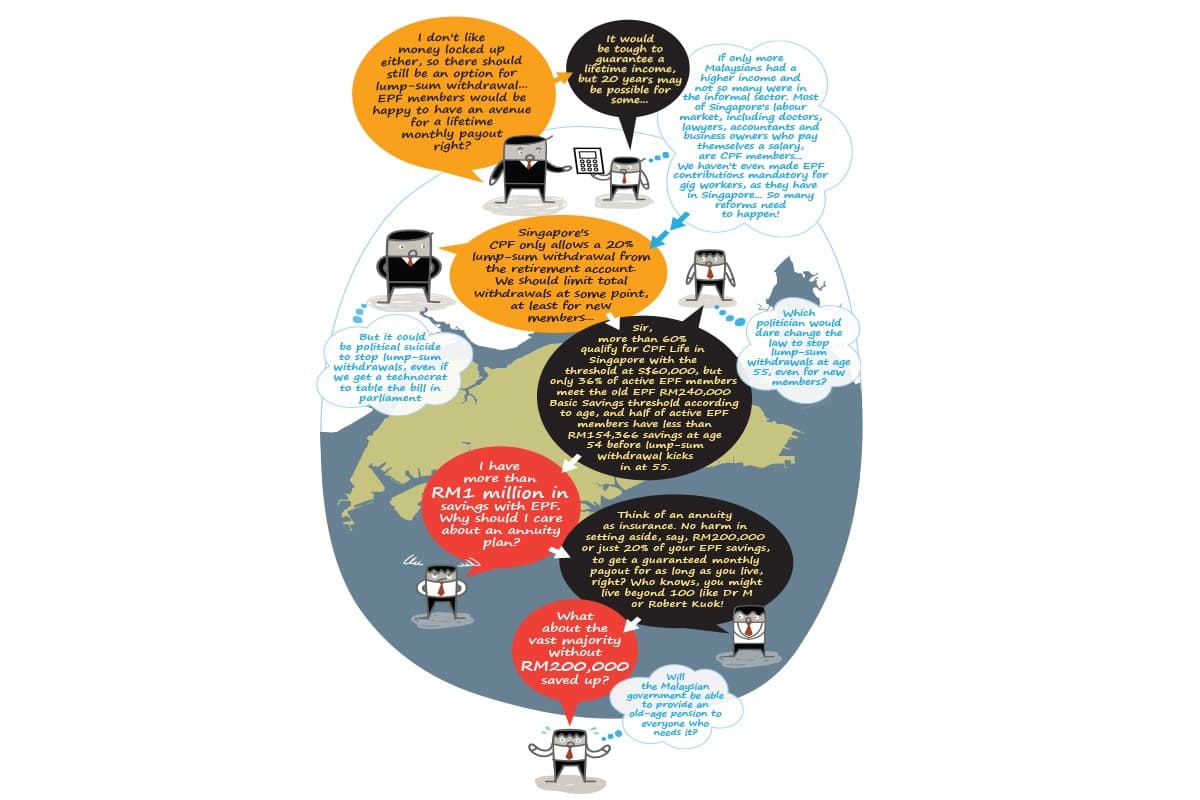
While Putrajaya has yet to provide details, apart from assuring that existing EPF members will continue to be allowed to withdraw their savings when reaching age 55, it is likely that what is being considered is an EPF annuity scheme which, ideally, would be able to guarantee a minimum level of lifetime monthly income.
An example of this would be Singapore’s CPF Life annuity where members of the Central Provident Fund (CPF) born in 1958 (age 67 in 2025) or after and have at least S$60,000 savings in his or her Retirement Account (RA) when starting monthly payouts (between age 65 and 70), will be automatically enrolled into the national longevity insurance scheme that provides a lifetime monthly payout — regardless of how long they live — and is guaranteed by the Singapore government.
Taking a leaf from the CPF’s Full Retirement Sum (FRS) of S$213,000 that allows a lifetime payout of between S$1,610 and S$1,730 per month from age 65, the EPF may be able to introduce an annuity plan that can pay at least the current minimum income of RM1,700 per month.

The potential takers for such a plan, if introduced, may only be the 36% that meet the EPF’s old RM240,000 basic savings at every age threshold — unless more Malaysians voluntarily sign up as an EPF member.
What the EPF had hinted
Savings with the EPF are also guaranteed by the Malaysian government.
In a statement on Aug 1, the EPF said the government’s proposal to introduce a monthly pension payout scheme mentioned in the 13MP “is currently being studied and any decision will be made only after thorough engagement with key stakeholders and careful consideration of members’ long-term interests”.
“The proposed retirement savings account restructuring, as announced under the 13th Malaysia Plan, is intended to help members’ savings last longer in retirement through a steady income stream, with no change to existing withdrawal rights and a voluntary opt-in for current members,” the EPF said in a separate statement dated Aug 14.
In March, EPF CEO Ahmad Zulqarnain Onn told The Edge in an interview that “converting at least basic savings to an income stream is a high priority [as is] expanding coverage to informal or categories of workers who are not today contributing to EPF”.
“It is about expanding coverage from the 60% covered right now to a higher number, [and] making sure that when people retire, whatever they have saved goes a little bit longer, and eventually protecting them on longevity risk as well,” he said.
Ahmad Zulqarnain also noted that ideally, “all occupations, whether formal or informal, are covered”, referring to the need to require everyone in the labour force to contribute to a formal pension scheme by law.
Those who have been paying close attention, would have noticed that last year, the EPF replaced its old RM240,000 basic savings sum at age 55 with a three-tier recommended EPF savings range at age 60 under the Retirement Income Adequacy Framework, where savings thresholds will be reviewed every three years, with the next update being in 2029.
The EPF’s three-tier recommended savings level to aspire to by age 60 are Adequate Savings of RM650,000, Basic Savings of RM390,000 (60% of Adequate Savings), and Enhanced Savings of RM1.3 million (two times Adequate Savings).

The EPF’s recommended Adequate Savings (RM650,000) threshold would enable a monthly withdrawal starting at RM2,708 in year one, growing annually at just over 5% to RM7,389 by year 20. [See Chart 1]
Basic Savings (RM390,000) would support monthly withdrawals of RM1,625 in year one, growing to RM4,434 by year 20.
Meanwhile, Enhanced Savings (RM1.3 million) would allow a more comfortable retirement by supporting monthly withdrawals of RM5,417 in year one, increasing to RM14,779 by year 20, for a more comfortable retirement.
The illustrated sum can be derived from a rising annuity formula, but with a fixed term of 20 years rather than a lifetime income as offered under CPF Life annuity in Singapore.
Under the CPF, there are also three levels of retirement sums, namely the Basic Retirement Sum (BRS), Full Retirement Sum (FRS) and the Enhanced Retirement Sum (ERS).
In 2025, the BRS is S$106,500 and is estimated to be able to provide a lifetime income of between S$860 and S$930 a month, according to data on the CPF’s website. [See Table 1]
A CPF member with S$60,000 at age 55, for example, is estimated to only be able to receive S$570 a month. A CPF member with FRS of S$213,000 at age 55 stands to receive a monthly lifetime income of between S$1,610 and S$1,730. A higher lifetime monthly payout of between S$3,100 and S$3,300 is possible for a CPF member with S$426,000 in his or her retirement account by age 55.
Tougher conditions

There are, however, multiple challenges that Malaysia needs to overcome for a lifetime annuity plan from the EPF to benefit more Malaysians.
For one, most Singaporeans are CPF members, with the government having the foresight to end DB pension for civil servants nearly four decades ago in 1986, and moving them under the defined contribution (DC) CPF scheme when the median population age in the city state was 28 years old as opposed to 43 currently.
Unlike in Singapore where they have to contribute to the CPF, self-employed individuals, which include sole proprietors or partners in professions like law and accounting, are not required to contribute to the EPF in Malaysia.
Singapore’s labour market is also vastly skewed towards the formal sector compared with Malaysia which has a thriving informal economy.
The EPF’s 8.98 million active members represent only 51.5% of the country’s 17.43 million labour force as at June 2025. That leaves close to 40% of the labour force uncovered by a pension scheme, given that most of Malaysia’s 1.6 million civil servants (9.2% of the labour force) have defined-benefit public pension coverage.
Sizeable aged population
While half of Malaysia’s population is projected to still be under the age of 33 by 2030, with the median population age expected to be 40.7 years in 2060, compared with 31 years currently, many have enjoyed the benefit of a public pension for the past four decades on this side of the Causeway.
Incidentally, by the end of the 13MP period in 2030, some 6.6 million or 18.1% of the population will be aged 55 and above, up from 16.4% or 5.6 million persons currently.
In just over five years, about 1.13 million or 3.1% of the population are projected to be aged 75 and above by 2030 — up from some 2.5% of the population currently. [See Chart 2]
More importantly, more Singaporeans meet basic retirement savings thresholds.
In 2022, Singapore’s Ministry of Finance projected that eight in 10 active CPF members turning 55 in 2027 will be able to set aside at least the BRS of S$114,110 (BRS is S$106,500 in 2025) on the CPF Life Standard Plan to have close to S$1,000 per month when they turn 65, up from S$850 per month for those turning 55 in 2022.
Notably, Singapore does not allow CPF members to empty their accounts when turning age 55 but requires a certain amount to be kept to ensure there are savings during old age.
While 75% of EPF contributions are now “locked up” in Retirement Account 1, up from 70% since May 11, 2024, the introduction of Flexible Account 3 (10% of statutory savings) that allowed anytime withdrawals regardless of saving levels had seen at least RM14.79 billion withdrawn by 4.63 million members below age 55 in just over a year since its launch, the Ministry of Finance (MoF) told parliament on Aug 13.
That means RM3.19 billion more had been withdrawn the past eight months (mid-December 2024 to mid-August 2025), given that RM11.6 billion had been withdrawn by four million members in the first seven months of its introduction. There is still RM10.16 billion in EPF Account 3, the MoF added without providing an update on how many meet the EPF’s basic recommended savings.
Withdrawals for housing, education and medical are allowed under Well-being Account 2 that makes up 15% of statutory EPF savings for private sector wage earners.

Later versus earlier withdrawal
The lifetime monthly sum promised by CPF Life starts from age 65, with average life expectancy (at birth) in Singapore being 83.2 years (81.2 years male, 85.6 years female). But those who reach the age of 65 in Singapore can live to age 86.2 or another 21.2 years, on average (19.5 years male, 22.7 years female) — which means Singaporean men should plan until age 84.5 and women to 87.7 years.
Put another way, one’s retirement savings need to last at least 20 to 25 years, if one starts drawing down the old-age kitty from age 65. If one starts using retirement savings at age 55, however, savings would need to last at least 30 years.
Lifetime income is harder to promise in Malaysia because full withdrawal of statutory EPF savings is currently allowed by law when one reaches age 55, and according to the EPF, most people finish spending the retirement savings within five years.
Strong pushback from EPF members and the possibile political backlash are reasons why the letter of the law had not been changed to raise the EPF withdrawal age from 55 to 60, despite the retirement age raised to 60 in 2012. This is also seen by how Putrajaya had to assure that any changes to EPF lump-sum withdrawals would not be mandatory to existing members.
The EPF’s new three-tier recommended savings continue to project payouts over 20 years while asking that members consider voluntarily holding back from emptying out EPF savings at age 55 and allow at least a portion to compound until at least age 60 to ensure members’ retirement kitty lasts longer.
Ensuring adequate old-age savings will only become more important with increased longevity. Malaysia’s average life expectancy has increased from around 54 years in the 1950s to 75 years today, and this is projected to reach 81 by 2050 — which is an increase of about a year every four years, as previously pointed out by Ahmad Zulqarnain.
According to data from the Department of Statistics Malaysia (DoSM), Malaysian men who reach 65 are expected to live another 15.1 years (to age 80.1) while women who reach 65 are expected to live another 17.4 years (to age 82.4). A baby born in the year 2024 is expected to live until 75.2 years (73 years boy, 77.8 years girl).
Working for longer
Malaysia, which last revised retirement age in 2012, is evaluating a proposal to raise the retirement age to 65 from 60 currently. Those aged 55 to 64 make up 8.5% or 1.46 million of the country’s 17.23 million labour force in the first quarter of 2025. [See Chart 3]
In Singapore, where 19.9% of its 3.6 million citizens are aged 65 and above, the employment rate for seniors aged 65 to 69 was 49.1% in 2024. Singaporean citizens aged 80 and above rose from 85,000 or 2.5% in 2014 to 142,000 or 3.9% in 2024, data from Singapore’s Department of Statistics show. From July 1, 2026, Singapore will raise the retirement age from 63 to 64 and the re-employment age from 68 to 69.
Malaysia already allows double tax deduction for wages paid to senior citizens aged 60 and above who earn less than RM4,000 a month. Employers’ EPF contributions for senior citizens are also lower than the statutory 11% and 12% for wage earners under age 60.
Risk-pooling factor in annuities
Chairman of the government backbenchers club, Datuk Mohd Shahar Abdullah, who had previously served as deputy finance minister, urged the government to not make a monthly pension payout under the EPF mandatory for members but allow flexibility and choice.
“If the proposal to introduce a monthly annuity is to be expanded or made the default option, it must be protected against the effects of inflation,” Mohd Shahar said in parliament when debating the 13MP. “This means the annuity or monthly pension payment structure must be reviewed regularly and adjusted in line with the rising cost of living.”
He rightly noted that EPF members can already arrange for monthly payments after age 55 instead of making a lump-sum withdrawal.
Yet, the current arrangement is more a scheduled payment out of existing savings versus the benefit of an annuity that provides an avenue to guarantee a certain amount of lifetime monthly payouts like in the case of CPF Life by leveraging on risk-pooling.
For EPF members with higher savings concerned about subsidising those with lower savings, there are already working models, which allows risk-pooling without outright subsidising others with smaller savings.
And as seen with CPF Life, EPF members would likely need to have to work towards having a certain amount of savings to be able to afford an annuity. The lower number of EPF members that can afford a national annuity, should it be introduced, the higher the fiscal burden for old-age subsidies.
Save by subscribing to us for your print and/or digital copy.
P/S: The Edge is also available on Apple's App Store and Android's Google Play.