

This article first appeared in The Edge Malaysia Weekly on August 18, 2025 - August 24, 2025
Demand rapid transit (DRT) services have been operating in the Klang Valley for close to 1½ years, including a six-month proof-of-concept (POC) period by the Selangor government that ended on July 21, 2024.
During this period, commuters got acquainted with the service, with many flocking to the social media pages of DRT players that participated in the POC — Kumpool, Trek and mobi — asking for the service to be extended to other areas.
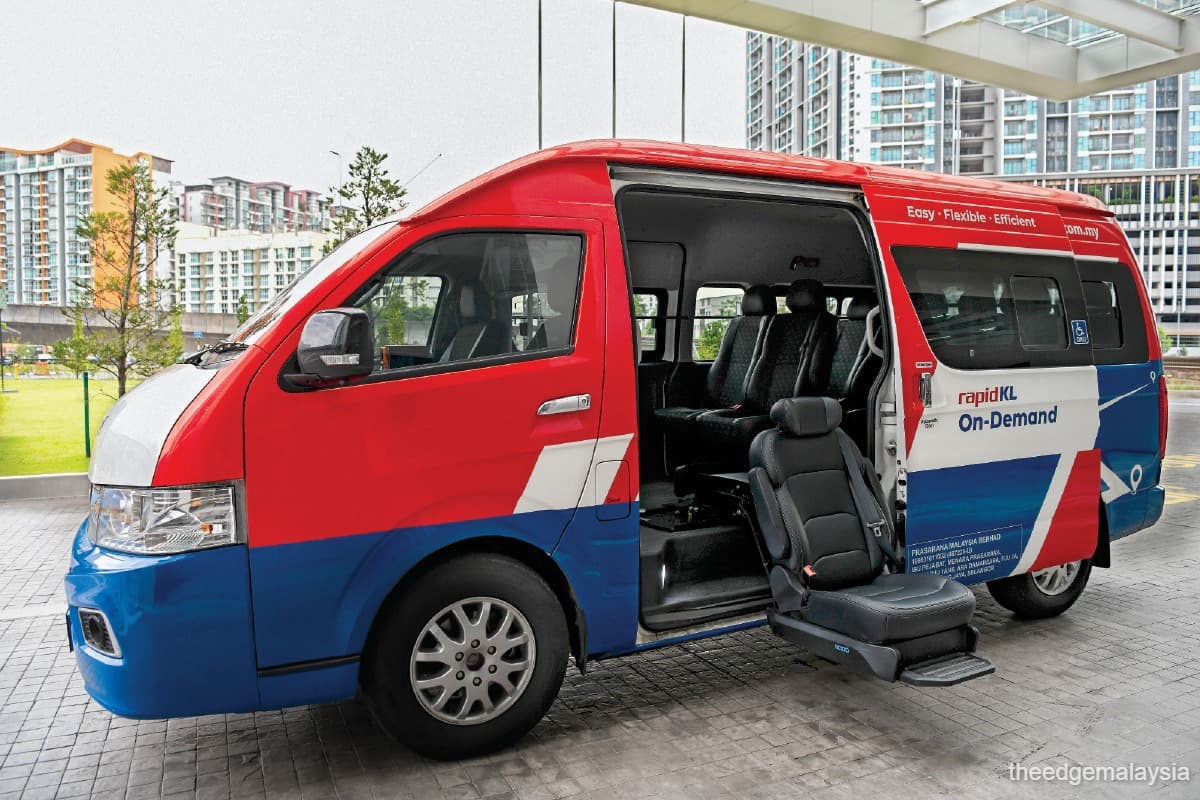
Seeing the increased demand for the service, Prasarana Malaysia Bhd’s Rapid On-Demand (ROD) entered the market to respond to commuters’ needs. As at July this year, ROD — which operates in the Klang Valley and Penang — had 17,000 active users per day and it targets to have a minimum of 36,000 active users per day by year end. Meanwhile,Kumpool has close to 10,000 active users per month.

From the low fares to flexible routes and pick-up times, it is no wonder why DRTs are a hit. But now, industry players are assessing how to keep the service going, while keeping it financially and environmentally sustainable.
During the POC period, the Selangor government provided a subsidy of RM2 per ride. On top of that, there was a RM5 cap on fares.
ROD offers a promotional fare of RM1, says Rapid Bus Sdn Bhd acting CEO Ku Jamil Zakaria, as a means to invest in the future of public transport. The price to serve per commuter is RM5, which means RM4 is absorbed by Prasarana.
Kumpool’s average fare is RM3, but this varies as it charges based on distance travelled. Goh Chun Hean, head of Kumpool Sdn Bhd, says in order for the service to be financially sustainable, the price per ride for a low-performing zone can go up to RM10, which may be too costly for commuters.
“Right now, if there is no government subsidy, it will be hard to run the business sustainably. And looking at the interest in the DRT service, the fleet size is also going to increase too, which will require more capital as well,” says Goh.
Following the POC period, the Selangor government is deciding on how to continue providing DRTs to the people. It also looked into areas to cover and new rates, which have yet to be announced.
In an email interview with ESG, Selangor exco of investment, trade and mobility Ng Sze Han says the study was completed in 4Q2024 and the state government, alongside Menteri Besar Selangor Inc (MBI), outlined a framework that will be the guideline for implementation. The details of the framework, however, were not revealed.
“Commuters can expect broader implementation of DRT across Selangor, with improved accessibility for Selangorians, and collaborations with other DRT providers to strengthen existing public transport connectivity,” he says.

App consolidating all DRT providers coming soon
The bigger question is whether this solution is finally going to be able to encourage Malaysians to utilise public transport and see a reduction of vehicles on the road.
Industry players are hopeful. Taking into account the other players — e-hailing services that can be costly and buses have fixed routes — the flexibility of DRTs seem to plug the remaining holes in the transport system.
“Currently, only 17% of the population in the Klang Valley utilises bus and rail to travel to different points of interest (POI). We want to bring up those numbers, and ROD might be able to improve the ridership numbers,” says Rapid’s Ku Jamil.
In June, Transport Minister Anthony Loke said the percentage of public transport usage in Malaysia has only reached 20%, a far cry from the 40% target outlined in the National Transport Policy 2019-2030.
In the same month, Kuala Lumpur mayor Datuk Seri Maimunah Mohd Sharif announced that the Kuala Lumpur Local Plan (PTKL) aims for 70% of the public to be using public transport by 2040. The plan also aims to create a transport network that allows the public to go from place to place with a walking distance of less than 400m.
As a Ministry of Finance-owned company, Rapid Bus is choosing to invest in DRTs first, in hopes that it would encourage increased ridership and, at the same time, reduce the number of vehicles on the road.
“With public transport, it’s a chicken and egg situation. If you don’t provide the vehicles and services first, people will not try it. And so, we have put out the service first, so that we can build a relationship with commuters and gain their confidence,” says Ku Jamil.
“Pricing is still a challenge at the moment, but our main focus is to increase ridership.”
Ku Jamil says it is also in the process of developing a consolidated booking app for all DRT players, so commuters will not need to switch between apps to book the service. The app is due to be completed in a year.
In addition, both Kumpool and Rapid Bus are looking to move to electric vehicle (EV) vans, but it would require significant capital investment. Goh says it could be up to RM100,000 of additional investment per van. On top of that, there are not many EV vans in the market.
“We are waiting for the right price point. Once we hit that sweet spot of where the savings that we get from electricity charging is larger than diesel, then it would make sense to switch.”

Increasing need to expand to more areas
While demand is there for DRTs, Goh explains that before it can offer a service in an area, an assessment needs to be done. This includes assessing the population density, frequency of movement in and out of the area and the number of POIs.
“POIs include the likes of shopping malls, hospitals and even universities. High-rise buildings are also a factor because carpooling is higher, whereas with landed properties, it might be tougher, especially since more areas are usually gated,” he explains.
It helps that each DRT player has its own coverage areas with little to no overlap, says Goh, ensuring that the service gets to spread out to as many people as possible.
But providing service in the outskirts is still a challenge, he says, because while the people there need the service more than urbanites, the return on investment (ROI) also needs to be justified.
“In places like Bangi and Rawang, providing consistent coverage is tough if the take-up rate is low. Also, the demographics in these areas are older folk and penetrating the elderly market is a challenge because using the app and booking the service doesn’t come naturally to them.”
In some urban areas, route recalibration needs to happen so that the buses and DRT vans are deployed effectively. Goh says it has taken note of routes that suit buses and those that suit DRT vans, and this data has been passed on to Prasarana.
Ku Jamil says it is also working with the Land Public Transport Agency and other DRT operators to see how each of their routes can be aligned.
“We do not want to create congestion … At the moment, we want to increase buses in the Klang Valley because based on our study, we need at least 3,600 buses, and at the moment, we have around 1,200 buses on the road,” he says.
“For ROD, we recalibrate it every three months based on route performance and number of passengers. Currently, we serve 93 zones and have 287 vans. Once the LRT Shah Alam opens, we will be operating at 101 zones with 305 vans.”
He adds that RM50 million was invested in purchasing 300 vans, which include the necessary technologies and payment systems for the ROD system.
Save by subscribing to us for your print and/or digital copy.
P/S: The Edge is also available on Apple's App Store and Android's Google Play.