

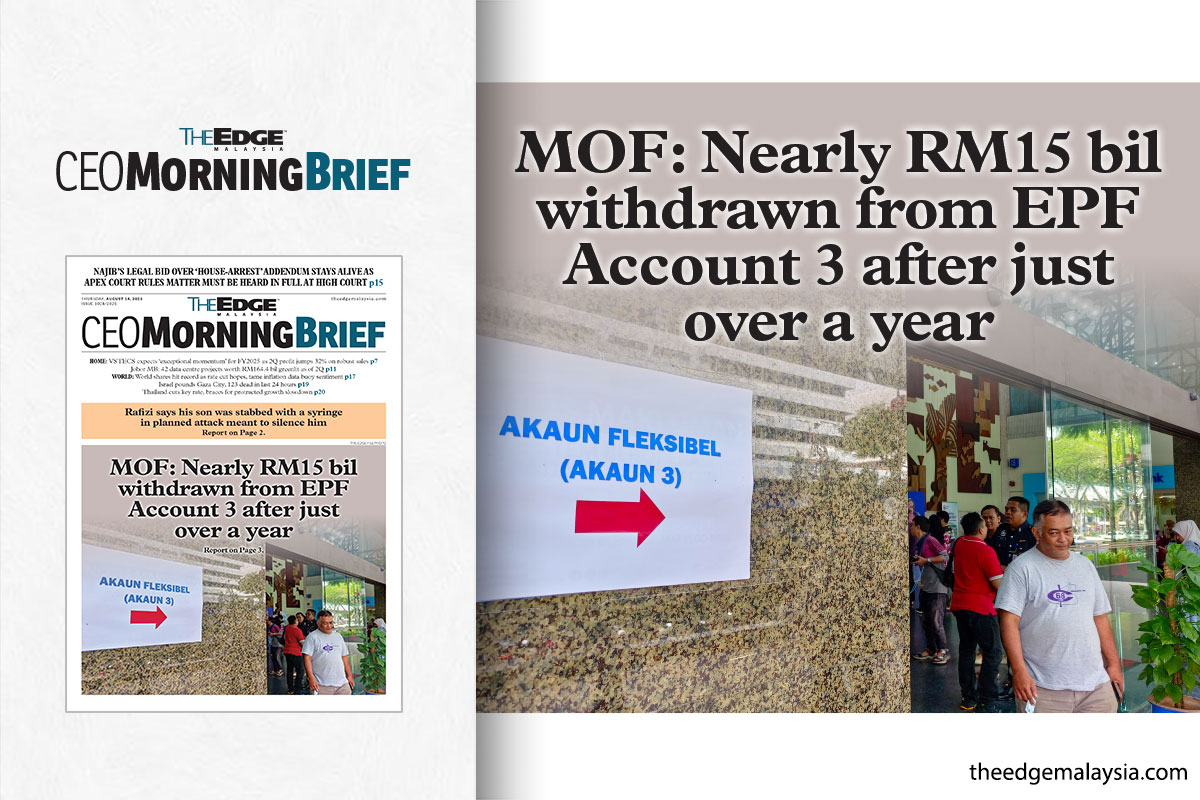
KUALA LUMPUR (Aug 13): A total of RM14.79 billion had been withdrawn from the Employees Provident Fund's (EPF) Flexible Account, also known as Account 3, just over a year since its launch, according to the Ministry of Finance (MOF).
Account 3 was introduced in May 2024 to provide more flexible access to EPF savings for short-term financial needs.
The MOF said the withdrawals were made by 4.63 million EPF members, representing 35.14% of the 13.2 million members below the age of 55.
“The total remaining balance in the Flexible Account stood at RM10.16 billion,” the ministry said in a written parliamentary reply to Datuk Seri Shahidan Kassim (PN–Arau).
The national retirement fund introduced Account 3 following a restructuring exercise that took effect on May 11 last year, aimed at catering to members’ short-term financial needs. Members below 55 are allowed to withdraw from this account at any time.
Under the new structure, contributions are allocated in a 75:15:10 ratio across Account 1 (Retirement), Account 2 (Sejahtera) and the Flexible Account, replacing the previous 70:30 split between Accounts 1 and 2.
In the same reply, the MOF reiterated its stance against allowing withdrawals from Account 1, emphasising that EPF savings — especially in Account 1 — are meant for retirement and are not a long-term solution to issues such as the rising cost of living or employment instability.
However, it stressed that the government remains mindful of the financial challenges faced by the public, and has introduced various assistance measures, including direct cash aid, targeted subsidies and special incentives, to ease the burden and safeguard the people’s wellbeing.
In a separate written reply to Datuk Alias Razak (PN–Kuala Nerus), the MOF said the EPF is prepared to consider enhancing its i-Lindung facility to allow the use of Account 2 funds for the purchase of insurance and takaful products in the future.
It noted, however, that this is merely one of several proposed financing options currently available, and stressed that purchasing the insurance and takaful product will be voluntary, with policyholders free to use any available financial resources to pay premiums.
Stakeholder engagement sessions are currently under way to develop a basic insurance and takaful product under the RESET programme, which aims to address rising healthcare and private insurance costs, the ministry said.
It added that the product’s structure and design have yet to be finalised, with the concept targeted for completion by December 2025 and implementation planned for end-2026.
For more Parliament stories, click here.