

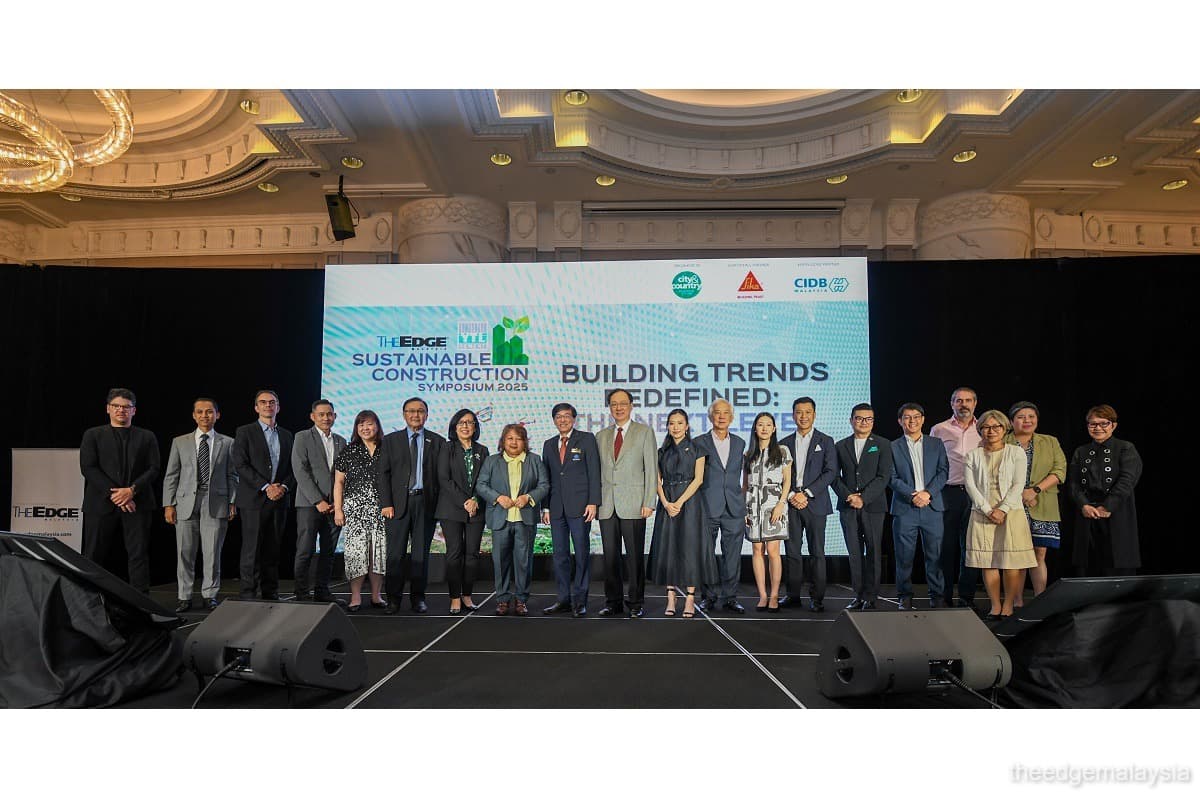
(From left) Skidmore, Owings & Merrill LLP (SOM) design principal Nicolas Medrano, Construction Research Institute of Malaysia senior manager of consultancy and inspection Mohd Khairolden Ghani, SOM senior associate principal Ian Ralph, YTL Cement Group general manager Lim Tze Liang, The Edge Malaysia chief commercial officer Sharon Teh, Master Builders Association Malaysia president Oliver Wee, YTL Cement CEO Datuk Yeoh Soo Keng, Construction Industry Development Board CEO Zainora Zainal, Real Estate and Housing Developers’ Association Malaysia president Datuk Ho Hon Sang, YTL Cement group managing director Datuk Seri Michael Yeoh, YTL Cement executive director Rachel Yeoh, The Edge Media Group publisher and group CEO Datuk Ho Kay Tat, YTL Cement executive director Michelle Yeoh, YTL Cement director Joshua Yeoh, Malaysian Institute of Architects deputy president Dexter Koh, Eastern Pretech Solutions CEO Lee Mun Sam, Sika Malaysia general manager Francisco Retondo, The Edge Malaysia editor-in-chief Kathy Fong, City & Country senior editor E Jacqui Chan and The Edge Malaysia editor emeritus Au Foong Yee (Photo by Low Yen Yeing/The Edge)
KUALA LUMPUR (Aug 13): Working smart with purpose is as important as working hard and together for sustainable construction, according to YTL Cement Group executive director Rachel Yeoh at The Edge Malaysia and YTL Cement’s Sustainable Construction Symposium 2025 with the theme "Building Trends Redefined: The Next Level".
In her welcome speech, she noted that this year’s symposium is anchored around the realisation that there is an opportunity to work hard and to work together, and there is a critical opportunity to work smart when it comes to sustainable construction.
“To work smart is also to work with purpose. Today, IBS (industrialised building system) is implemented in 45% of projects across Malaysia, contributing to a 25% reduction in construction waste and related emissions,” she said.
“As an industry leader, we recognise our responsibility, and [our subsidiary] Geo Alam Environmental is scaling up operations with support from leading waste management partners from China. Together, we are working towards converting more waste into alternative fuels for industrial use. In parallel, we are continuing to invest in R&D for the development of low-carbon products — efforts that align us closely with the National Construction Policy 2030.”
Nevertheless, she reckoned that one of the barriers to wider adoption of sustainable construction methods is the lack of a framework recognising low-carbon cement and concrete, including in building certification.
“Currently, only 20% of global certification systems include such criteria and this limits industry uptake. CREAM’s effort to close this gap is a significant step forward, with the introduction of the SustainBuild Mark certification — Malaysia's first product certification for ESG (environmental, social and governance) performance in building materials that meet ISO standards,” Yeoh added.
“In Southeast Asia, the construction sector accounts for 20% of regional carbon dioxide emissions. This highlights the immense opportunity to employ sustainable building practices with great impact. We have the ability to reduce energy consumption by up to 50% and water use by 40% using solutions already available to us. Change requires creativity and impact requires integration.”
Held on Wednesday (Aug 13) at JW Marriott Hotel Kuala Lumpur, the symposium aimed to challenge industry players to move beyond conventional sustainable construction practices and explore how sustainable construction can be reimagined by integrating advanced technologies.
The by-invitation-only event was attended by about 300 industry stakeholders comprising C-suites and directors of property development and construction companies and related associations.
The event was organised by The Edge Malaysia and YTL Cement, with Sika Malaysia serving as the supporting partner and the Construction Industry Development Board (CIDB) Malaysia as the knowledge partner.
Sika is a speciality chemicals company with a globally leading position in the development and production of systems and products for bonding, sealing, damping, reinforcing and protection in the building sector and industrial manufacturing.
In his opening address, The Edge Media Group publisher and group CEO Datuk Ho Kay Tat said that there is a promising shift in the construction industry with sustainable practices like the use of eco-friendly materials steadily moving into the mainstream in recent years.
“More companies are also rethinking their designs, sourcing responsibly and seeking innovative solutions that reduce environmental impact while delivering economic value. This is a positive change but it is only the beginning. Progress requires an openness to new practices, new technologies and new ways of thinking about how we build,” he said.
“While challenges remain, they also bring opportunities, and the push for sustainable construction drives innovation and opens the door to partnerships across industries. This symposium provides a valuable platform to share knowledge, exchange experiences and strengthen our collective commitment to sustainable construction.”
Speakers for the morning session were Skidmore, Owings & Merrill LLP (SOM) senior associate principal Ian Ralph and Construction Industry Development Board (CIDB) Malaysia CEO Zainora Zainal.
There was also a panel discussion that comprised YTL Cement general manager Lim Tze Liang, Master Builders Association Malaysia (MBAM) president Oliver Wee and Real Estate and Housing Developers’ Association (Rehda) Malaysia president Datuk Ho Hon Sang that was moderated by The Edge Malaysia editor emeritus Au Foong Yee.
Creating new ways of urban living
In his presentation titled “Beyond Business: How Cities Can Thrive in an Age of Accelerating Urban Intelligence”, SOM’s Ralph explored the development of social districts and showcased innovative projects that highlight the economic and social benefits of intelligent urban design and how artificial intelligence (AI) can be leveraged to create a future where urban cores thrive as vibrant communities.
He added that when it comes to the 15-minute city metrics, there are six essential functions to be effectively fulfilled within a 15-minute walking/biking distance, namely living, working, commerce, healthcare, education and entertainment.
“A smart city isn’t just about the technology itself; it’s about how that technology serves the people living in it. It is about people-first policies and places, data-driven decisions, preparing for change and advancing low-energy solutions as well as embracing and enabling flexibility,” he said.
“Our challenge is to design cities where innovation and human experience work together — shaping places where people want to live, work and play.”
In the following presentation titled “Realising Sustainable Construction in Malaysia”, Zainora spoke on the urgency of sustainable construction, as the built environment contributes to about 34% of global carbon dioxide emissions and about 32% of global energy consumption. An urgent shift is needed, she reckoned, from purely economic growth to environmental resilience and social inclusion.
Therefore, to tackle the situation, she noted that CIDB is currently in the midst of finalising the Construction ESG Guideline (cESG), as ESG is becoming non-negotiable for construction firms and goes beyond reporting. It is also to align industry standards in terms of ESG goals, while upskilling the workforce through training programmes.
“There are three strategic objectives of the cESG Framework, which are to ensure the construction industry remains competitive by integrating ESG principles into its principles, strengthen regulatory oversight over sustainability matters in the construction industry and support the transition to a low-carbon construction industry in line with Malaysia’s net zero ambitions,” she added.

In the panel discussion, “Smart-Driven Green Construction — Headwinds & Opportunities”, the panellists also briefly spoke on their respective topics before the main discussion. YTL Cement’s Lim, in his presentation titled “Building Together: Smarter and More Sustainable”, explained how the company has begun adopting smart systems to enhance efficiency and is increasingly leveraging IT and AI to serve customers better.
“How a premix company (like YTL Cement) enhances efficiency is through automation. This includes high-volume, time-sensitive deliveries, often reaching up to 2,000 trips per day across multiple job sites during peak hours. Integration with GPS and traffic tracking for real-time visibility, an automated job arrangement system for efficient delivery assignment and a truck queuing system to streamline plant loading and reduce delays as well as integrating digital systems across operations to deliver faster, smarter and more transparent concrete delivery — reducing delays, minimising waste and providing real-time visibility that enhances customer trust, satisfaction and operational excellence," he said.
Rehda’s Ho, in his presentation titled “Smart Green Construction: Innovative Technologies, Challenges and Applications”, highlighted the need for the adoption of holistic green and sustainable construction strategies to answer the government’s call and for the betterment of the environment, the industry, the nation and, ultimately, the rakyat.
“Green and smart construction is often misconceived as relevant only during the construction phase, when in fact it spans the entire project lifecycle — from sustainable planning and design in pre-construction to efficient operation and maintenance post-construction, integrating every stage of the supply chain,” he said.
The usage of technology also has several advantages, he added. For example, a Rumah Idaman project built with the IBS method enjoys 33% savings in construction time as well as a 49% reduction in total on-site labour cost.
MBAM’s Wee, meanwhile, discussed the challenges in adopting sustainable practices for construction in his presentation titled “Slow Uptake of Green Solutions”. He explained contractors are in a passive position regarding whether to use green construction materials and/or solutions, as it is mainly the call of the clients, namely the developers.
“If the contract doesn’t specify green or sustainable components, we can’t simply decide to deliver something different, especially without a clear instruction or, more importantly, without payment for those additional measures,” he said, adding that ESG compliance covers a wide range of areas, making full compliance challenging for any construction firm.
“Nonetheless, as contractors, we should establish practical strategies to minimise waste and reduce and reuse materials whenever possible. In reality, voluntary compliance without meaningful incentives often results in low urgency as many small and medium players in the industry operate on very tight margins and have limited capacity or motivation to invest in innovation,” he explained.
“A practical solution could be for the relevant authorities to introduce an ESG maturity index to assess and grade each company’s readiness. This would give project owners greater confidence when pre-qualifying bidders while also providing contractors with a tangible benchmark to demonstrate their ESG commitment, particularly when competing for multinational projects.”
At the panel discussion, The Edge’s Au asked Rehda’s Ho and MBAM’s Wee about the industry’s resistance to adopting green construction, to which both concurred that the immediate concern is cost — but both developers and contractors know that it is the direction they need to take or they will lose out in terms of competitiveness.
Au also asked the panellists what it takes for the country to shape a more resilient, data-centric, future-ready and flexible built environment for the next generations. Rehda’s Ho noted that Rehda and MBAM should work hand in hand with CIDB on data-related information, since they are members of the board.
“This creates the basis for strong collaboration. Whoever initiates a data-centric approach, regardless of which aspect of the construction industry, will be helping future generations and ensuring sustainability year after year, generation after generation. This is what we need,” said Ho.
Wee explained that MBAM is already working hard on this effort. “We do, in fact, collect a lot of data. Contractors harvest valuable information such as machinery operating hours, labour productivity and equipment usage. This data allows us to estimate costs more accurately for future or similar jobs.
“The only challenge is the way we collect data, which can still be quite manual, sometimes even handwritten. But with today’s IT tools, we can capture data more accurately, selectively and in a targeted manner. Many contractors have already started doing this,” he said.
YTL Cement’s Lim agreed with Rehda’s Ho and MBAM’s Wee, adding that sufficient and relevant operational data is needed for AI to read and analyse data completely and accurately.
“This allows AI to understand and interpret your day-to-day operations before it can provide meaningful analysis. Looking ahead, I believe training and awareness are essential. We need to educate the public and future generations, starting from universities and even at the primary and secondary school levels, so they understand the real benefits of the sustainable approaches we are implementing today,” he added.
Mindset change is required
The second half of the event featured two speakers, namely SOM design principal Nicolas Medrano and Construction Research Institute of Malaysia (CREAM) senior manager of consultancy and inspection Mohd Khairolden Ghani.
There was a fireside chat, titled “Rethinking Building Solutions and Mindsets”, featuring Sika Malaysia head of sustainability and digitalisation for concrete target market in APAC region Damian Lusty, Malaysian Institute of Architects (PAM) deputy president Dexter Koh and Eastern Pretech Solutions CEO Lee Mun Sam. This session will be moderated by Freda Liu.
In his talk, “Designing with Compassion: Creating Buildings That Care for People, Planet and Performance”, SOM’s Medrano explored how architecture can prioritise human well-being, environmental responsibility and high performance. He presented examples of how the firm restored coastal cities that were heavily exploited due to various activities such as overfishing, logistics, mining, tourism and mineral extraction.
“How do we start to design these places compassionately — creating a sense of restoration and an economy that can thrive over time? How can we add value to blue economies, create designs that increase job opportunities, attract responsible tourism and combat climate change?” he asked.
“We have developed a toolkit that begins with creating a high-quality public realm — a space where people can be healthy, feel safe and develop a sense of belonging. Restoring biodiversity is critical. For every site we work on, we aim to increase ecological diversity while fostering a people-focused economy and creating places for communities to come together. Innovation is also key — not only using the latest technologies but also recognising that nature has been teaching us lessons for centuries. In a way, nature is the original AI: highly intelligent and adaptive.”
Next up was CREAM’s Khairolden with his talk “Malaysia’s Sustainable Construction Initiatives: Diving into the Details”, where he presented two key components currently being advanced under CREAM and CIDB Malaysia’s sustainability agenda.
They are the SustainBuild Mark (SB Mark), a certification framework aimed at promoting sustainability performance across the construction value chain, as well as the 2025 Construction Waste Management Guideline, developed in response to increasing volumes of construction waste and limited recycling infrastructure.
CIDB is also currently updating the embodied carbon inventory data and developing a carbon calculator to target the most impactful sources and serve as a practical tool for various professionals.
“In the way forward towards sustainable construction, we need to accelerate SB Mark adoption across the industry by promoting it as a key sustainability tool and embedding it into procurement criteria, project planning and capacity-building efforts.
“Secondly, we also need to leverage carbon and waste data for better decisions, utilising updated embodied carbon inventory and construction waste guidelines to inform lifecycle-based planning and material selection. Thirdly, it is to strengthen incentives and policy alignment by enhancing support through targeted incentives and ensuring alignment between SB Mark, waste regulations and national green procurement strategies,” he said.
At the fireside chat, Liu focused on the intention versus implementation of sustainable construction. Cost, among others, has been cited by the speakers as the reason for the delayed implementation of the effort.
PAM's Koh observed that there is a disconnect between various policies from different bodies and that the industry is working in silos.
“In a way, we are not working closely enough with each other. We can and should do better if we actually come together and solve sustainability as a whole. It shouldn’t just be, ‘Oh, I’ll do this part because I’m good at it.’ We need to look at the overall ecosystem of sustainability,” he said, but noted that he has seen some improvement in the industry.
Sika's Lusty — who covers 22 countries under his portfolio, from advanced countries like New Zealand and Australia to countries that have barely started — reckoned that Malaysia is somewhere in the middle in terms of the implementation of sustainable construction.
“A lot of where we are in our sustainability journey comes down to education — there’s still a lack of understanding and we need to create simple pathways for sustainability. CREAM has moved into a new system that is more effective and easy to use and this is a fantastic start. But many people still don’t know how to use tools like LCA (Life Cycle Assessment) and EPD (Environmental Product Declarations). They don’t ask the right questions because they don’t yet understand — like, why get certified, why pay extra, are we talking about initial cost or lifecycle cost?” he said.
Eastern Pretech Solutions' Lee observed that the mindset that it is not worth paying a premium for sustainable construction is slowly changing over the years — albeit slowly.
“Agencies like CIDB have done a tremendous job promoting IBS, so people know about it now. Twenty years ago, breaking that cost barrier was hard. Today, they still ask, ‘How much?’, but they’re also starting to think about the value gained by paying a small premium,” he said.
For the full coverage of The Edge Malaysia and YTL Cement’s Sustainable Construction Symposium 2025, check out the Aug 25 issue of City & Country.