

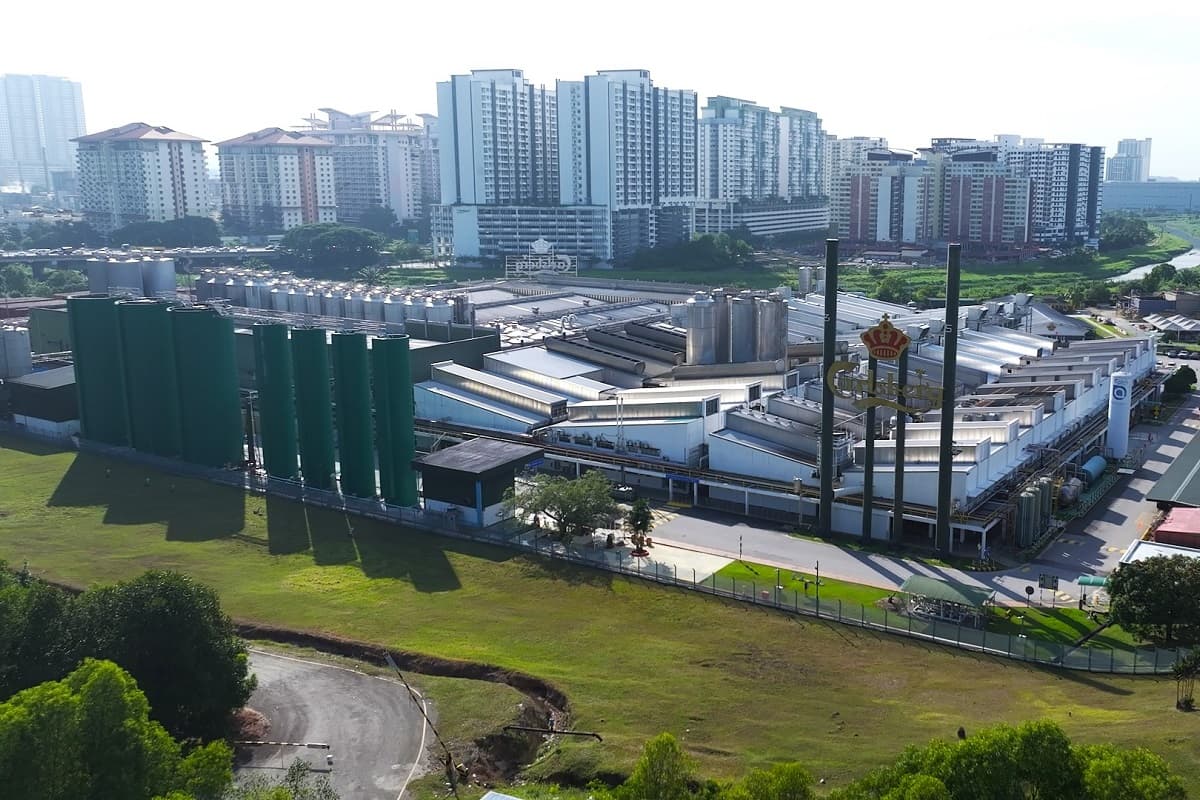
KUALA LUMPUR (Aug 12): Carlsberg Brewery Malaysia Bhd (KL:CARLSBG) announced a 20 sen dividend payout on Tuesday, its second interim payout for its financial year ending Dec 31, 2025 (FY2025), following a 3.2% year-on-year rise in its second quarter profit.
This raises its dividend payout for the year so far to 43 sen per share, one sen more than the 42 sen it declared in the same period last year.
The group's net profit for the second quarter ended June 30 (2QFY2025) rose to RM81.93 million from RM79.40 million in 2QFY2024, despite revenue dipping 3.4% to RM490.17 million from RM507.48 million. The stronger performance was driven by higher contribution from its Sri Lankan associate and a reduction in tax expenses, which dropped 11.2% to RM22.22 million from RM25.03 million.
The group's associate, Lion Brewery (Ceylon) PLC, contributed RM9.1 million in profit, up from RM8.3 million in 2QFY2024, thanks to improved revenue in Sri Lanka.
In Malaysia, sales grew by 1.5% to RM369.4 million, boosting profit from operations up 4.6% to RM80.7 million. This improvement was partly attributed to a lower base in the previous year's quarter, which had been affected by a jump in trade purchases in 1QFY2024, ahead of a price increase.
In contrast, the company's Singapore operations experienced a 15.9% decline in revenue to RM120.8 million, and a 28.5% drop in profit from operations to RM14.6 million. This was due to weaker on-trade performance and intense pricing competition, reflecting cautious consumer sentiment and subdued discretionary spending.
For the first half of FY2025, Carlsberg's net profit rose by 5.4% to RM176.45 million, up from RM167.33 million a year earlier, despite a 6.5% decline in revenue to RM1.15 billion from RM1.23 billion.
Speaking at a media briefing, managing director Stefano Clini acknowledged that beer volumes have softened this year, citing both supply constraints and weaker market sentiment. “I’d say more in Singapore than in Malaysia, but also in Malaysia, especially in trade, we see fewer consumers,” he said.
Clini pointed to shifting consumer behaviour, noting that discretionary spending has tapered off. “Previously, you had to book a good restaurant two or three weeks in advance. Now, you can call at seven or nine and there’s always a table available. Consumers are simply spending a little less.”
He added that this trend has weighed more heavily on premium brands, while the mainstream Carlsberg brand has remained comparatively resilient.
“Looking ahead, our continued focus on disciplined discount management and operational efficiency underscores the resilience of our business strategy. Despite the subdued local market, this gives us the confidence to keep investing behind our brands,” Clini said.
At Tuesday’s close, Carlsberg Malaysia shares were up two sen or 0.1% at RM17.28, valuing the group at RM5.28 billion. Year to date, the stock has declined 16.4%.