

This article first appeared in The Edge Malaysia Weekly on August 11, 2025 - August 17, 2025
FOR decades, Tan Sri Robert Tan Hua Choon quietly carved out a niche for himself in Malaysia’s corporate landscape — not with flamboyant multibillion-ringgit deals, but through calculated plays across a web of small capitalisation listed companies.
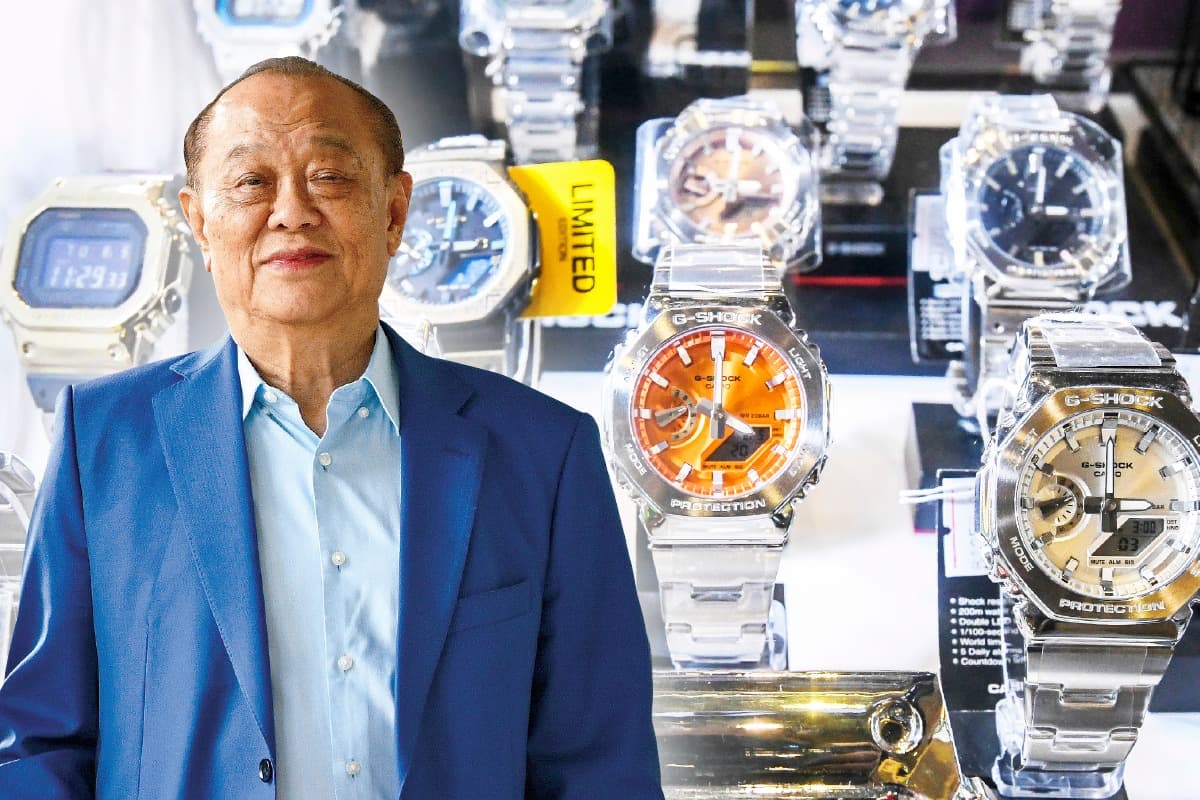
Dubbed the “Casio King” for his decades-long exclusive distributorship in Malaysia with Japanese electronics giant Casio Computer Co Ltd, he was also known as a master of the small-cap space, buying into and selling out of many firms, as well as controlling significant stakes in nearly a dozen public-listed companies over the years.
But the landscape has changed. Over the past 11 years, Tan has gradually divested his interests in at least five listed companies — prefabricated door manufacturer Malaysia Aica Bhd (Maica), shipping outfit PDZ Holdings Bhd (KL:PDZ), ceramic products maker Goh Ban Huat Bhd (GBH), automotive battery producer GPA Holdings Bhd and Computer Forms (M) Bhd (KL:CFM). Back-of-the-envelope calculations show that he pocketed about RM300 million just from divesting his stakes in these companies.
The latest move came just last month, when the self-made businessman and his son, Datuk Seri Tan Han Chuan, received a conditional buyout offer from oil and gas veteran Abd Azis Mohamad and his investment firm Kintan Prima Sdn Bhd for their 40.33% stake in Jasa Kita Bhd (KL:JASKITA).
Abd Azis, who already owns 4.69% of Jasa Kita, is working with his wife — former Malaysia Digital Economy Corporation (MDEC) CEO Datuk Yasmin Mahmood — and brother-in-law, Boustead Holdings Bhd director Datuk Seri Iskandar Mizal Mahmood (who recently emerged as a substantial shareholder with a 5% stake in the company), on the acquisition.

The deal, worth RM68.89 million, raises questions about whether Tan — the elusive 84-year-old tycoon who has been involved in manufacturing, banking, shipping, property development and trading — is now quietly drawing the curtain on his colourful corporate career. After all, Jasa Kita, which manufactures and distributes electric motors, was listed in 1993 during the super bull run and is known as his flagship company.
Subsequently, his Marco Holdings Bhd (KL:MARCO) — the sole distributor of Casio watches and calculators since the 1970s — took over the listing status of ailing biscuit maker Khong Guan Holdings Bhd via a back-door listing in 1999.
Since then, Tan has had several companies listed and held substantial stakes in many of them, earning a long-standing reputation as one of Bursa Malaysia’s original “penny stock kings”, or “small-cap king” to some. At the peak, he was said to have controlled as many as 36 companies.
Today, apart from Marco and Jasa Kita — which Tan is in the process of divesting — he still controls property firm JKG Land Bhd (KL:JKGLAND) and cosmetics products contract manufacturer FCW Holdings Bhd (KL:FCW). The offices of these four companies are located in Menara JKG in Jalan Raja Laut, Kuala Lumpur.
Those who have been following Tan would know that the recent Jasa Kita deal is the latest in a series of corporate exits.
In 2014, he sold his entire equity interest in Maica to property developer Tan Sri Ter Leong Yap for RM33.39 million, paving the way for the listed firm’s transformation into what is now Sunsuria Bhd (KL:SUNSURIA). That same year, he disposed of a 19.13% stake in PDZ to Pelaburan MARA Bhd for an estimated RM29.22 million.
The reclusive corporate figure’s involvement in sanitaryware maker GBH was particularly noteworthy. In 2009, he made a surprise takeover of the century-old company, buying out the founding Goh family after a fierce shareholder tussle.
Eight years later, Tan sold his stake in GBH — once seen as his key asset — to Datuk Seri Edwin Tan Pei Seng and Datuk Seri Godwin Tan Pei Poh, who are renowned in Johor’s property scene through Joland Group of Companies, which was founded by their father Datuk Tan Eng Boon. The listed company is now known as Paragon Globe Bhd (KL:PGLOBE), with the legacy businesses having been sold back to Tan.
At the height of the Covid-19 pandemic, in August 2020, Tan sold his 28.32% stake in GPA, which makes automotive and motorcycle batteries, to British Virgin Islands-based Galaxy Coast Ventures Ltd, which is reportedly linked to Hextar Global Bhd (KL:HEXTAR) major shareholder Datuk Eddie Ong Choo Meng. GPA was later renamed Joe Holding Bhd (KL:JOE).
Then in 2022, Tan disposed of 64.97% of Computer Forms, a distributor of computer and stock forms, to Sanichi Technology Bhd (KL:SANICHI) founder Datuk Seri Dr Jacky Pang Chow Huat for RM79.91 million.
Clean shell companies
According to industry observers, Tan’s strategy has often involved stripping out the operating assets while leaving behind relatively clean shell companies — those with minimal liabilities, some cash on the books and compliant reporting records — making them attractive acquisition targets. Yet, the eventual disposals are often executed at a premium, reflecting the market’s appetite for clean, cash-backed shell companies.
Nevertheless, these divestments mark a shift from Tan’s previous approach of maintaining controlling blocks of shares in a cluster of companies that are often flying under the radar.
Assuming that Tan will be letting go of Jasa Kita, he will retain major stakes only in Marco (25.64%), FCW (30.61%) and JKG Land (27.14%). All three counters are relatively quiet in terms of market activity and corporate developments.

Marco remains perhaps his most enduring business. The exclusive distributor of Casio watches, calculators and musical instruments in Malaysia, the company is synonymous with Tan himself. His deep-rooted relationship with Casio Computer dates back to 1970, built not on formal contracts but on decades of mutual trust — an unusual arrangement by today’s standards.
In a rare interview with The Edge in 2017, Tan recalled going door to door at shopping malls trying to convince retailers to stock Casio products, which at the time were seen as low-end alternatives to the Swiss timepieces. His perseverance eventually paid off, turning Marco into a market leader in its category.
Notably, Marco bought a 40.39% stake in Time Galerie (M) Sdn Bhd (TGSB) for RM26.66 million in December 2018. Five years later, the group achieved full ownership of Time Galerie by acquiring the remaining 59.61% equity interest in the watch retailer for RM37.6 million. Today, Time Galerie operates more than 50 retail outlets nationwide.
While Marco — or rather, all of Tan’s listed companies — remains fairly profitable, his mini business empire appears to be shrinking.
Industry observers point to his age — he is now in his mid-eighties — and a lack of a clear succession plan as possible reasons for the gradual retreat. While his son Han Chuan has been involved in selected entities such as Jasa Kita, there is little indication of an imminent generational takeover.
In fact, Tan is understood to have placed considerable trust in his long-time lieutenant Datuk Anderson Thor Poh Seng. In recent years, he also appeared keen on grooming his grandson — more so than other family members — to be his successor.
Interestingly, Tan is also known to swing between extremes, talking about selling off everything when he feels weary, only to reverse course and go on a buying spree when his energy returns. This unpredictability has long made it difficult to pin down his next move.
Daim and Spanco
There has long been market chatter about Tan’s close ties to former finance minister the late Tun Daim Zainuddin, with some suggesting that the unwinding of old business networks may be a reason he has stepped back from the limelight.
Whether those relationships once aided deal-making is anyone’s guess. What’s clear, however, is that Tan himself appears to be slowing down — even if the occasional deal, such as Marco’s full acquisition of Time Galerie or the offer for his stake in Jasa Kita, still finds its way to him.
Tan has always been said to have ties with Daim, which date back to the early 1990s.
In 1992, one Robert H C Tan (as stated by Josef Tosovsky, the Czech Republic’s then central bank governor) was said to have set up a bank in the Czech Republic called IC Bank, with a capital of US$13 million. The bank later became part of Daim’s International Commercial Bank Financial Group (ICB), which was listed on the Alternative Investment Market of the London Stock Exchange. ICB has since been taken private and many of its assets sold off.
The bank in the Czech Republic was not Tan’s first foray into banking. He also had a 21.3% stake in Malta-based Lombard Bank.
Meanwhile, his UCM Industrial Corp Bhd (which became Kuala Lumpur City Corp Bhd) controlled stockbroking outfit KL City Securities Sdn Bhd, which was swallowed by Alliance Bank Malaysia Bhd (KL:ABMB). Back then, Alliance Bank was linked to Daim via Langkah Bahagia Sdn Bhd.
Apart from his nickname “Casio King”, Tan is also well known for being one of the shareholders of Spanco Sdn Bhd, which was appointed on Jan 1, 1994, to supply, maintain and repair the government’s fleet of saloon cars for a period of 25 years.
In 2004, the Ministry of Finance ordered a review of the Spanco deal as it was believed that the government had overpaid for the services provided. It was later reported that the government was paying a total of RM221.6 million a year to Spanco to rent some 10,963 Proton cars for official use.
On Dec 11, 2019, Cekap Urus Sdn Bhd — a joint venture between Berjaya Group, Naza Group and Tunku Tun Aminah Sultan Ibrahim Ismail — received a letter of intent (LOI) from the Tun Dr Mahathir Mohamad-led Pakatan Harapan government for a new fleet management contract. However, it was terminated a year later on Dec 22, 2020, under the administration of Tan Sri Muhyiddin Yassin.
In July 2023, Berjaya Corp Bhd (KL:BJCORP) founder Tan Sri Vincent Tan Chee Yioun filed a lawsuit against the finance ministry and Spanco regarding the terminated LOI, alleging that the contract was awarded to Spanco even though its offer price was higher by RM700 million. This prompted the Malaysian Anti-Corruption Commission (MACC) to open an investigation into the issue.
In April 2024, Tan was charged for allegedly cheating the finance ministry on Feb 27 and 28, 2019, in a RM3.966 billion government fleet contract by misrepresenting that Spanco had at least 30% bumiputera interest in the tender process, resulting in the company securing the contract. The charge sheet, however, did not provide details on what was allegedly false about the bumiputera equity.
According to Companies Commission of Malaysia (SSM) data, Spanco’s shareholders are Jati Rata Sdn Bhd (46%), Robert Tan (24.65%), his son Tan Han Chuan (14.67%), his daughter Datin Tan Ching Ching (9.68%) and Minhat Mion (5%).
It is worth noting that Han Chuan and his sister Ching Ching also control more than 70% of furniture company Eurospan Holdings Bhd (KL:EUROSP), in which their father’s right-hand man Thor sits on the board as non-executive director.
Going back to Spanco, Tan claimed trial and his lawyer Datuk Wan Azmir Wan Majid noted that he had health issues, including hypertension and knee and back pain, which required him to use a cane to support himself.

Cekap Urus is still seeking to invalidate the termination of the LOI. It is also asking the court for a declaration that the government and ministry’s decision to award Spanco the fleet project through direct negotiation was invalid, null and void. The hearing date for the judicial review has been rescheduled to later this month on Aug 28.
So, whether Tan is winding down by design or simply caught in the changing tides of Corporate Malaysia is hard to tell. At 84, the low-profile businessman has become even more elusive, having retreated from the public eye.
Attempts by The Edge to contact Tan for comment were unsuccessful.
Some say the pressures of old age and legal scrutiny have taken their toll. Others believe he still has cards left to play, just not as openly as before.
Like it or not, the court case involving the government fleet contract has cast a long shadow over his legacy, especially given how Spanco was once seen as one of the most coveted concessions in town.
In Malaysia’s corporate circles, power seldom exits with a bang — it usually fades, sometimes quietly, at other times under pressure. Perhaps the Spanco controversy and the Daim factor are among the issues that have left Tan feeling weary. For a man who once made the headlines but rarely spoke to the press, his silence in recent years may speak louder than any statement.
What comes next remains unclear. But for now, the “Casio King” appears content to let time tick by.
Save by subscribing to us for your print and/or digital copy.
P/S: The Edge is also available on Apple's App Store and Android's Google Play.