

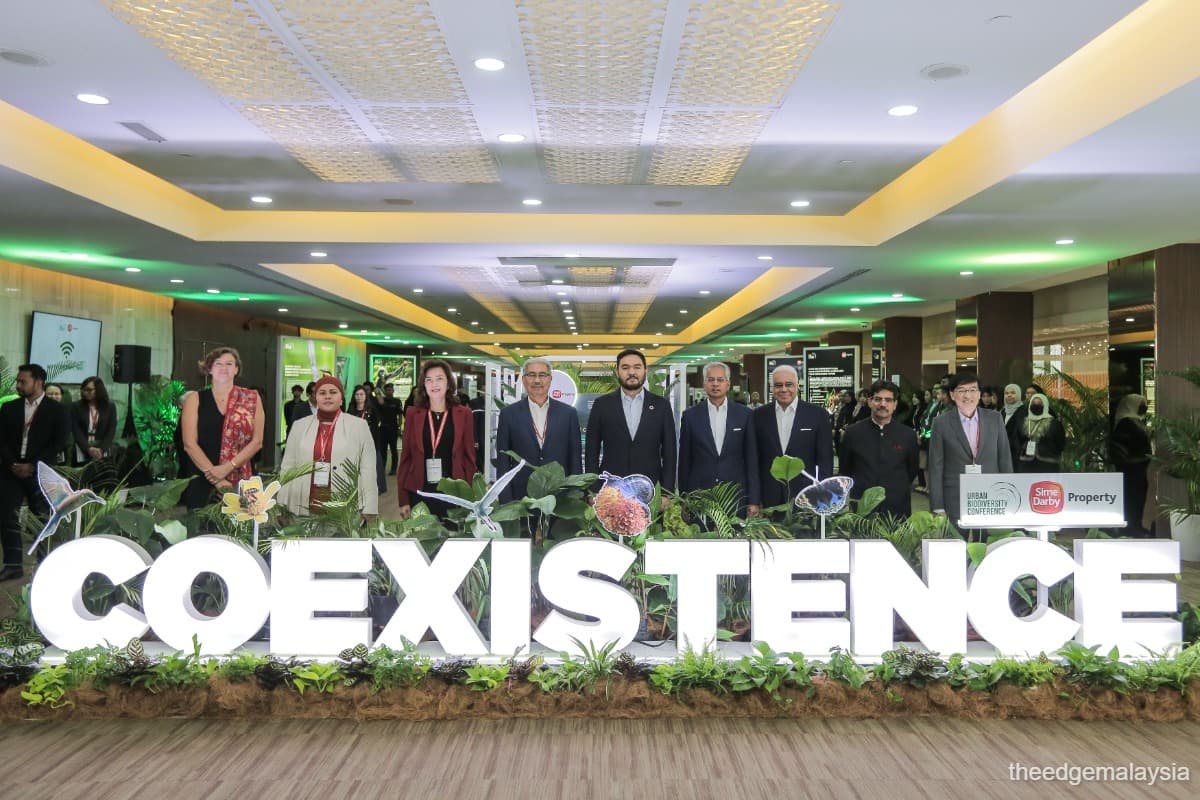
(From left) Founding University College London director of the Institute for Innovation and Public Purpose Professor Mariana Mazzucato, Sime Darby Property Bhd (SDP) non-independent non-executive director Nur Farahbi Shaari, independent non-executive director Datuk Hamidah Naziadin; non-independent non-executive director Tengku Datuk Seri Ahmad Shah Sultan Salahuddin Abdul Aziz Shah, Raja Muda of Selangor Tengku Amir Shah Sultan Sharafuddin Idris Shah, SDP group managing director and CEO Datuk Seri Azmir Merican; non-independent non-executive director Tan Sri Jaganath Derek Steven Sabapathy, independent non-executive directors Mohamed Ridza Mohamed Abdulla and Datuk Ho Hon Sang. (Photo by Zahid Izzani/The Edge)
KUALA LUMPUR (Aug 5): Prioritising biodiversity in cities is not about turning urban areas back into forests. Instead, it calls for designing the built environment to work in tandem with natural systems, not in opposition to it, said Tengku Amir Shah Sultan Sharafuddin Idris Shah, Raja Muda of Selangor, at the Urban Biodiversity Conference (UBC) 2025 organised by Sime Darby Property Bhd (SDP) on Tuesday.
During his royal address, Tengku Amir talked about the need to pursue growth in cities without degrading the natural systems that make life possible for humans. To do so, however, will require a fundamental shift in how people think, build and lead.
“Selangor, as Malaysia’s most urbanised state, has a responsibility to lead by example. We are blessed with diverse ecosystems, from mangroves and wetlands to forests and rivers, all woven into the fabric of our rapidly developing cities. But this ecological legacy is fragile, and our role in it is not merely to preserve it, but to actively integrate it into our future,” said Tengku Amir at the conference, which was held at the Sime Darby Convention Centre.
The inaugural UBC2025 theme was “Coexistence: Shared environments for balance and resilience.”
The e-mobility partner for the event was Auto Bavaria, the accommodation partner was Le Meridien, while the media partner was The Edge Malaysia.
To ensure that urban biodiversity can thrive, strategic investments to improve liveability and resilience are crucial, added Tengku Amir.
The goal is to embed biodiversity into the blueprint of every township, and to restore and reintroduce ecological corridors.
“Green infrastructure should be embraced not merely as an aesthetic feature, but as an operational necessity. Above all, cities should be viewed not as machines to be optimised, but as ecosystems to be nurtured,” he said.
This sentiment was echoed by Datuk Seri Azmir Merican, group managing director and CEO of SDP, in his opening remarks. He highlighted that the rate of urban expansion in Selangor has multiplied by nearly five times from the previous decade, leading to a reduction of 8% in the state’s forests.
“Cities will need to ‘do more with less’: Less space, less tolerance for pollution and less budget for ecological areas,” he said.
Subsequently, the increase of residential and commercial areas is causing significant environmental stress. To address this, biodiversity must be a core part of urban development.
“As property developers, it might seem counterintuitive for us to be having a conversation on biodiversity. Seeing as development and conservation are often seen at opposite ends, we believe this is exactly what we should be talking about. We are in the business of building downstream and that resource requires land. What matters just as much as what we build, is how we build them,” said Azmir.
This agenda to protect biodiversity should also be a national conversation that involves all stakeholders, said Datuk Seri Fadillah Yusof, deputy prime minister and minister of energy transition and water transformation, during his fireside chat.
For the government to translate its policies into action, it needs funding from the private sector and participation of local communities.
“We need the non-governmental organisations, and more importantly, we need the community leaders to be in the forefront to realise the vision that we have, because they are the ones who will be on the ground, monitoring,” said Fadillah.
The deputy prime minister also delivered the closing address for the conference, where he shared the Malaysian government’s policies and strategies to protect biodiversity, such as the successful initiative to plan 100 million trees, the Fourth National Physical Plan and the National Biodiversity Policy 2022-2030.
Malaysia will also champion these issues in the region as the chair of Asean this year.
“As chair, Malaysia will lead in introducing the Asean Smart Cities Network Action Plan (2026-2035). This long-term strategic blueprint seeks to harmonise urban development across the region by integrating cutting-edge technologies, sustainable governance and community-driven approaches,” said Fadillah.
“We are also advancing the Asean Biodiversity Plan 2024 to conserve, sustainably manage, and share the benefits of the region’s rich biological assets.”
During the event, a memorandum of understanding signifying a five-year partnership on urban biodiversity was signed between SDP and Tropical Rainforest Conservation and Research Centre. The non-governmental organisation has already been working with SDP to build ecological corridors and conserve endangered, rare and threatened trees in a nursery in the City of Elmina.
The other sessions at the conference addressed the topic of biodiversity from different angles, and featured speakers such as Datuk Seri Dr Maimunah Mohd Sharif, mayor of Kuala Lumpur; Datuk Rizal Rickman Ramli, deputy president and group CEO at Permodalan Nasional Bhd; Tan Sri Abdul Wahid Omar, chairman of Cypark Resources Bhd; Tan Sri Shahril Ridza Ridzuan, chairman of Axiata Group Bhd; and Mak Joon Nien, CEO of Standard Chartered Malaysia.