

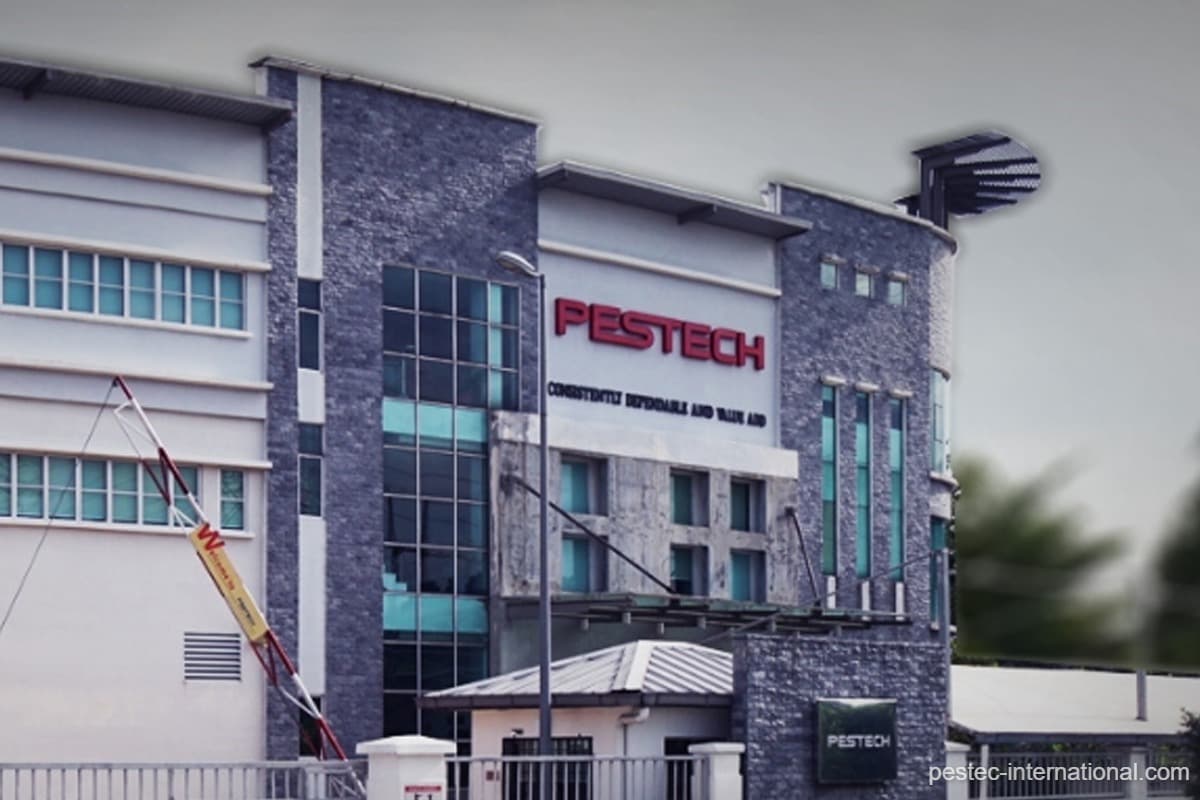
KUALA LUMPUR (Aug 1): Pestec International Bhd (KL:PESTEC) said its external auditor has expressed its unqualified audit opinion with a material uncertainty related to the group’s ability to continue as a going concern.
Messrs Grant Thornton Malaysia PLT’s opinion is related to the group’s audited consolidated financial statements for the financial period ended March 31, 2025 (AFS 2025), highlighting that the group incurred a net loss of RM341.5 million and the company a net loss of RM257.3 million during the period, the engineering company said in a bourse on Friday (August 1).
Grant Thornton Malaysia also highlighted that Pestech’s total current liabilities exceeded its current assets by RM26.49 million, while the company’s total current liabilities exceeded current assets by RM114.36 million.
These conditions have raised significant doubt about the group and the company’s ability to continue as going concerns, the auditor said.
The auditor added that the ability of the group and of the company to continue as a going concern are highly dependent on their ability to generate sufficient cash flows to meet their obligations; the continuous financial support provided by the financial institutions, creditors and holding company; and continuous effort in tendering and securing profitable projects.
“If these are not forthcoming, the group and the company may be unable to realise their assets and discharge their liabilities in the normal course of business,” it noted.
Nonetheless, the board of Pestec believes the group and the company will be able to continue operating, saying that “the holding company has agreed to provide continuing financial support for them to meet its liabilities as and when they fall due.”
Pestec’s largest shareholder is Dhaya Maju Infrastructure (Asia) Sdn Bhd, who holds a 61.39% stake in the listed company.
It also indicated the steps taken to address key audit matters related to the material uncertainty related to a going concern.
During the financial period, Pestec had raised RM160 million via a restricted issue of 1.33 billion new shares to support its funding requirement. This was followed by another RM27.81 million raised from an additional restricted issue of 231.79 million shares after the financial period.
The proceeds were used to repay bank borrowings, operational requirements and working capital management, it noted.
Additionally, Pestec also implemented a court-approved scheme of arrangement to waive debts, which was completed on May 26, 2025.
It added that the management is in active discussions with financial institutions to secure credit facilities, and has implemented a working capital strategy aligning project cash inflows with operational outflows. This includes proactive engagement with its principals and customers to expedite the finalisation of progress payments without unnecessary delays.
Furthermore, the group continues to receive financial support from other creditors and institutions, including structured payment plans with key creditors to distribute near-term obligations over an extended period.
Pestech reports 49% deviation between audited and unaudited net loss
In a separate filing, Pestec reported a deviation of more than 10% between the net loss of its unaudited and audited financial statements for its financial period ended March 31, 2025 (FPE 2025).
The deviation, it said, was primarily attributable to the increase in material and construction costs, impairment loss on financial assets and adjustment to present value of contract asset.
Pestec had reported its unaudited financial statements for FPE 2025 on May 28, which showed a net loss (attributed to the owner of the company) of RM230 million.
However, the audited results showed that the net loss totalled RM342 million, a variance of RM112 million or 49%.
Under market listing requirements, a listed entity must report any deviation of 10% or more between the profit or loss after tax and minority interest stated in the unaudited and audited financial statements, and provide an explanation for the deviation.
On Thursday, Pestec said it had been given until August 7 to submit its annual report for the financial year ended March 31, 2025 (FY2025), failing which the trading of its shares would be suspended the following day.
Pestec had failed to submit its annual report — including annual audited financial statements, as well as the auditors’ and directors’ reports — to Bursa Securities for public release within the stipulated timeframe by July 31.
The delay was due to the “new management’s ongoing review of information and documents necessary to complete the audited financial statements”.
“The company expects to issue and submit its annual report 2025, together with its financial statements on or before Aug 7,” it said.
Pestec recently faced a boardroom shake-up and legal dispute, having announced the immediate removal of its group chief executive officer Paul Lim Pay Chuan on July 18. This after he refused to return to work, following a dispute over alleged constructive dismissal — which the company denied.
Pay Chuan, who had earlier filed a representation under Section 20 of the Industrial Relations Act, has since been redesignated as a non-executive director. His uncle, former deputy chairman Lim Ah Hock, was also redesignated as a non-executive director the same day.
Shortly after, the duo filed a lawsuit against Pestec, seeking a combined RM17.52 million in alleged unpaid advances. The High Court has fixed case management for August 4.
The legal dispute came after a restricted share placement at the end of last year, which saw Dhaya Maju emerge as the new controlling shareholder in Pestec, with a current stake of 61.39%. The exercise diluted Paul’s direct shareholding to 4.52%, resulting in him ceasing to be a substantial shareholder.
On Friday, Pestec’s share price settled two sen or 14.81% lower to 11.5 sen, bringing the group a market capitalisation of RM294 million. Over the past one year, the stock has dropped 52%.