

This article first appeared in City & Country, The Edge Malaysia Weekly on August 4, 2025 - August 10, 2025
As climate change, rapid urbanisation and resource depletion are increasingly becoming pressing challenges, it is important for Malaysia’s property development and construction industries to rethink how cities are planned, buildings are constructed and resources are utilised.
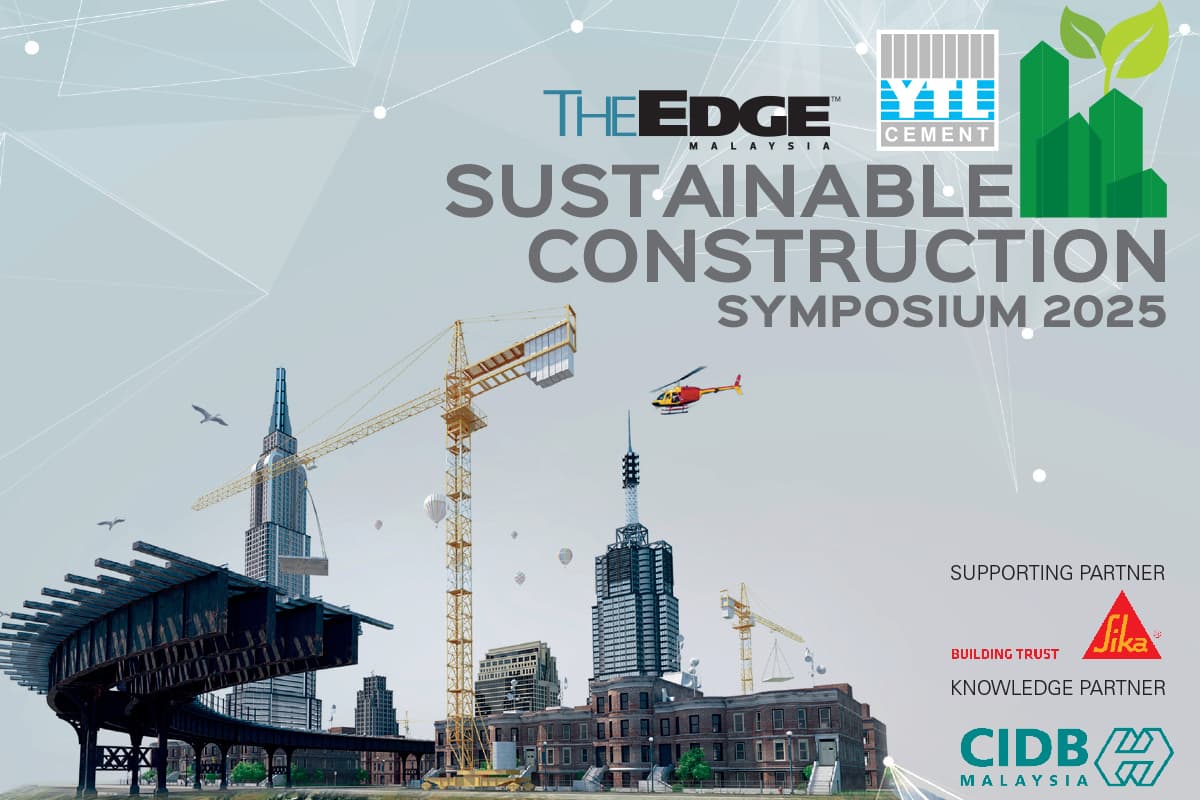
The Edge Malaysia and YTL Cement’s Sustainable Construction Symposium 2025, with the theme “Building Trends Redefined: The Next Level”, challenges industry players to move beyond conventional sustainable construction practices and explores how sustainable construction can be reimagined by integrating advanced technologies.
To be held on Aug 13 at JW Marriott Hotel Kuala Lumpur in Bukit Bintang, the by-invitation-only symposium will feature four presentations, a panel discussion and a fireside chat session.

The morning session will see two presentations, by Skidmore, Owings & Merrill LLP (SOM) senior associate principal Ian Ralph titled “Beyond Business: How Cities Can Thrive in an Age of Accelerating Urban Intelligence” and Construction Industry Development Board (CIDB) Malaysia CEO Zainora Zainal titled “Realising Sustainable Construction in Malaysia”, as well as a panel discussion titled, “Smart-Driven Green Construction — Headwinds & Opportunities”.
The panel will comprise YTL Cement Group general manager Lim Tze Liang, Master Builders Association Malaysia (MBAM) president Oliver Wee and Real Estate and Housing Developers’ Association (Rehda) Malaysia president Datuk Ho Hon Sang and be moderated by The Edge Malaysia editor emeritus Au Foong Yee.
In his presentation, SOM’s Ralph will explore the development of social districts and showcase innovative projects that highlight the economic and social benefits of intelligent urban design and how artificial intelligence (AI) can be leveraged to create a future where urban cores thrive as vibrant communities.

“The intersection of data collection, sharing and rapid scenario testing has the potential to revolutionise decision-making in urban planning, leading to more desirable, liveable and sustainable environments. By leveraging these tools, we can assess various parameters that influence city and building functions, optimising factors such as programme diversity, street design and public spaces to effectively respond to challenges like climate change, accessibility and equity,” he says.
However, not all vital aspects of urban living can be quantified, says Ralph. “Elements such as culture, community and adaptability are more challenging to measure, yet crucial for fostering vibrant urban spaces. As we advance our planning strategies, it is essential to balance data-driven insights with these qualitative factors to ensure that our cities remain not just efficient, but also rich in the ingredients that enable places to thrive and reinvent themselves.”
In the following presentation, Zainora will speak on the SustainBuild (SB) Mark certification, a voluntary sustainability and environmental, social and governance (ESG) performance assessment developed by the Construction Research Institute of Malaysia (CREAM).
“SB Mark focuses on evaluating both construction products and an organisation’s ESG management system, offering a credible way for industry players to benchmark and improve their sustainability standing. While SB Mark is not a regulatory requirement, it complements CIDB’s broader push towards sustainable construction by helping companies align with rising market expectations, green procurement practices and future ESG reporting obligations,” she says.
“The presentation will also touch on how tools like SB Mark fit into Malaysia’s wider construction transformation agenda, offering practical steps for developers, manufacturers and contractors to take action, even if they are just starting out.”

Smart and green construction the way to go
The panellists will also briefly speak on their respective topics before the main discussion.
YTL Cement’s Lim, in his presentation titled “Building Together: Smarter and More Sustainable”, will explain how the company has begun adopting smart systems to enhance efficiency and is increasingly leveraging IT and AI to serve customers better.
“The future of construction will be shaped by how we integrate digital innovation with sustainability. Equally important is our progress in ESG, from continued R&D in lower-carbon products to exploring circular solutions and adopting new production technologies that reduce emissions and lower environmental impact,” he says.
“Recognising that strong collaborations across the value chain are needed for real progress, we are working together with customers, policymakers and partners to build smarter, more sustainable outcomes for everyone.”

Lim is of the view that in the move towards smart and green construction, the industry will require deeper integration of innovation, stronger policy alignment and greater supply chain readiness.
MBAM’s Wee, in his presentation titled “Slow Uptake of Green Solutions”, will discuss the advantages and disadvantages of adopting sustainable practices for construction.
“The adoption [of sustainable practices] is generally still low and slow where the construction landscape is concerned simply because it has always been a cost element to the contractor. In order to allow smart green construction to progress, we need commitment from all stakeholders,” he says.
“There are notable examples of buildings incorporating green features, particularly in areas such as energy and water savings, but the pace of adoption in digital construction such as Building Information Management (BIM) and Industrialised Building System (IBS) is still far from widespread.”
Although there are concerns about cost, Wee reassures that smart green construction solutions such as BIM and IBS offer ready and practical tools to address construction challenges.

“These technologies help minimise material wastage and optimise labour usage, while enhancing construction quality, productivity and safety. Although there are concerns about the supply chain capacity for IBS components, market forces will eventually balance supply with demand through equilibrium as adoption increases,” he stresses.
Rehda’s Ho, in his presentation titled “Smart Green Construction: Innovative Technologies, Challenges and Applications”, will highlight the need for the adoption of holistic green and sustainable construction strategies “to answer the government’s call and for the betterment of the environment, the industry, the nation and, ultimately, the rakyat”.
There is no denying that construction is one of the biggest contributors to greenhouse gas emissions worldwide, including Malaysia, he says. “Although the industry has a long way to go to realise the net zero emissions target, and we may meet challenges on our road to achieve it, adopting green construction measures is a viable way to address these environmental issues. At the same time, these measures need to be future forward, given how technology is part and parcel of all business operations.”
“It is imperative that we move along with the times to ensure we are not left behind with obsolete technology or methods. We emphasise the necessity and opportunities that can be found through its adoption and, just as importantly, we acknowledge the challenges developers face in adapting these technologies in their operations that may hinder growth,” he adds.
More information on the evening session of the symposium will be published in the Aug 11 issue of City & Country.
Save by subscribing to us for your print and/or digital copy.
P/S: The Edge is also available on Apple's App Store and Android's Google Play.