

This article first appeared in The Edge Malaysia Weekly on July 28, 2025 - August 3, 2025
IN 2003, Scientex Bhd (KL:SCIENTX), a leading player in flexible plastic packaging and a property developer, embarked on a path to bring in RM10 billion in annual revenue and deliver 50,000 affordable homes by 2028. This would require the group to double its revenue and net profit as well as its production capacity every five years.
Scientex has reached the halfway mark in its journey to what the group calls Vision 2028. It reported a record performance in the financial year ended July 31, 2024 (FY2024) — which its managing director and CEO Lim Peng Jin, 57, describes as a “super performance year” — with its net profit reaching RM545.2 million and revenue climbing to RM4.48 billion.
Scientex currently has a total packaging manufacturing capacity of about 450,000 tonnes per year, making it one of the leading integrated flexible plastic packaging producers in Asia-Pacific. The group had built 40,598 affordable homes as at end-June 2025.
With just three years to go, will Scientex reach those goals? Lim says the RM10 billion revenue target remains a long-term aspiration, even if it takes a longer time to achieve. Nevertheless, it remains committed to its goal of doubling its FY2023 net profit of RM438.14 million within five years, by FY2028.
Buoyed by robust demand for affordable housing and continued government support for homeownership, the group has been accumulating land beyond its traditional stronghold of Johor to include Melaka, Selangor, Negeri Sembilan, Perak, Penang and Kedah. It has spent more than RM1.8 billion to acquire six parcels totalling 3,735 acres in the past 12 months.

Lim says the group has no plans to slow down the pace as it aims to deliver 10,000 affordable homes annually within two years, up from an estimated 6,000 to 7,000 homes in 2025.
Scientex’s total land bank as at April 30, 2025, stood at 11,034 acres, with a potential gross development value (GDV) of more than RM50 billion.
While its property ventures have come under the spotlight in recent years, Scientex is also banking on its packaging business to drive the group’s growth, even though the segment is experiencing some softness amid heightened competition. The group remains on the hunt for mergers and acquisitions (M&A) to expand its capabilities in the packaging industry.
“Over the past two years, we’ve announced many land purchases, especially those exceeding RM150 million. This might give the impression that Scientex is shifting towards property development,” Lim tells The Edge in an interview.
“However, both packaging and property development remain our core businesses. We don’t prioritise one business over the other — they are equally important to us. They simply operate on different cycles, and our focus adjusts accordingly.”
In fact, Scientex has quietly continued expanding its packaging segment through smaller, less publicised M&A.
In the past 12 years, the group has aggressively pursued acquisitions under Lim, who has been at the helm since November 2001. It has invested more than RM1.2 billion in strategic packaging-related companies such as Great Wall Plastics Industries Bhd, Seacera Polyfilms Sdn Bhd, Mondi Ipoh Sdn Bhd (now known as Scientex Great Wall (Ipoh) Sdn Bhd), Klang Hock Plastic Industries Sdn Bhd, Mega Printing & Packaging Sdn Bhd and Daibochi Bhd — now renamed as Scientex Packaging (Ayer Keroh) Bhd (KL:SCIPACK).
Its M&A activity slowed during the Covid-19 pandemic but resumed in September 2022 with the RM63.8 million acquisition of an 80.2% stake in Taisei Lamick Malaysia Sdn Bhd, a specialist in liquid and paste packaging for sauces, seasoning powders, condom wrappers and beverage sachets. Japan-based Taisei Lamick Co Ltd retains the remaining 19.8% stake. The company has since been renamed Scientex Packaging (Kajang) Sdn Bhd, broadening the group’s reach in the flexible packaging market.
More recently, Scientex acquired a 70% stake in Hiro Food Packages Manufacturing Sdn Bhd, a producer of rigid plastic food packaging such as sushi trays, lunch boxes and cake boxes, for RM37.8 million. The remaining 30% equity interest is held by its Japanese partner.
“We are actively exploring new opportunities. With fewer packaging players left in Malaysia, we are expanding our focus to Southeast Asia, East Asia and the US,” says Lim.
Scientex targets two main types of acquisitions: companies offering access to new markets for existing products and those with proprietary technologies that complement the group’s existing portfolio, like Taisei Lamick.
“We prefer to acquire a controlling stake so we can drive growth. Whether we retain the partner depends on each case,” he says.
To enhance its capabilities, Scientex has invested RM350 million over the past three years in 56 new machines to boost its flexible packaging output.
“A base film sells for RM6 to RM7. But once we print, laminate and convert it into bags, it can fetch between RM10 and RM30. That’s why we invested in new printing machines, pouch makers, laminators, automation systems, form-fill-seal (FFS) extrusion technology and cast lines,” Lim explains.
The group has also ramped up automation across its operations to counter rising labour costs. “For example, with automated bag-making machines, we can reduce manpower from between 70 and 80 workers to just six, while nearly doubling output,” he says.
The group’s recently launched fully robotic plant in Shah Alam, Selangor — which involved an investment of RM80 million — is a showcase of this automation push. “From raw materials in silos to finished goods on pallets, there’s no human touch. The plant operates with only 40 employees, whereas manual operations would require 100,” he adds.
Softness in packaging segment nearing bottom
But while the growth prospects of the packaging and property markets are bright over the long term, they do not necessarily move in tandem.
Scientex saw its net profit fall 8% in the nine months ended April 30, 2025 (9MFY2025) to RM376.42 million from RM409.35 million in 9MFY2024. Revenue held steady at RM3.33 billion. The decline was primarily attributed to lower contribution from the packaging segment, given the intensifying competition stemming from capacity expansion in the market during the pandemic.
The packaging segment accounted for 56% of the group’s overall revenue in 9MFY2025, while the property segment made up the remaining 44%. Lim hopes to achieve an equal contribution from both segments in the future.
He notes that in any industry, there are always ups and downs.
“During the pandemic years — FY2021 and FY2022 — the group benefited from exceptionally strong margins in packaging. However, FY2023 was a year of cost pressures, particularly from surging electricity prices. The electricity tariff rose by 50%, which significantly impacted us. Our monthly electricity bill increased from RM8 million to RM12 million, translating into an additional RM50 million annually,” he recalls. Electricity now accounts for roughly 25% of Scientex’s operating costs.
Over the past year, intensified global competition in packaging has further compressed margins. “Overall, we’re seeing a decline in packaging margins, but the property segment has performed strongly so far in FY2025, which helped offset the softness in the packaging segment,” says Lim.
Nevertheless, the group is expecting the full-year FY2025 pre-tax profit to be flat or slightly lower than FY2024, with its net profit potentially dipping slightly due to higher effective tax rates in the property division.
As at June 30, 2025, Scientex had launched property projects valued at more than RM2 billion, surpassing the RM1.9 billion worth of launches in FY2024. The group plans to launch RM3 billion worth of properties in FY2026.
According to Bloomberg data, analysts expect Scientex to end FY2025 with a lower net profit of RM525.5 million and revenue of RM4.6 billion compared with FY2024, before rebounding to RM566.2 million and RM4.9 billion respectively in FY2026.
Lim says the packaging market will remain challenging in the near term, although he believes the industry has reached the bottom of the current down cycle, which has been longer than usual.
“Between 2020 and 2022, it was a golden period for the packaging and chemical industries, with many new players and capacity entering the market. What we’re seeing now is a consolidation phase from 2024 to 2026,” he adds.
“We’ll likely see weaker players exit while stronger ones adapt and survive. To remain competitive, we must keep improving.”
As supply-demand imbalances and competition escalate, Scientex has undertaken the process of consolidating its packaging portfolio.
“Some product lines are promising and have strong growth potential. Others face margin pressures, so we’ve exited certain subsegments. This is a period of consolidation where we’re sharpening our focus,” says Lim.
“At the same time, we are investing in new machines, talent and digital transformation. Our goal is to become fundamentally more competitive.”

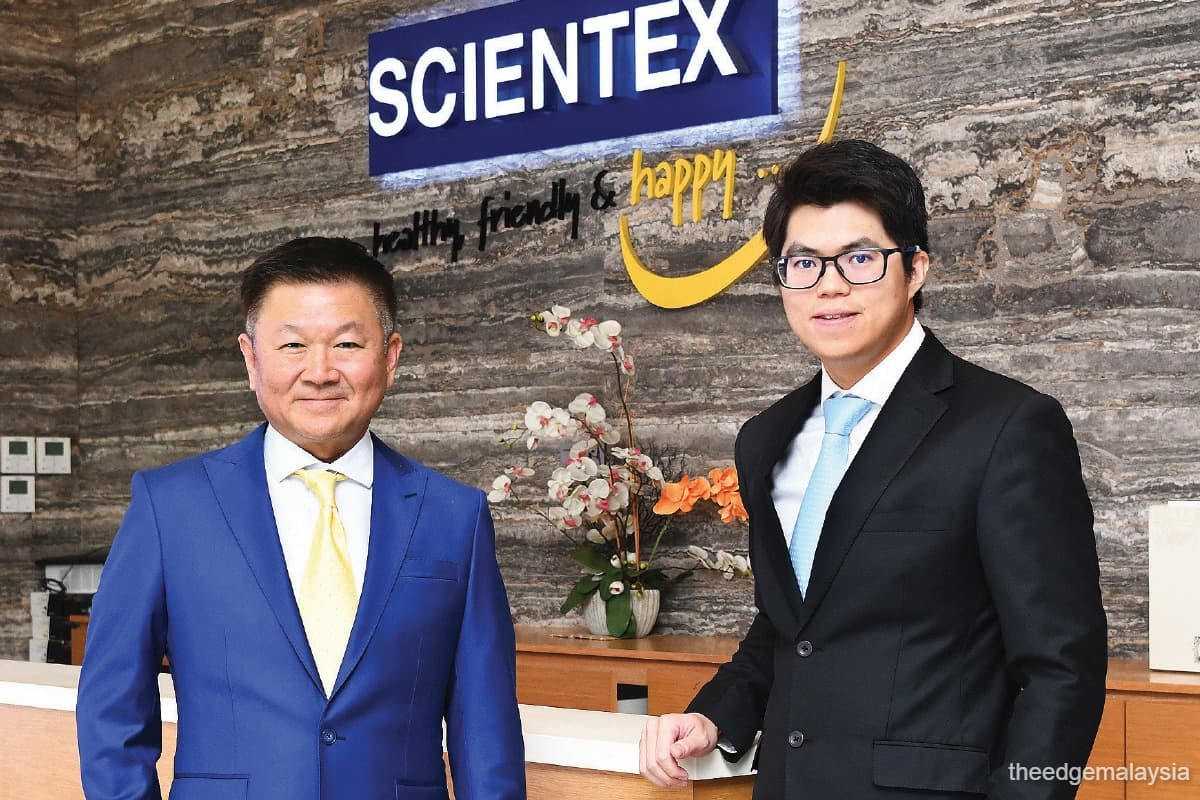
Driving this digital transformation is executive director of packaging Scott Lim Jian You. The 32-year-old is the son of Scientex’s non-executive chairman Lim Peng Cheong, 62, and nephew of Lim. As a third-generation scion of the Lim family, Jian You represents the family’s continued influence in Scientex, via its 57.86% stake. “While most of the employees are professionals, it’s also important to groom the next generation and integrate them with experienced professionals within the group,” Lim says, adding that the group launched a two-year graduate programme this year for new hires.
US plant gamble pays off as tariffs bite
Given that Scientex currently exports 70% of its packaging products, any trade slowdown triggered by US tariffs could weigh on its customer orders, say analysts.
According to Lim, the group’s strategic decision to establish a manufacturing presence in the US nine years ago has proved to be timely, particularly in the face of rising trade barriers. Its US$25 million investment in a stretch film manufacturing plant in Arizona has helped mitigate the impact of US trade tariffs, while strengthening its position in a key export market.
“Last year, our sales to the US amounted to about RM100 million, of which RM95 million was stretch film produced at our Arizona plant,” says Lim.
He explains that the decision to build the facility was partly driven by customer demand. “We had customers in the US urging us to set up a local plant to better serve them. It also allowed us to procure raw materials and produce competitively. We’ve been exporting to the US since the early 2000s, so we understand the market well.”
Although the initial years were challenging, performance has picked up notably in recent quarters. “We struggled a little in the beginning, but it improved post-Covid-19. Over the past six months, the factory’s volume has grown by around 50% and it’s now generating modest profits,” says Lim.
The Arizona facility was a greenfield investment — built from the ground up — as no suitable acquisition targets were available at the time. The plant continues to operate at an annual capacity of 30,000 tonnes, although it was designed to be expandable to 60,000 tonnes.
“If everything goes well, we’re open to further expansion, whether through new greenfield projects or acquisitions. Ideally, we’d like to add one or two more plants to cover the US East Coast,” he says.
Outside the US, Scientex is eyeing growth opportunities in South Asia and East Asia, including Japan, particularly in the converted plastic packaging segment. Lim notes that such plans are still at the exploratory stage.
Scientex currently operates 18 manufacturing plants across Malaysia, Vietnam and the US. Last month, the group announced its exit from Myanmar, citing ongoing economic and political instability that had led to persistent operational challenges.
“For many of the investments we’re making today, the results won’t be immediate. But when the market turns or new opportunities arise, we will be ready,” says Lim.
“Like in the US, once customers understand and appreciate the value we bring, we will see a jump in business. Our factory is already there, fully set up and ready to scale.”
No second bid for Scientex Packaging (Ayer Keroh)
The group has no plans to revive its bid to take Scientex Packaging (Ayer Keroh) private, says Lim.
“At the moment, the plan is to maintain the status quo. We respect the perspective of minority shareholders to remain part of the listed entity. If an opportunity arises, we’ll explore it. But for now, there’s nothing under discussion,” he adds.
Scientex had attempted to take private Scientex Packaging (Ayer Keroh), then known as Daibochi, via a mandatory general offer in November 2021, but the move was unsuccessful. The offer only garnered 71.9% equity interest, falling short of the 90% threshold required to delist the company.
Scientex remains the largest shareholder of Scientex Packaging (Ayer Keroh) with a 71.89% stake. Other notable shareholders include TNTC for Apollo Asia Fund Ltd (10.3%) and Samarang UCITS — Samarang Asian Prosperity Fund (5.43%).
Lim says Scientex has no intention to spin off its two core businesses into separate listed entities, pointing out that having two businesses in one listed company has worked for the group over the last 23 years.
“These two businesses operate on different cycles. When the packaging business is strong, it generates surplus cash flow, which we use to acquire land if the property market is slow. Conversely, when the property market is booming and land prices are high, we redirect our funds to acquire packaging companies to expand capacity instead of overpaying for land,” he explains.
As at end-April 2025, Scientex had RM184.67 million in cash and cash equivalents as well as RM2.07 billion in total borrowings, about half of which are short term. This results in a net debt of RM1.88 billion and a net gearing ratio of 0.46 times.
Despite the relatively high gearing, Lim is unconcerned, pointing out that the group’s unbilled sales and assets have grown to about RM2 billion. “Our gearing remains manageable. We intend to keep it below 0.5 times.”
He adds that the group has no plans to raise funds from the capital market.
“We’re confident of our ability to generate strong cash flow to fund future growth. That’s why we maintain a dividend payout of 30% of annual net profit, with the remaining 70% reinvested in the business.”
Of the eight analysts covering Scientex, four have a “buy” rating and four a “hold”, with an average target price of RM3.95. This indicates an upside potential of 25%, given last Thursday’s closing price of RM3.17.
The share price surged to a one-year high of RM4.514 on Nov 6, 2024, but has since fallen by 30%. At the close of trading last Thursday, the company was valued at RM4.93 billion, with a price-earnings ratio of 9.35 times based on forecast FY2025 earnings.
Save by subscribing to us for your print and/or digital copy.
P/S: The Edge is also available on Apple's App Store and Android's Google Play.